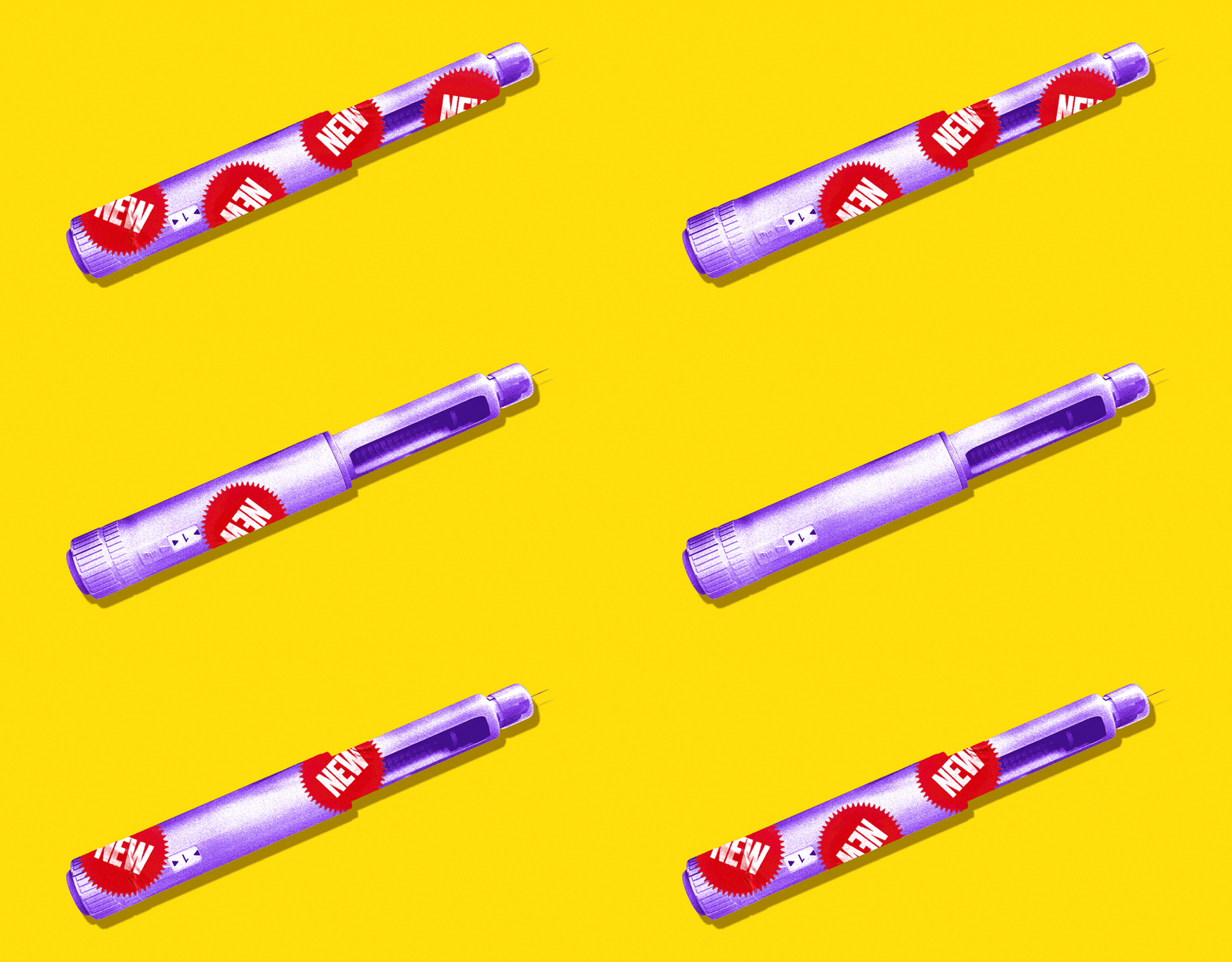
“Ozempic is about to be old news,” my colleague Yasmin Tayag wrote in 2023, just before an even more powerful obesity drug, tirzepatide, then best known as Mounjaro, was approved. Well, two years later, Mounjaro is becoming old news, too. A whole slew of next-generation obesity drugs are on the horizon, some already advanced enough in clinical trials to be looking as good as—if not better than—those already on the market. The novel medications continue to push the upward limits of weight loss, now to almost 25 percent of body weight on average, but they also differ in their modes of action. They target different cells and different parts of cells in the brain and body.
Obesity, after all, is not monolithic. “We don’t have a disease of obesity. We have a disease of obesities,” Angela Fitch, chief medical officer at Knownwell, a national obesity-care clinic, and a former president of the Obesity Medicine Association, told me. With the coming explosion of obesity drugs, doctors could soon match each patient’s condition to their optimal medication: A 25-year-old with fatty-liver disease may need a different drug than a 75-year-old with low muscle mass. About 100 million adults live with obesity in just the U.S., a market massive enough for multiple mediations to find a niche. “One size will not fit all, and one size will not be best for all,” Richard DiMarchi, a chemist at Indiana University who has worked on obesity drugs at both Eli Lilly and Novo Nordisk, told me.
The most obvious way obesity drugs are not one-size-fits-all is that those on the market do not actually work for all. Although patients on semaglutide, the drug in Ozempic and Wegovy, lost on average 10 percent of their body weight, a third lost less than 5 percent in one clinical trial. Some even gain weight taking the drug. And others suffer such terrible side effects, including constant nausea and vomiting, that they cannot take it at all.
Ozempic functions by mimicking a single hormone called GLP-1; the drug’s mode of action is relatively simple but limited. To improve upon Ozempic, drugmakers have started targeting GLP-1 in combination with other hormones linked to hunger and satiety. The second drug currently on the market, the tirzepatide found in Mounjaro and Zepbound, resembles GLP-1 in addition to another hormone called GIP, hitting receptors for both in the brain. The GIP component may serve a double function, promoting additional satiety while suppressing some of the nausea caused by GLP-1. However tirzepatide truly works—and experts caution that no one knows—it prompts, on average, about 20 percent weight loss. It’s only the first of the “GLP-1 plus” drugs to market.
Other GLP-1-plus drugs in development include GLP-1 plus amylin, GLP-1 plus glucagon, and GLP-1 plus anti-GIP, which surprisingly could work as well as Mounjaro’s combination of GLP-1 plus GIP. (“If you aren’t confused,” Randy Seeley, an obesity researcher at the University of Michigan, told me, “you aren’t paying attention.”) In fact, all of these combinations seem to work—at least based on preliminary data from clinical trials—even as a precise understanding of the science lags. Some of the hormone mimics, such as for amylin, might also work alone. And others could be remixed into combinations of more than two. The drug retatrutide, which is in trials, is a triple hitter that targets GLP-1 plus glucagon plus GIP receptors, all at once. In an early Phase 2 trial, patients lost on average 24 percent of their weight, the highest of any obesity drug so far. The best responders lost upwards of 40 percent.
Even more intriguing than the top-line weight-loss numbers are metabolic changes unique to particular drugs. Glucagon, for example, ramps up liver metabolism; drugs based on this hormone could help break down fat accumulated in the livers of patients who also have fatty-liver disease. (The FDA is expediting review of one such drug, survodutide, for liver-disease patients.) Meanwhile, GLP-1-based drugs appear to protect against cardiovascular disease, even independent of weight loss. Patients prone to heart disease might fare best on medication that includes a GLP-1 component. When it comes to obesity, Seeley said, “your flavor of metabolic disease will be different than the next person’s.” Obesity drugs of the future may finally reflect that diversity, too.
An extensive menu of obesity drugs that work via distinct biological mechanisms means that patients will have more options to try. If they aren’t losing weight on drug A, they can move on to drug B or C. Experts don’t yet understand why the drugs work differently in different people, but hormone receptors in our brains likely vary in subtle yet important ways. The new drugs not only hit distinct combinations of hormone receptors; they also each tickle those receptors in a unique way.
In the near future, doctors and patients will probably have to trial-and-error their way to what works best. Further down the line, experts tell me, they hope to have a test, such as a blood test, that can forecast how patients will fare. Doctors could tell patients that they’ve got five different drugs at the ready, “and if I do this one test on you, I do this one test on you, I can predict which one of these drugs is the best for you,” Jonathan Campbell, an obesity researcher at Duke University, told me.
Maximum weight loss might not always be the goal for everyone though. The 40 percent that some people lose on retatrutide would be far too much for a patient barely over the BMI cutoff for obesity. Patients who don’t need to optimize weight loss may choose to prioritize convenience instead, which drugmakers are also happy to oblige. Most obesity drugs on the market are formulated as weekly injections. But Eli Lilly is developing a daily pill called orforglipron, and Amgen is testing a monthly injection called MariTide. And some patients, especially those who are elderly with already low muscle mass, might need extra help preserving their strength. The powerful appetite suppression that induces fat loss can induce muscle loss too. A number of drugmakers are now trialing obesity drugs in combination with various muscle–preserving drugs.
A mere decade ago, obesity drugs powerful enough for people to routinely drop double-digit percentages of their body weight were unheard-of. Today, there are two, and they feel ubiquitous. In yet another 10 years, this toolbox of just two obesity drugs will likely appear tiny and outdated. The next phase of the obesity-drug revolution is coming, with more drugs to choose from.