For decades, the threat of nuclear conflict between the U.S. and the Soviet Union hung over humanity — and occasionally the superpowers edged toward the brink, as with the Cuban missile crisis.
But beginning in the 1970s, American and Soviet leaders started taking steps toward de-escalation, leading to a handful of critical treaties, including the 1987 Intermediate-range Nuclear Forces Treaty that eliminated an entire class of nuclear-capable missiles.
The pact was terminated in 2019 after the U.S. withdrew. On Tuesday, Russia announced it was ending self-imposed restrictions on the deployment of the missiles covered in the agreement.
READ MORE: Russia will no longer abide by self-imposed moratorium on intermediate-range missiles
That leaves just one nuclear arms pact between Moscow and Washington still standing: New START, which experts say is on the ropes and set to expire in February in any case.
While the end of nuclear weapons agreements between the U.S. and Russia does not necessarily make nuclear war more likely, “it certainly doesn’t make it less likely,” said Alexander Bollfrass, an expert on nuclear arms control at the International Institute for Strategic Studies.
Moscow and Washington are still signatories to multilateral international treaties that aim to prevent the spread and use of nuclear weapons, but the increasingly erratic relationship between the countries, combined with the dwindling treaties, has many worried.
Survivors of the atomic bomb dropped 80 years ago Wednesday by the U.S. on the Japanese city of Hiroshima expressed frustration about the growing support of global leaders for nuclear weapons as a deterrence.
US and Russia have far fewer warheads than decades ago
In 1986, the Soviet Union had more than 40,000 nuclear warheads, while the U.S. had more than 20,000, according to the Federation of American Scientists.
A series of arms control agreements sharply reduced those stockpiles.
The federation estimated in March 2025 that Russia has 5,459 deployed and non-deployed nuclear warheads, while the U.S. has 5,177. Together, that’s about 87% of the world’s nuclear weapons.
Washington and Moscow have signed a series of key treaties
In May 1972 — a decade after the Cuban missile crisis — the U.S. and Soviet Union signed the Strategic Arms Limitation Talks I, or SALT I, which was the first treaty that placed limits on the number of missiles, bombers and submarines carrying nuclear weapons.
At the same time, they also signed the Anti-Ballistic Missile Treaty, or ABM, putting restrictions on missile defense systems that protect against a nuclear strike.
Then, in 1987, Soviet leader Mikhail Gorbachev and U.S. President Ronald Reagan inked the INF treaty, banning missiles with a range of 500 to 5,500 kilometers (310 to 3,410 miles).
U.S. President Donald Trump withdrew from the pact during his first term, citing Russian violations that Moscow denied. The White House also said it placed the U.S. at a strategic disadvantage to China and Iran, neither of which was party to the agreement and each of which it said had more than 1,000 INF-range missiles.
The Kremlin initially said it would abide by its provisions, but on Tuesday, it ended that pledge.
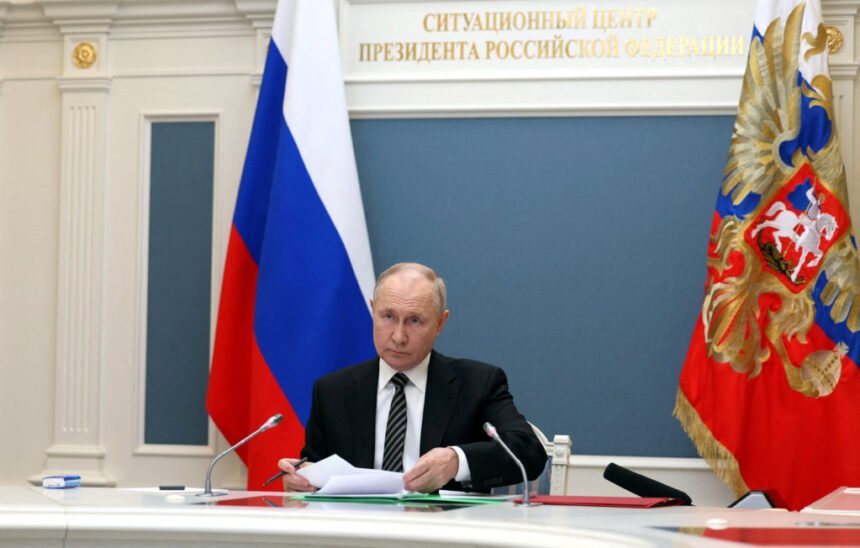
Even before that, Moscow test-fired its new intermediate-range Oreshnik hypersonic missile at Ukraine in November. Russian President Vladimir Putin has said those missiles will be deployed to Russia’s neighbor and ally Belarus later this year.
Meanwhile, the START I nuclear arms reduction treaty signed in 1991 reduced the strategic arsenals of U.S. and Russian nuclear warheads, as well as missiles, bombers and submarines carrying them. It has since expired. Another treaty, START II, was signed but never entered into force.
In 2002, then-U.S. President George W. Bush withdrew from the ABM agreement after the Sept. 11, 2001, attacks because of concerns that the agreement limited U.S. capabilities to counter attacks, including from countries such as Iran or North Korea.
Russia strongly opposed the move, fearing that it would allow the U.S. to develop a capability that would erode its nuclear deterrent.
The last remaining bilateral treaty — New START, signed in April 2010 — aimed to set limits on deployed nuclear weapons and launchers and enforce on-site inspections.
It, too, is “functionally dead,” said Sidharth Kaushal, a senior fellow in military sciences at the Royal United Services Institute in London.
It expires on Feb. 5, 2026, and Russia already suspended its participation after its invasion of Ukraine, resulting in a halt of on-the-ground inspections of Russian nuclear sites. Moscow said, however, it would continue to abide by the pact’s limits on its nuclear forces.
Russia and the US aren’t the only players
The INF and New START treaties, in particular, led to “serious on-the-ground inspections” that lowered tensions in Europe, Bollfrass said.
Their end could rachet up tensions between the two Cold War adversaries, experts said.
But they also reflect a broader interest in conventionally armed intermediate-range missiles, the experts said, pointing to the planned U.S. deployment of such missiles to Europe and the Pacific, as well as Israel’s and Iran’s use of missiles during their recent war.
New bilateral agreements on nuclear weapons between the U.S. and Russia in the immediate future are “highly unlikely” because the level of trust necessary to negotiate and follow through with an arms control agreement does not exist, Kaushal at RUSI said.
And the U.S. is increasingly looking at other threats. Both the Bush and Trump administrations withdrew from treaties with Russia partly by citing concerns that the agreements didn’t place limits on other countries’ build-up of nuclear weapons.
As China increasingly becomes a nuclear peer of the U.S. and Russia, it could drive a “competitive spiral” in which Washington could develop more nuclear, as well as conventional, weapons to counter what it perceives as a threat from Beijing, Kaushal said.
Any increase in U.S. intermediate- or long-range weapons could, in turn, drive Russia to increase its own nuclear arsenal, he said.
But even as Cold War treaties end, Cold War thinking may endure.
The possibility of mutually assured destruction may still demand restraint, the experts said.
___ The Associated Press receives support for nuclear security coverage from the Carnegie Corporation of New York and Outrider Foundation. The AP is solely responsible for all content.