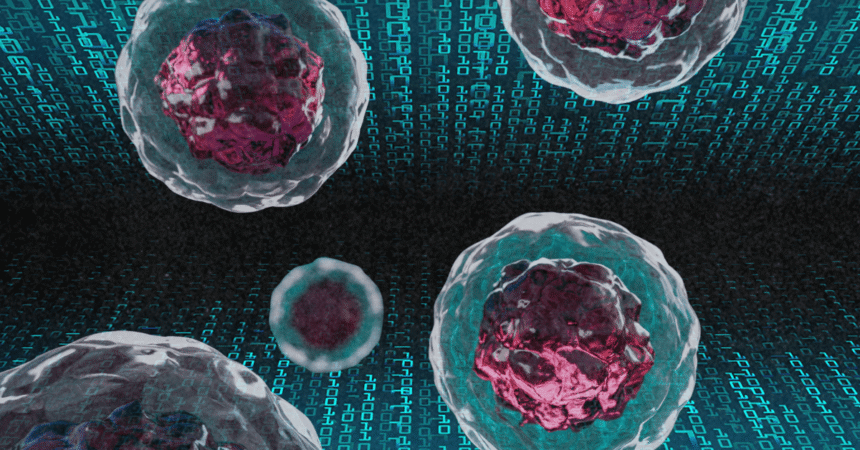
A human cell is a Rube Goldberg machine like no other, full of biological chain reactions that make the difference between life and death. Understanding these delicate relationships and how they go wrong in disease is one of the central fascinations of biology. A single mistake in a gene can bend the protein it makes into the wrong shape. A misshapen protein can’t do its job. And for want of that protein, the organism–you–may start to fall apart.
Cells are so complex, however, that getting a sense of how one protein’s failure spreads through the system is tough. Graham Johnson, a computational biologist and scientific illustrator at the Allen Institute for Cell Science, recalls fantasizing at a lunch table, more than 15 years ago, about a computer model of a cell so detailed, so complete, that scientists could watch such processes happening. At that time, “everyone just snickered,” he says. “It was just too unrealistic.”
But now some researchers are using AI to take new steps towards the goal of a “virtual cell.” Google’s DeepMind is working on such a project, and the Chan Zuckerberg Initiative (CZI) has made virtual cells a major focus in their Biohub research network, says Theo Karaletsos, senior director of AI at CZI. There is even a new prize, set up by the Arc Institute, for virtual-cell-style models. The goal of all these endeavors is to predict how both healthy and diseased cells work, in so much detail that it’s possible to speed up the development of drugs and accelerate scientific discoveries. Virtual cells might even streamline basic research, some think, moving biologists from the lab bench to the keyboard.
What is a virtual cell, anyway?
The precise definition of a virtual cell varies depending on whom you talk to. Some scientists, like Johnson, hope that a virtual cell will include a visual representation that you can click through and explore. Others think of it primarily as a set of computer programs that can answer questions and make predictions about what’s likely to happen. But the concept is not a new idea. For decades, biologists have been building mathematical models of cellular processes. To make them, researchers draw on data from experiments with real cells, coming up with equations that describe what’s going on.
There’s now more data about the human cell than ever before, thanks in part to technology that allows scientists to spy on the activities of individual cells. But figuring out equations for every process and putting them all together is a monumental task. “The old way of doing it”—manually, that is—”had, I would say, only very limited success,” says Stephen Quake, a professor at Stanford University and the former head of science at CZI. Last year, he and other researchers published a paper laying out a vision for another approach, one that feeds data about cells directly to specialized AIs. “You build models that are learning directly from data, rather than trying to write down equations,” he says.
Read More: Why Baby Boxes Are Suddenly Everywhere
Quake and his colleagues have had some interesting early results. They used data on cells from 12 different species to train an AI. The AI was then able to make accurate predictions about the cells of species it had never seen before, Quake says. It was also able to infer the relationships between different types of cells in a single species, despite being given no information about those links. “That’s what got me, personally, super-excited about this approach,” Quake says.
Another team of researchers, including some at Google DeepMind, is exploring using AI to create virtual cells as well. They have trained AIs on large datasets of information about cells, allowing users to ask questions like, “How will this cell respond to this drug?” and then receive answers about which portions of the cell are likely to be affected.
These are just some of the approaches scientists are taking toward the creation of virtual cells. It’s likely that there will eventually be many different kinds of virtual cells, designed for different kinds of researchers to use. The virtual cell used by a cancer biologist, for instance, might be different from one used by a cell biologist looking to answer questions about how a given structure evolved. And it is possible they might use both traditional modeling approaches and AI.
What virtual cells might allow us to do
Virtual cells could make it faster and easier to discover new drugs. They could also give insight into how cancer cells evade the immune system, or how an individual patient might respond to a given therapy. They might even help basic scientists come up with hypotheses about how cells work that can steer them toward what experiments to do with real cells. “The overall goal here,” Quake says, “is to try to turn cell biology from a field that’s 90% experimental and 10% computational to the other way around.”
Some scientists question how useful predictions made by AI will be, if the AI can’t provide an explanation for them. “The AI models, normally, are a black box,” says Erick Armingol, a systems biologist and post-doctoral researcher at the Wellcome Sanger Institute in the U.K. In other words, they give you an answer, but they can’t tell you why they gave you that answer.
Read More: 11 Things Therapists Wish Every Kid Knew
“Personally, why I ended up in this field is because I wanted to simulate the whole human body and how the cells connect to each other and interact. So that’s the dream,” he says. Black-box answers might be helpful for steering drug development, but they might not be as useful to basic scientists—at least not the way many AIs are currently set up. (Karaletsos, from CZI, says that some of their AIs are set up to provide explanations of their reasoning. “We want to understand, not just predict,” he says.)
Johnson, who authored a paper in 2023 about the importance of building virtual cells, hopes that whatever scientists end up building will be capable of being visualized. His ideal is “a visual, interactive, intuitive version of something complicated,” he says. “I think AI is absolutely critical to enabling all this. I’m just not interested in black-box predictions as the primary outcome.”
Regardless of how they are built, it may be a while before virtual cells of some kind are up and running. “This is not something that’s going to be done next year,” says Quake. “I think it will take a full decade to realize the potential.”
But since that long-ago lunchtime chat, Johnson says, advances in cell biology and in computer science have fundamentally shifted the prospects of someday having a virtual cell. “I no longer feel like a lunatic just ranting about this,” he says. “It feels plausible now.”