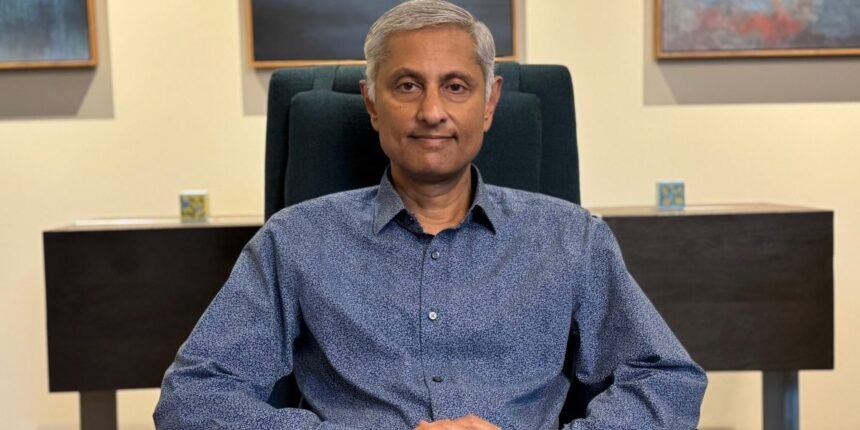
Waymo is experimenting with generative AI and other technologies for its self-driving cars, but the company believes the assortment of laser sensors and radars mounted on its cars remains the safest way to run a robotaxi service at scale—at least for now.
“We’ve done a lot of research. We’re aware of what works and what doesn’t work at our scale and what we need to do,” Srikanth Thirumalai, who is vice president of onboard engineering for the current robotaxi industry incumbent, Waymo, said this week at the Ai4 Conference in Las Vegas.
While rivals like Tesla are pushing self-driving cars that rely solely on video cameras, Waymo’s Thirumalai says the combination of LiDAR and radar provides “an additional safety net” to make sure that the company has the adequate data it needs to make driving decisions “under all conditions”—including extreme weather.
Thirumalai was speaking on stage in an interview with Fortune. Earlier that day, Thirumalai gave a solo presentation, describing Waymo’s AI stack and approach to safety in detail that has allowed the company to scale its operation to five cities by mid-2025 and conduct more than 100 million driverless miles. In his presentation, Thirumalai showed a video of how LiDAR sensors on the Waymo Jaguar I-PACE had picked up movement from human beings readying to jump in the road, even when the vehicle’s cameras had not—or a woman preparing to go around a stopped bus and directly into the path of a Waymo robotaxi. In both instances, Waymo’s robotaxi stopped or maneuvered out of the way to avoid contact with the pedestrians, according to the videos.
The presentation showed the stark contrast in approaches between Waymo and one of its newer rivals, Tesla, which launched a small-scale, invite-only robotaxi service in Austin this June, with safety drivers in the passenger seat. Tesla, which was demonstrating its full self-driving (FSD) technology via demo rides at the Ai4 Conference, is only using video cameras and its AI technology for FSD and Tesla Robotaxi, after years of Elon Musk stating that other sensors are expensive and unnecessary. “LiDAR is a fool’s errand,” Elon Musk said in 2019. “Anyone relying on LiDAR is doomed. Doomed! [They are] expensive sensors that are unnecessary.”
Thirumalai wouldn’t say directly whether he considered camera-only self-driving systems like Tesla’s to be safe for the public roads. He said that you have to consider “the whole process” of how a system is built, tested, then validated, and he also said that you cannot statistically compare Waymo’s system to another, because of the lack of comparable safety metrics. General Motors’ subsidiary Cruise, which also used LiDAR and radar systems, suspended operations earlier this year after it failed to relaunch after a serious accident in San Francisco. For context, Tesla said it had driven 7,000 driverless miles at the end of July, compared to Waymo’s 100 million.
“If we are talking about objective measures, then we have to look at the statistics of our safety record, at scale, right?” Thirumalai said. “When someone actually says: Yes, we matched your safety at your scale with a different system, that’s great. We’ll take that.”
Waymo is regularly testing new technology as it becomes available, according to Thirumalai. As part of that experimentation, he said that Waymo has researched how multimodal models like Gemini can be incorporated into the Waymo tech stack (Waymo has not tested any other generative AI models besides Google’s Gemini, Thirumalai confirmed). The robotaxi company has published several papers of its research into multimodal models, including a city-scale traffic simulation with a generative world model as well as Waymo’s research around EMMA, Waymo’s End-to-end Multimodal Model for Autonomous driving. Waymo has reported that co-training its vehicles with EMMA helped with things like object detection and road graphs, saying there was “potential” for EMMA as a generalist model for autonomous driving applications. However, EMMA is expensive, can only process a small number of image frames, and does not incorporate LiDAR sensors or radar—all of which lead to “challenges” for using EMMA as a “standalone model for driving”
Thirumalai said incorporating generative AI models into the self-driving tech stack is an area of “intense research,” and that he believes this will continue. “But there’s a lot more work that’s going to be needed to make the system as simple as possible,” he said.