Updated at 4:05 p.m. ET on June 24, 2025
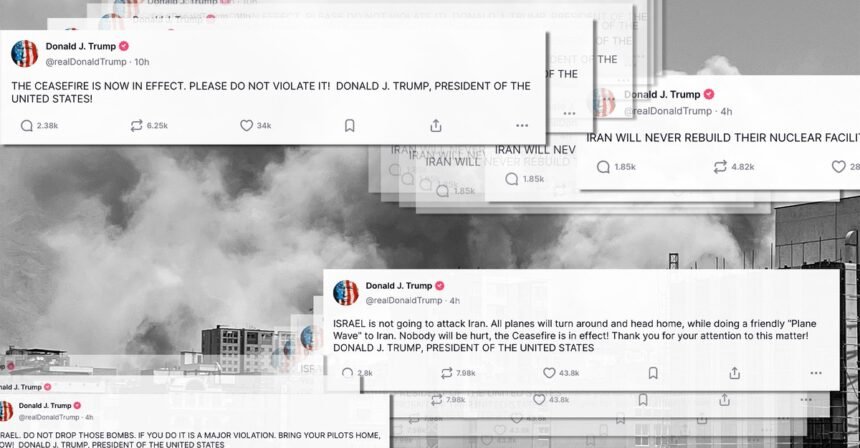
At 1:08 a.m. eastern daylight time, President Donald Trump proclaimed on social media that a cease-fire between Iran and Israel was “NOW IN EFFECT,” potentially ending an intense 12 days of violence and allowing all sides to step back from a wider, more destructive regional war. “PLEASE DO NOT VIOLATE IT!” Trump wrote.
By 6:50 a.m., the government of Israeli Prime Minister Benjamin Netanyahu had dispatched aircraft on a mission to strike back after what Israeli officials said was an Iranian violation of the emerging truce. Trump returned to Truth Social. “ISRAEL. DO NOT DROP THOSE BOMBS,” the president wrote. “BRING YOUR PILOTS HOME, NOW!”
Those early-morning hours of whiplash in the most destructive phase of Iran and Israel’s decades-long conflict underscored the uniquely Trumpian way that the president has managed the hostilities: with a running social-media commentary that has been at times bellicose, at times conciliatory, and always bountiful with his unfiltered views of the war.
In recent days, Trump has posted real-time information about the conflict, announcing the massive raid the United States conducted on a trio of nuclear sites in Iran on Saturday, suggesting that Iranian Supreme Leader Ayatollah Ali Khamenei’s regime should be forced from power, and demanding that “EVERYONE” keep oil prices down. (He has also been posting his usual fare of favorable poll ratings and a graphic reading: “TRUMP WAS RIGHT about everything.”)
The Israeli ambassador to the United States, Yechiel Leiter, speaking to reporters in Washington this morning, said he found logic in the president’s flurry of bombastic and sometimes-contradictory social-media statements. “Alone, they’re a one-instrument band,” Leiter said. “Together, they form a concert.”
Trump’s latest burst of Truth Social diplomacy began yesterday, after Iran launched a counterstrike against the United States, directing missiles at Al Udeid Air Base, in Qatar. Trump boasted on Truth Social about Iran’s “very weak response” and said that no missiles had reached their targets. “Perhaps Iran can now proceed to Peace and Harmony in the Region, and I will enthusiastically encourage Israel to do the same,” he wrote. He concluded, as he had in other posts over the past week, “Thank you for your attention to this matter!”
Later in the day, around 6 p.m., Trump announced that the two countries had reached a cease-fire deal and that it would take effect in several stages overnight. The truce, “on the assumption that everything works as it should,” would end what he called “THE 12 DAY WAR.” Late yesterday and into today, at 10:18 p.m. and again at 1:08 a.m., Trump warned both countries to respect the agreement. Many of the details, however, were unclear, especially the timing and the sequencing. Iran initially denied that any such deal had been reached.
According to U.S. and Israeli officials, Israel launched a round of strikes on Iran around 3 a.m. local time, which Israel said had targeted Iranian forces in Tehran. Shortly before 7 a.m. in the Middle East, when the cease-fire was supposed to take effect, Iran launched missiles in response, Iranian and Israeli officials said. Israel accused Iran of firing subsequent volleys after the deal took effect. Israel’s air force scrambled to respond, launching jets toward Iran. (Iran denied violating the cease-fire.)
The exchange angered Trump. Before his departure for a NATO summit this morning, he told reporters outside the White House that Iran and Israel “have been fighting so long and so hard that they don’t know what the fuck they’re doing.” Once aboard Air Force One, Trump called Netanyahu, demanding that Israel call off any further strikes. The Israeli leader agreed to limit his country’s response, a Trump-administration official told us, speaking on condition of anonymity to describe sensitive matters. According to Netanyahu’s office, most of the attacks were called off, and Israel struck only one radar site.
By early evening in the Middle East, the cease-fire was holding, an Israeli security official told us. The official said it was the Iranians who had first violated the cease-fire, prompting the Israeli-air-force raid that Trump had asked Netanyahu to halt. Both countries have denied violating the cease-fire, and Iran accused Israel, as well, of breaching the deal.
Experts predicted a litany of challenges to any lasting cease-fire, among them the president’s impulsiveness. “It’ll be shaky and Trump’s endless use of troll power will risk undercutting the weak foundation at every moment,” Brian Katulis, a senior fellow at the Middle East Institute, told us. “But the center of gravity across the region remains more interested in de-escalation, particularly among Gulf states like Oman, Saudi Arabia, the United Arab Emirates, and Qatar.” The Gulf states, Katulis said, “have quietly served as quiet shock absorbers during this war and will continue to play that role.”
Aboard Air Force One, the details of the murky early-morning episode seemed to fade as Trump fired off a series of social-media posts on other matters, including European defense spending, his administration’s deportation actions, and his use of the National Guard against protesters in California. But he also continued to highlight what he portrayed as a major victory, one that lines him up (as suggested in posts he amplified) for a Nobel Peace Prize. The war was over—for now—but the president’s social-media commentary lived on.
“Nobody will be hurt, the ceasefire is in effect,” he wrote on Truth Social. “Thank you for your attention to this matter!”
This article has been updated to correct the timeline of Israel’s and Iran’s strikes.