So what was that all for?
President Donald Trump emerged today from his summit with Russia’s Vladimir Putin without a deal and without much to say. Trump rarely misses a chance to take advantage of a global stage. But when he stood next to Putin at the conclusion of their three-hour meeting, Trump offered few details about what the men had discussed. Stunningly, for a president who loves a press conference, he took no questions from the reporters assembled at a military base in Alaska.
In his brief remarks, Trump conceded that he and Putin had not reached a deal to end the war in Ukraine or even pause the fighting. “There’s no deal until there’s a deal,” the president said. He characterized their three-hour meeting—vaguely—as “very productive.” Of the outstanding issues between the two sides, he admitted that “one is probably significant,” but he didn’t say what that was. “We didn’t get there but we have a very good chance of getting there,” Trump insisted. The Russian president, for his part, made mention of “agreements” that had been struck behind closed doors. Yet Putin also provided no elaboration, leaving the distinct impression that it was a summit about nothing.
If anything, Putin seemed to make clear that his demands regarding Ukraine haven’t changed. In his usual coded way, he said an agreement could be reached only once the “primary roots” of the conflict were “eliminated”—which means, basically, that Ukraine should be part of Russia. “We expect that Kyiv and European capitals will perceive that constructively and that they won’t throw a wrench in the works,” Putin said, in what sounded like a warning. “They will not make any backroom dealings to conduct provocations to torpedo the nascent progress.”
As Putin and Trump boarded their respective airplanes for their flights home, Ukraine and Europe were left guessing as to what the coming days will bring. Will more missiles fly toward Kyiv? Will a second meeting involving Ukrainian President Volodymyr Zelensky occur? Trump was equally as vague in a Fox News interview taped after the summit, though he did suggest that the next steps in the process would be up to Zelensky. What was clear today was that Trump, who had once promised to bring the war to a close within 24 hours, left the summit empty-handed.
“Summits usually have deliverables. This meeting had none,” Michael McFaul, an ambassador to Russia under President Barack Obama, told me. “I hope that they made some progress towards next steps in the peace process. But there is no evidence of that yet.”
At their last summit, in Helsinki in 2018, Trump and Putin captivated the world when they took questions, revealing details of their private discussions as the American president sided with Moscow, rather than his own U.S. intelligence agencies, over Russia’s 2016 election interference. This time, they quickly ducked offstage as reporters shouted in vain. When the two men did speak, they mostly delivered pleasantries. Putin even repeated Trump’s talking point that Russia’s invasion of Ukraine in 2022 would never have happened had Trump been in office then. And Trump, once more, said that the two men “had to put up with the Russia, Russia, Russia hoax.”
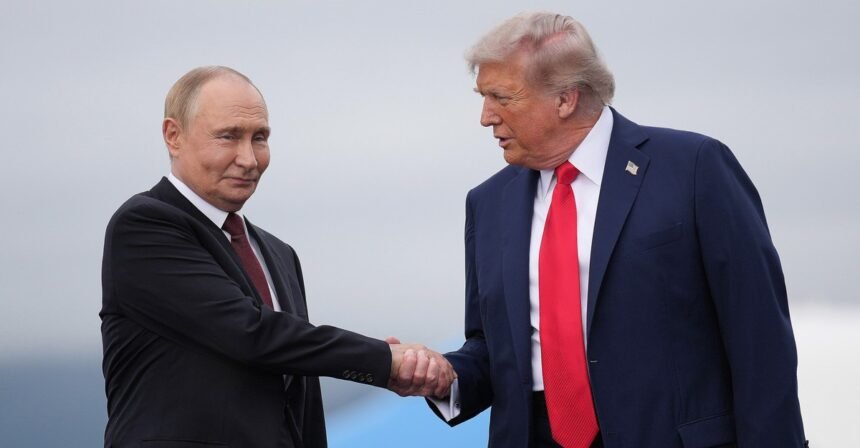
That the summit happened at all was perceived by many as a victory for Putin, who, after years as an international pariah, was granted a photo with a U.S. president on American soil—on land that once belonged to Russia, no less. And he was greeted in an over-the-top, stage-managed welcome that involved a literal red carpet for a man accused of war crimes. Putin disembarked his plane this morning moments after Trump stepped off Air Force One, and the two men strode toward each other past parked F-22 fighter jets before meeting with a warm handshake and smiles. After posing for photographs, and quickly peering up at a military flyover that roared above them, the two men stepped into the presidential limousine, the heavily fortified vehicle known as “the Beast.”
The White House had announced earlier in the day that the two men would not have a previously planned one-on-one meeting, but would instead have a pair of sitdowns flanked by advisers. But here, in the backseat of the Beast, Putin had his time alone with Trump. As the limousine drove off the tarmac to the summit site, Putin could be seen in a rear window laughing.
Putin and Trump were scheduled to have a formal meeting at Joint Base Elmendorf-Richardson, followed by lunch. But after the first meeting ran long, extending to more than three hours, reporters were abruptly rushed to the room where the press conference would be staged. The second meeting had been canceled. Had there been a breakthrough or a blowup? Putin sported the better body language: He almost glowed as he spoke to the press, offering a history lesson about Alaska, while praising the “neighborly” relations between the men. And, oddly, he got to speak first, even though Trump was the summit’s host. Trump, in contrast, seemed subdued, only perking up when Putin ended their media appearance by suggesting that their next summit be in Moscow.
“I think Trump did not lose, but Putin clearly won. Putin got everything he could have wished for, but he’s not home free yet,” John Bolton, who was a national security adviser in Trump’s first term, told me. “Zelensky and the Europeans must be dismayed. And I thought Trump looked very tired at the press event. Putin looked energetic.”
Putin seemed eager to broaden the conversation beyond Ukraine. He brought Russian business leaders to Alaska, hoping to play to Trump’s hopes of better economic relations between the two countries, and perhaps strike a rare-earth-minerals deal. He also suggested earlier this week that he would revisit a nuclear-arms agreement, perhaps allowing Trump to leave the summit with some sort of win that did not involve Ukraine. But nothing was announced on those fronts either.
The fear in Kyiv and across Europe was that Trump is so desperate for the fighting to stop, he might have agreed to Putin’s terms regardless of what Ukraine wants. That did not happen, which was cheered across the continent, and Trump said that he would soon consult with Zelensky and NATO. But Putin has shown no sign of compromising his positions. He wants Russia to keep the territory it conquered, and Ukraine to forgo the security guarantees that could prevent Moscow from attacking again. Those terms are nonstarters for Ukraine.
The Europeans and Ukrainians had good reason to be nervous about today’s summit. Trump has spent most of his decade on the global stage being extraordinarily deferential to Putin, which continued when he returned to the White House this year. He initially sided with Russia—even blaming Ukraine for causing its own invasion—before slowly souring on Putin’s refusal to end the war.
This summit came together in about a week’s time; final details were still being arranged even as some of Putin’s delegation arrived in Alaska yesterday. Trump’s personal envoy, Steve Witkoff, made several visits to Moscow in recent months. He had been in the Middle East when he received word through a back channel that Putin might finally be willing to come to the table given Trump’s more hostile rhetoric toward Putin and threat of sanctions. After a series of meetings with key Trump senior aides and multiple flights across the Atlantic, Witkoff met again with Putin and accepted the offer of a summit. (He also accepted a twisted gift: Putin presented Witkoff an Order of Lenin award to pass along to a senior CIA official whose son had been killed in Ukraine fighting alongside Russia.)
Summits, particularly those as high-stakes as ones between American and Russian presidents, usually take weeks if not months to plan. Everything is carefully choreographed: the agenda, the participants, the ceremony. Normally, the outcome is more or less predetermined. In the days before the actual summit, aides hash out some sort of agreement so the two leaders simply need to show up and shake hands to make the deal official. That was clearly not the case today—or in other Trump-Putin meetings.
Trump had met with Putin seven previous times, all but one coming on the sidelines of larger summits and all friendly. The first was at the G20 in Hamburg, Germany, in 2017, when the two men sat next to each other for an hours-long leaders dinner. Their last meeting, at the G20 in Osaka, Japan, in the fall of 2019, ended with Trump mockingly warning Putin to never interfere again in American elections, with a sarcastic smile and exaggerated finger wag.
But Helsinki is the headliner. It came against the backdrop of Special Counsel Robert Mueller’s investigation into possible ties between the Trump campaign and Moscow. I was one of the two American journalists called upon to ask a question, and I posed to Trump whether he believed Putin or his own U.S. intelligence agencies about Russia’s interference in the 2016 election. Putin glared at me. Trump sided with Moscow. The eruption on both sides of the Atlantic was fierce and immediate, and even some loyal Republicans said they thought Trump’s answer was a betrayal of American values. Some of Trump’s top aides—including Secretary of State Mike Pompeo and Chief of Staff John Kelly—were photographed with pained expressions on their faces. Fiona Hill, Trump’s Russia adviser, told me later that she nearly faked a heart attack in a desperate attempt to get the summit to stop.
Anchorage wasn’t Helsinki. For that, Europe can be grateful. Trump didn’t give away Ukrainian land to Russia or demand that Zelensky take a bad deal, at least immediately. But Putin did get much of what he wanted, including a high-profile summit and, most of all, more time to continue his war. When he boarded his plane to leave Alaska, he was spotted smiling again.