


In the working-class city of Commerce, where cars speed past on highways and the Citadel Outlets tower over neighborhoods, there is a steakhouse named Stevens. By day, it’s a classic and charming old restaurant where working people go for quiet, hearty meals.
But every Sunday night, the outside world disappears.
As waiters whisk about in starched button ups, couples lead each other by the hand toward the dance floor in the restaurant’s ballroom, where Stevens’ tradition of Salsa Sundays has been bringing the community together for 73 years.
At 7 p.m. every Sunday, beginner lessons start at Stevens Steakhouse.
(Emil Ravelo / For The Times)
An eight-piece band plays brass, electric guitar, bongos and timbales, filling the room with music as dancers twirl in a dizzying array. One attendee, 29-year-old Amy Hernandez, greets a few familiar faces before she steps onto the dance floor, spinning in confident steps with a wide smile on her face.
Hernandez is part of a revival that’s been getting younger people excited about salsa music — and flocking to Stevens. She grew up watching her father dance salsa, but started diving back into the genre on her own to find comfort during the L.A. wildfires earlier this year. She credits Bad Bunny’s “Debí Tirar Más Fotos” for re-sparking her interest.
“It was very healing for me,” she says of the album, which blends old-school Puerto Rican boricua samples with Latin dance and reggaeton influences for an emotional imagining of Puerto Rican identity.
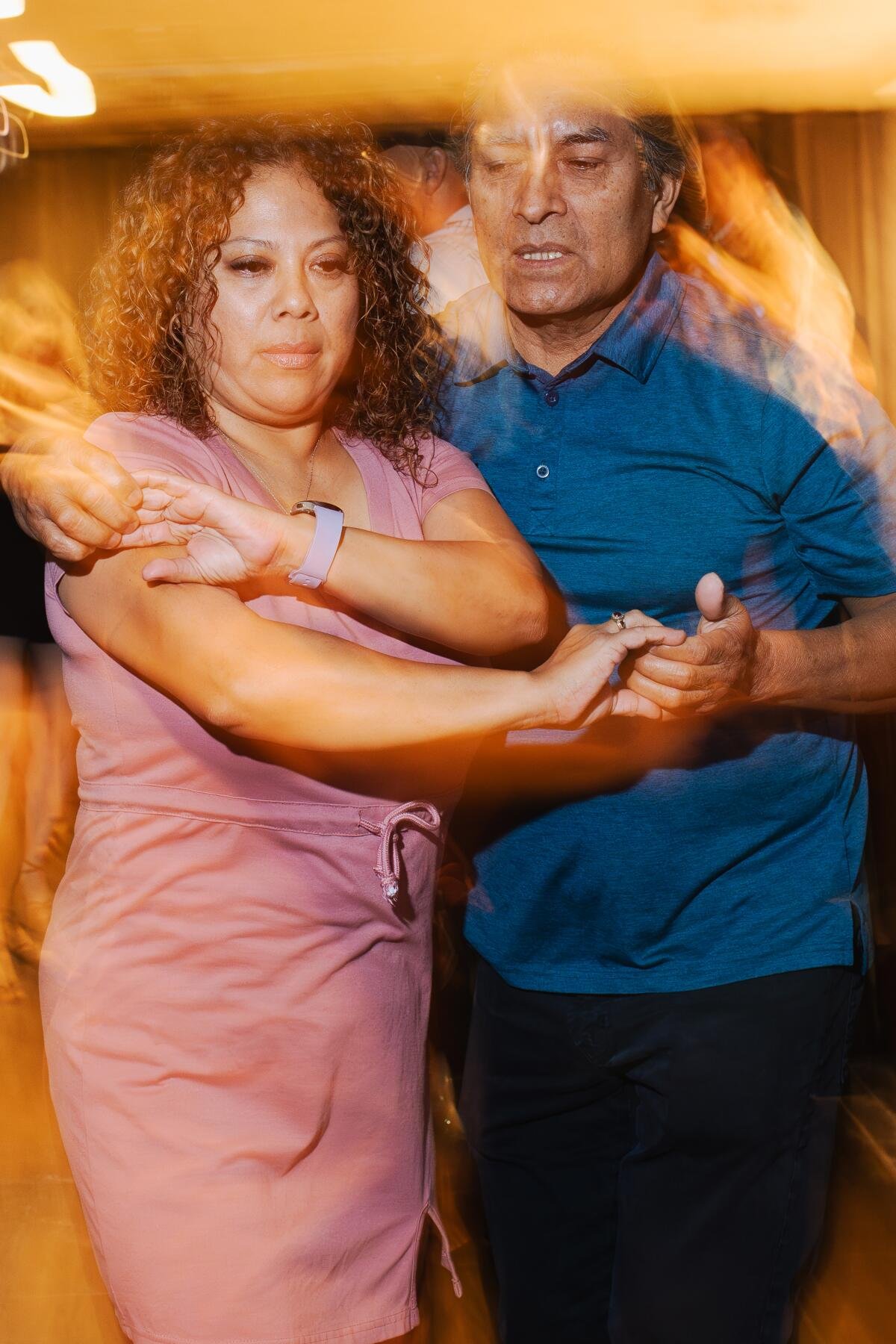
For decades, Stevens has brought friends, couples, and families together for live music and dance.
(Emil Ravelo/For The Times)
When college friends recommended Stevens as an affordable place to dance, Hernandez mentioned it in passing to her dad. “He laughed and said, ‘I remember that place. I used to dance there too,’” Hernandez says.
The increasingly mainstream artists of Latin fusion genre reggaeton are returning to tradition. Along with the music of Bad Bunny, who’s headlining the upcoming Super Bowl halftime show, you can find classic salsa references in reggaeton star Rauw Alejandro’s latest album “Cosa Nuestra,” and in Colombian pop star Karol G’s multi-genre summer album “Tropicoqueta,” which will be at the center of her headlining Coachella set.
“You can feel the younger energy,” says longtime Stevens salsa instructor Jennifer Aguirre. “It makes me really happy to see a younger generation take on salsa. Because I was worried for a bit. I didn’t know how salsa is going to continue.”
Los Angeles has a unique relationship with salsa, the Afro-Caribbean dance born from Cuban mambo. In cities like Miami and New York, salsa arrived with Cuban and Puerto Rican immigrants. Instead, L.A.’s salsa influence came from Golden Age Hollywood, where Latin dance in movies produced a singular, flashier Angeleno style, characterized by quick turns and theatrical movement, according to salsa historian Juliet McMains.
The 1990s were another high for the genre, when West Coast pioneers like the Vazquez brothers and their first-of-its-kind dance team Salsa Brava sparked a local dance craze. The Vazquezes introduced the “on-1” step and innovated a flashier, dramatic style of salsa in L.A. that brought crowds to competitions and congresses through the 2000s. Legendary late promoter Albert Torres founded the L.A. Salsa Congress in 1999, the first congress on the West Coast, drawing a worldwide audience for Angeleno salsa.
Opened in 1952 by Steven Filipan (and located on Stevens Place), Stevens in Commerce became a local hub for Latin music. “The interesting part was that the area wasn’t Latin at all,” says Jim Filipan, Steven’s grandson and now the third-generation owner of the restaurant. “My grandfather had a foresight that this genre would be the future.”
Jim recalls his childhood growing up in the restaurant. “We would have hundreds of people on Sundays,” he says. “The ballroom, the restaurant, everyone was dancing salsa, and it was incredible. My dad took over in the ‘70s, and I was running it with him in the ‘90s.”
Yet by the 2010s it was apparent that another genre was taking hold of the Latin dance scene: bachata, ushered in by smooth-singing New York stars like Prince Royce and Romeo Santos. Salsa quickly went from being considered hip to rather old-fashioned.

During a Stevens dance lesson, guests learn how to spin on the dance floor.
(Emil Ravelo / For The Times)
Aguirre witnessed the genre lose interest firsthand. “It was like an immediate switch,” Aguirre says. “Salsa just wasn’t as popular anymore, and people would walk over to the other side of the restaurant to take the bachata lessons.”
The pandemic also dealt a large blow to local salsa clubs, as peers in the long-standing dance club industry fell to lower attendance rates and rising rent. And in the last year, two historic venues, the Conga Room and the Mayan, closed permanently.
Stevens almost had the same fate. The financial burdens during the pandemic made Jim consider closing for good. But he couldn’t help but consider the responsibility of his family’s legacy and the special place Stevens holds for local dancers.
“It’s very emotional for me because I have four generations in this restaurant, and now my daughter works here,” he says.
When Stevens reopened, the community came back in droves, ushering in a new era of excitement for salsa.
These days, at the beginning of every class, dance instructor Miguel “Miguelito” Aguirre announces the same rule.
“Forget about what happened today, forget about your week, forget about all the bad stuff. Leave it at the door,” Aguirre says. “It’s going to be better because we’re going to dance salsa.”

Dance instructor, Miguel Aguirre, right, mans the DJ booth alongside DJ Pechanga, another longtime employee of Stevens. Every weekend, the duo brings Latin music to the forefront of the space.
(Emil Ravelo/For The Times)
Aguirre has taught salsa at Stevens for 30 years. In many ways, the steakhouse has shaped his life. It’s where he discovered his love for teaching dance and much more.
“I started coming here in the ‘90s, sneaking in through the back door. I was a teenager, so not old enough to show my ID, but one day, Jim just said, ‘You guys cannot come in through the back anymore. You can come into the front,’” Aguirre says. “And then one day he said, ‘Hey, we are missing the instructors. They’re not coming in. Can you guys teach the class?’ And, I’m still here.”
Jennifer Aguirre, a fellow dance teacher at Stevens, is his wife. She met him one day at Stevens’ annual Halloween party.
“He asked me to join his class because they ‘needed more girls,’” Jennifer says, laughing.
Now Jennifer teaches the beginner’s class, while Miguel is on intermediate. But once 10 p.m. hits, it’s social dancing time. The whole floor comes together and a familiar community converges. If attendees are lucky, they might catch Jennifer and Miguel, a smooth-dancing duo, letting loose, stepping and dipping effortlessly.
On a recent Sunday night, the low-lighted ambience of the restaurant met the purple lights of the dance room, with people sitting all around for a peek at the moves on display. Buttery steaks and potatoes cooking in the kitchen tinged the air as the dance floor came alive with women spinning in dresses and men in shining shoes gliding to the rhythm of the music. Miguel Aguirre manned the DJ stand, asking two singles if they knew each other and encouraging them to dance.
Gregorio Sines was one of the solo dancers on the floor, swaying partners easily under Miguel’s encouragement. Years ago, his friend, who frequented Stevens, dragged Sines out to dance socials, telling him it would be the best way to meet people and open up.
As someone who began with anxiety to dance in front of others, Sines now performs in Stevens’ dance showcases. He says consistently returning to the steakhouse’s historic floor and immersing himself in the supportive community not only changed his dance game, but brought him out of his shell.
“I tell anyone, if you’re scared to dance, you just have to get out there,” Sines says. “There’s a community waiting for you.”


