It takes an average of 14 to 17 years for people to be diagnosed with obsessive-compulsive disorder (OCD) after they start experiencing symptoms. One of the reasons so many “suffer in silence” is the shame that cloaks their days, says Alexandra McNulty, a therapist in Baltimore who specializes in the condition, which is characterized by unwanted thoughts and repetitive behaviors.
“The challenge is that OCD is often filled with very distressing thoughts that go against someone’s values and morals,” she says. That could mean repeated thoughts about hurting themselves by jumping in front of traffic, committing a violent act like murder, or engaging in taboo sexual acts. “Because of that shame, people often don’t feel comfortable explaining to folks, including their providers, what they’re experiencing.”
When they do open up—finally sharing their internal dialogue with loved ones—it’s not unusual to be flooded with well-intentioned but harmful comments that only fuel the sense of embarrassment they feel about the thoughts, images, and urges running through their brain. That can exacerbate the cycle of obsessions and compulsions, which is why, if you’re on the receiving end, it’s so important to be thoughtful about the way you respond. We asked experts to share the worst things to say to someone with OCD—and which words are truly helpful.
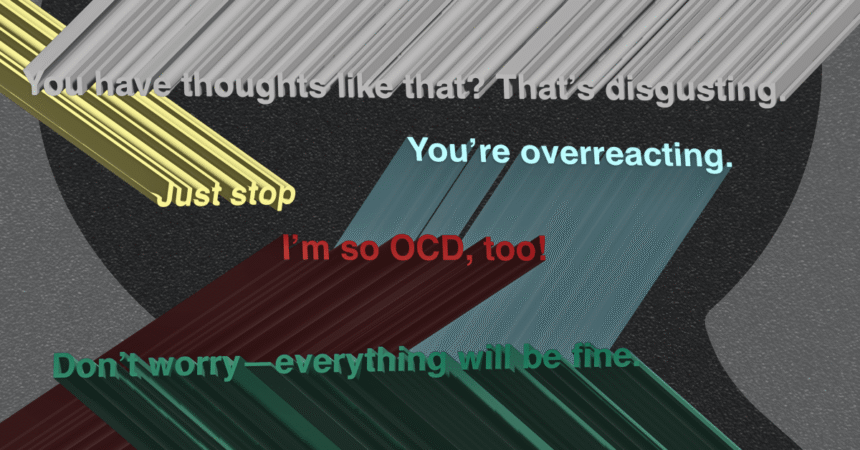
“Don’t worry—everything will be fine.”
If someone you love is struggling with distressing thoughts, it’s natural to want to reassure them. But that’s the worst thing you can do. Telling them that everything is going to be OK “might provide temporary relief, but the problem is that the only thing in this world that’s truly certain is that there will always be uncertainty,” says Alissa Jerud, a clinical assistant professor of psychiatry at The University of Pennsylvania. “When somebody provides that certainty, it may work for a moment, but then the brain is going to come back with, ‘Wait, what if they’re wrong?’ Or, ‘What if this time it’s OK, but next time it’s not?’”
That triggers a yo-yo effect: The person you love will feel anxious, then relieved, then anxious and in desperate need of reassurance again. It’s a vicious cycle that you should resist feeding into.
Instead say: “I know this is hard for you, and I know you can do hard things.”
Jerud’s clients often tell her it’s too painful, difficult, and anxiety-provoking to resist OCD’s demands. That’s why it’s important to remind your loved ones that they’re capable of doing challenging things—and to celebrate their effort. “Living with OCD is hard,” she says, “and it can feel so validating to have that acknowledged and to know that others believe in you.”
“You have thoughts like that? That’s disgusting.”
People with OCD can have debilitating intrusive thoughts that feel taboo, like about sexual violence or otherwise harming themselves or others. These aren’t a reflection of their true selves. If someone you love confides in you about what they’re experiencing, don’t respond with shock or horror. “The worst thing you can do is reinforce the shame, guilt, and disgust they’re already feeling,” Hardis says.
Instead say: “Our brain throws up lots of thoughts.”
It’s better to respond in a way that normalizes that you, too, have weird, distressing thoughts sometimes. Aim for a neutral tone, Hardis advises. If your kid just confided in you about a disturbing thought they had, for example, explain that the brain dispenses thousands of thoughts a day, and they don’t all mean something. She suggests adding: “I can appreciate how scary this must feel for you.”
“I’m so OCD, too!”
OCD—like any other mental-health condition—should never be used as an adjective. Yet people have latched onto the term as a way to express that they’re super organized or worried about germs. On the flipside, some exclaim that they wish they had OCD, because they could afford to be neater.
Read More: Stop Saying These 5 Things to People With Social Anxiety
“It overlooks the tremendous suffering someone might be experiencing,” says Joanna Hardis, a therapist in Cleveland Heights, Ohio, who specializes in treating OCD and anxiety disorders. “You might see someone washing their hands, but what you don’t see is the unrelenting and intrusive thoughts that may be driving it. You have absolutely no idea the level of torment of the thought behind that behavior.”
Instead say: “If you ever want me to help you find a therapist who provides highly effective, evidence-based treatment for OCD, I’d be happy to do so.”
This is “quite possibly the most helpful thing of all that you can say to someone with OCD,” Jerud says. Exposure and response prevention (ERP) therapy is the gold-standard treatment for OCD, but it’s not always easy to find a provider (especially one who’s available and affordable). Offering to do some of the legwork to track a clinician down can go a long way.
“Sometimes people don’t even realize they have OCD. They just think this is how they do things. This is how they live through the world,” Jerud says. “Letting them know that you’re happy to look into that for them if that would be helpful suggests that there might be an alternative path—that maybe they don’t have to always struggle in this way.” That can provide a much needed sense of hope, she adds.
“You’re overreacting.”
Telling someone there’s no reason to be anxious is “incredibly dismissive,” McNulty says. She likens it to saying: “I don’t see any problems, so therefore, your reaction doesn’t make any sense.”
“People with OCD have a horror movie of the worst-case scenarios running through their mind all the time,” she says. “Their brain can’t tell the difference between what’s happening and what could happen. To say they’re overreacting—well, no, their emotions and anxiety are actually very warranted given the story their mind is telling them.”
Instead say: “Your anxiety is real, but the story your mind is telling you might not be. You can trust what your senses are telling you.”
McNulty sometimes explains OCD like this: Say you had a dream that your husband cheated on you, and when you woke up, you were peeved at him, despite knowing your emotions weren’t grounded in reality. “The emotion is real, but the story is not real,” she says. “That’s what people are experiencing with OCD while they’re awake.”
Read More: The Worst Thing to Say to Someone Who’s Depressed
Of course, being able to talk to someone with OCD about the way their brain is operating requires a nuanced understanding of what they’re going through. That’s why she recommends attending a treatment session with your loved one, so you can learn all about OCD and how to support the person you care about. There are also lots of support groups for family members to join, which can provide valuable pointers on communication.
“If you do that one more time, there will be no screens for a week!”
Punitive statements are rarely, if ever, appropriate—and that includes when you’re talking to someone with OCD. “Would you punish a kid who has diabetes because their blood sugar is off?” Jerud asks. “We don’t know exactly what causes OCD, but there are certainly biological components. Why would we punish somebody when that’s just how their brain has been wired to work?”
Instead say: “That was really brave of you. Way to go!”
People with OCD tend to give themselves a hard time. When they’re stuck on an obsession, they reach a critical choice point, Jerud says: They can either give in to their urges, or try to reduce their anxiety in some way, which feels risky and difficult. “Each time they do that, they get a little stronger, and their OCD gets a little weaker,” she says. “When we reinforce those tiny wins, it can help empower them to keep going.”
“Just stop.”
If your loved one has to tap their body four times in a row before moving on to a new task, or insists on rewriting an email until it’s just right, you might be tempted to tell them to knock it off. They can control their own behavior, right? Not exactly. “OCD is not about a lack of willpower,” McNulty says. “In fact, it requires a lot of willpower—my clients often end up white-knuckling through life in order to be able to do the things they enjoy despite their obsessions and compulsions.”
Instead say: “I get that it’s hard right now. How can I, as your support person, help you in this moment?”
The same tactics won’t help everyone with OCD calm their minds, but grounding practices that focus on engaging your senses in the present moment are often valuable. You might offer to go for a walk with your loved one, for example, or listen to a favorite album together. If you’re not sure what would be most helpful, McNulty suggests asking: “What can we do right now to help pull you out of these really scary stories your mind is telling you?”
Read More: What It Really Means to Have Intrusive Thoughts
It’s also a good idea to spend time educating yourself about what OCD feels like, and ask your loved one questions about their experience. Rather than make assumptions, get curious: “What’s your mind telling you right now?” “If you don’t understand, ask,” she says. “Give somebody the space to share their lived experience, and listen in a non-judgmental way.”
Wondering what to say in a tricky social situation? Email timetotalk@time.com