Those exposed to Chinese ADRs—whether it’s a CEO of a U.S.-listed Chinese company, or an equity strategist dealing with the China market—are now all considering one question: Is the U.S. really going to kick Chinese companies off its stock exchanges?
Some of China’s largest companies trade in the U.S., including JD.com (No. 47 on the Fortune Global 500), Alibaba (No. 70) and PDD Holdings (No. 442). But these giants and many much smaller companies could have their existence as U.S.-traded companies threatened by a revived trade war against Beijing launched by U.S. President Donald Trump.
Last week, several Republican members of Congress, including Representative John Moolenaar, chair of the House Select Committee on the Chinese Communist Party, wrote recently appointed Securities and Exchange Commission Chair Paul Atkins to “express grave concern over the continued presence of Chinese companies on U.S. stock exchanges.”
In a letter reported by the Financial Times, the lawmakers pointed to U.S.-listed Chinese companies, large and small, from giants like Alibaba and JD.com to smaller startups like EV brand Xpeng and self-driving car provider Pony.AI.
‘Everything is on the table’
Worries over delisting have grown since late February, when Trump revived the threat of kicking Chinese companies off U.S. exchanges in his “America First Investment Plan.” In his memo, Trump ordered officials to determine whether Chinese companies were upholding U.S. auditing standards and investigate the structures these firms use to list on foreign exchanges.
Since then, administration officials have declined to rule out taking action against U.S.-listed Chinese companies, with Treasury Secretary Scott Bessent noting in a mid-April TV interview that “everything is on the table.”
“The threat is growing in a significant way,” says Sandeep Rao, a researcher at Leverage Shares.
The NASDAQ Golden Dragon China Index, which tracks Chinese companies listed in the U.S., is down by around 7% since “Liberation Day.” By comparison, Hong Kong’s Hang Seng Tech Index, which tracks tech companies traded in the Chinese city (including some that also trade in the U.S.) is down by 4.6% over the same period.
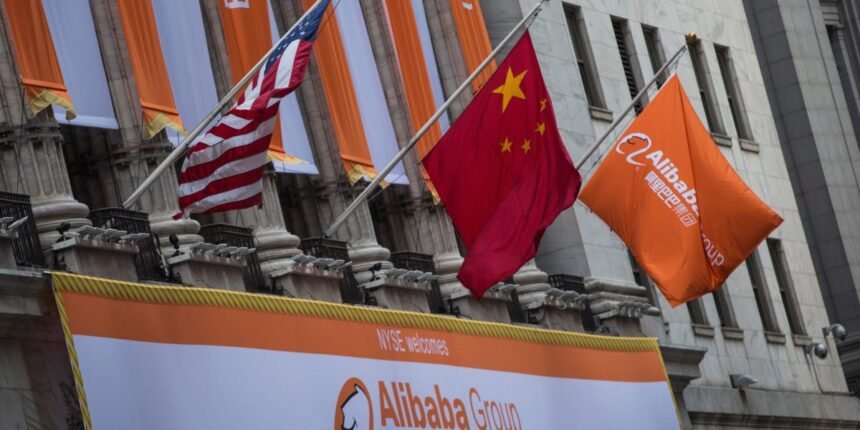
Chinese companies have long turned to the U.S.’s deep and liquid markets to raise capital. Alibaba’s IPO on the New York Stock Exchange in 2014 raised $25 billion, the world’s largest IPO at the time, and only superseded by Saudi Aramco’s 2019 listing in Riyadh.
As of the end of March, 286 Chinese companies are listed on U.S. exchanges, with a total market value of $1.1 trillion, according to exchange data cited by the South China Morning Post.
Yet U.S. investors have grumbled about poor auditing standards among Chinese companies. Technically, companies listed in the U.S. need to open their books to U.S. regulators, but Chinese officials often bar such access citing national security. The revelation in 2020 that Chinese coffee chain Luckin Coffee had inflated its sales was the last straw for Congress, which passed the Holding Foreign Companies Accountable Act that ordered Chinese companies to grant access to U.S. regulators or risk getting thrown off U.S. exchanges.
After years of negotiations, China in 2022 agreed to let U.S. regulators review auditing documents in the Chinese city of Hong Kong, lifting the delisting threat and calming investors.
Still, the damage had already been done, as U.S.-listed Chinese companies began to explore secondary listings in Hong Kong. Last year, Alibaba upgraded its Hong Kong listing to a primary listing, allowing the Chinese e-commerce company to tap mainland Chinese investors through the city’s Southbound Connect scheme.
Some investors “have been shifting over from holding the U.S. ticker to the Hong Kong ticker because of the delisting threat,” Rao says.
Hong Kong might be a winner
In mid-April, Goldman Sachs estimated that U.S. institutional investors hold about $830 billion worth of shares in Chinese companies, spread across the mainland Chinese, Hong Kong, and U.S. markets. About $250 billion of that is in Chinese ADRs.
Still, “holdings of equities by foreigners, particularly U.S. holders, have come down meaningfully versus where we were five years ago,” Cameron Chui, Asia equity strategist for JPMorgan Private Bank, said during a Wednesday briefing to reporters when asked the possibility of delistings. “The risk has definitely been meaningfully reduced.”
Rao notes that U.S. investors might still be able to keep trading in Chinese companies even if they do get delisted—it would just be in the less protected OTC market. Tencent, one of China’s largest tech companies, has its main listing in Hong Kong, but also trades in the U.S. OTC market.
Meanwhile, Chinese companies are already murmuring about other options. In a conversation with reporters on the sidelines of the Shanghai Auto Show, Pony.ai CEO James Peng said a secondary listing in Hong Kong was possible, though affirmed the startup was focusing on releasing its next generation of vehicles.
Geely Auto is also taking its U.S.-listed EV brand Zeekr private, just one year after its New York IPO, to streamline the Chinese auto giant’s operations and improve profitability.
In its mid-April report, Goldman Sachs highlighted 27 U.S.-listed Chinese companies that will likely be eligible for a Hong Kong listing (whether a secondary or primary listing), including PDD, retail stock trading platform Futu, and digital logistics platform Full Truck Alliance.
But some Chinese companies are braving geopolitics to pursue a U.S. listing. Chagee, a Chinese tea chain, raised $411 million in a U.S. IPO, debuting on the Nasdaq on April 17.
Hong Kong looks like a more attractive—or, at least, a less bad—place to trade shares. A primary listing in the city opens up the possibility of mainland Chinese investors trading the company’s shares. Southbound flows (i.e. from mainland China into Hong Kong) have surged in recent months, as mainland Chinese investors barrel into the AI boom represented by companies like Alibaba and Semiconductor International Manufacturing Corporation.
“It’s quite sensible to have, at the very least, a secondary listing in Hong Kong if you’re a U.S.-listed Chinese company,” Rao says.
The city is going through an IPO revival, as mainland Chinese companies now hope to tap global capital through an “overseas” listing. Last November, a $4 billion IPO by Midea, the world’s largest maker of home appliances, kicked things off; Mixue, an ice-cream chain with more outlets than McDonald’s, followed in March.
Hong Kong is expecting at least two more blockbuster IPOs in the coming months. CATL, the main supplier of batteries for Tesla, hopes to raise $5 billion in Hong Kong in the near future. (JPMorgan and Bank of America are assisting with the IPO, which has attracted congressional scrutiny.) Chinese automaker Chery Auto is also gearing up for a Hong Kong listing to raise $1.5 billion.
But Hong Kong isn’t a perfect replacement for New York. “There are no positives from this. Liquidity in Hong Kong is not the same as in the U.S.,” Chui said on Wednesday.
This story was originally featured on Fortune.com