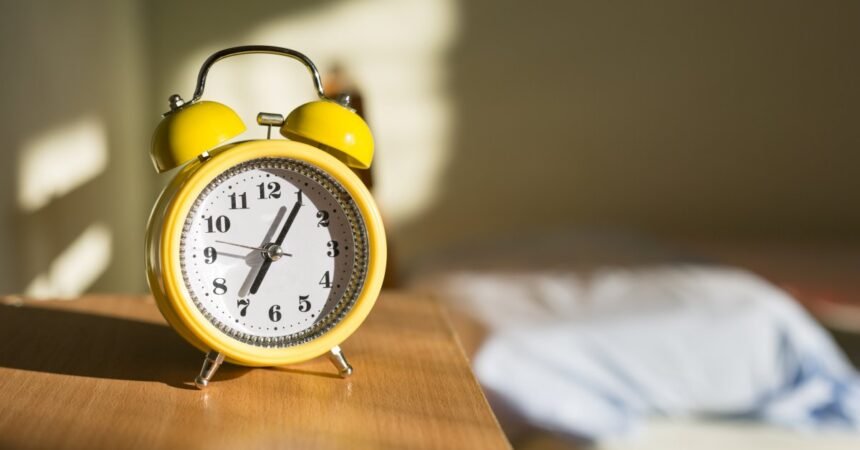
It’s no secret that we live in a sleep-deprived society. More than a third of Americans don’t get enough shuteye, defined as a minimum of seven hours a night. It’s not just the U.S.: much of the developed world is in a similar situation. “Sleep deprivation abounds,” says Eva Winnebeck, a chronobiologist at the University of Surrey in the U.K. “People do struggle to get up. Alarm clock use is high, lack of sleep is high.” (A rule of thumb: If you need an alarm clock to wake up, it probably means you aren’t sleeping enough.)
So why, exactly, do we compound the problem of sleep deprivation twice a year with Daylight Saving Time? Why do we, in spring and fall—on November 2 for Americans—mess with our internal clocks?
Experts think we should put this practice to rest. The American Academy of Sleep Medicine (AASM) and various European societies for sleep medicine and biological rhythms have spoken out against switching the clocks. “These seasonal time changes should be abolished,” reads the AASM statement, and the European groups’ statement likewise pushes for a single standard time, since keeping to one time throughout the year may line us up better with the sun. But while these organizations have been vocal, governments have resisted making a change to the status quo.
What sleep deprivation does to the body
Public-health researchers have found that sleep deprivation leads to more car accidents, greater risk of diabetes, and even a higher risk of heart attacks. That’s because long-term sleep deprivation influences the body’s biology in ways that go beyond merely feeling groggy. It can raise blood pressure and increase risk-taking behavior, and it can mean the disarrangement of the linkage between your body’s internal clock and the sun, something that’s especially common among shiftworkers.
Biological processes that should be happening at separate times start to overlap, while those that should be in sync start to spread out, a state that may be behind the elevated risks of heart disease and cancer in people who work nights.
Why we keep changing the clocks
This biannual disarrangement of our sleep schedules is not all that old. It is a policy set by governments, and the current U.S. practice of it dates back to 1966 with the passage of the Uniform Time Act. Before that, during the World Wars, the U.S. temporarily made use of twiddling with clocks in order to save on energy. The idea was to take the daily period of time that humans are active and move it so that more of it fell during natural hours of daylight, saving on fuel costs.
Read More: How Tracking Your Health Metrics Can Help You Live Longer
It restarted in the 1960s, when the Interstate Commerce Commission, which regulated transportation, pushed for a standardized approach to time. Companies managing planes and trains traveling across state borders needed a clear sense of what time it was where, and as part of the Act, regular Daylight Saving Time became mandated by law.
As of 2025, most Americans are on Daylight Saving Time eight months of the year, from March to November. Standard Time is only around for four months. (Hawaii and Arizona, among other localities, do not observe Daylight Saving Time.)
Seasonal shifts are natural, but not these shifts
It’s not that human biology requires an unchanging day and night.
Because Earth’s axis is tilted, in many places daylight hours wax and wane over the course of the year. It’s particularly evident farther from the equator; in Northern England, for instance, the shortest day of the year has fewer than eight hours of sun, while in San Antonio, it’s more than 10 hours.
Studies have revealed humans may be naturally set up to change the duration of their sleep over the seasons, says Manuel Schabus, a professor at the University of Salzburg in Austria who studies sleep. In a 2015 paper, researchers found that people in three different pre-industrialized societies got up just before sunset year-round, and they tended to fall asleep about three hours after sunset. They were awake about an hour longer in summer than in the winter. And studies on people from industrialized societies on camping trips without access to artificial light show them falling into rhythm with the sun.
Read More: Here’s How to Know You’re Talking to a Narcissist
But Daylight Saving Time requires an unnatural change that puts many people in conflict with the sun’s signals, says chronobiologist Martha Merrow, a professor at the Ludwig Maximilian University of Munich.
With Daylight Saving Time, “you need to use the alarm more,” she says. “We should be looking for ways to not use an alarm clock. Every time we use an alarm clock, we deprive ourselves of sleep.”
How to assess the biological ramifications of these policies, though, has been hard to pin down. “It’s really difficult to say what it does for an individual,” says Winnebeck. “But it affects everyone in a society. It does that over eight months of the year. And we do that multiple years in a row to millions of people.”
It might be the circadian equivalent, she says, of eating unhealthfully every day for years. “The problem is proving this. It’s very difficult.”
A hunch with a data problem
Does living on Daylight Saving Time for so much of the year impact health? It’s hard to answer this question, says Dr. Elizabeth Klerman, a professor of neurology at Harvard Medical School, but there are some hints in studies that compare health outcomes on the edges of timezones. That’s because people on the eastern rim of a timezone are in a privileged situation: The sun’s time and their clock time line up more precisely. Those on the western rim suffer a mismatch between solar time and clock time. In effect, this is similar to what Daylight Saving Time produces, says Klerman.
These studies show a fascinating pattern: “There’s more cancer on the western edge of the time zone,” she says. Higher levels of obesity and diabetes, which have been linked to circadian disruption, crop up more, too. People are also more likely to be sleep deprived.
That suggests that there might be real health consequences to Daylight Saving Time.
Read More: Why You Should Never Shower While Wearing Contacts
There are a number of studies asserting shorter-term risks to Daylight Saving Time: more traffic accidents the day after the shift, for instance. Russell Foster, a circadian neuroscientist at University of Oxford who has recently looked into much of this data, says that the studies tend not to be as conclusive as you might think.
However, the shift away from Standard Time does correlate with a spike in heart attacks; shifting back to Standard, back into sync with the sun, correlates with a decline.
Living on solar time
Scrapping seasonal time changes is a perennial subject of public-policy debate. In 2019, the European Parliament voted to end the practice. “But there is still no progress,” says Schabus. It’s proven hard to agree on what to do instead: Would some E.U. countries adopt a kind of permanent Daylight Saving Time year round? Would others use Standard Time?
Read More: Why Strength Training Is the Best Anti-Ager
Some sleep scientists wonder whether something more radical would ever be possible. What if we could actually follow the sun’s time, without artificial constructs like Daylight Saving Time, or even time zones? If we did that, it would be noon when the sun is right overhead, and wake times could follow the sun through the year. “Until we had a train system in Europe, people did use sun time,” says Merrow. When it comes to ensuring long-distance coordination—the kind of thing that time zones are used for now–perhaps computer tools could run the calculations for us, she muses.
Schabus, for his part, also prefers a sleep-wake cycle that can shift with the seasons, and he points to increased focus on flexible work hours in the E.U. as a potential boon to those interested in following the sun. “I think it’s easiest for our bodies to follow those rules,” he said. It’s how we evolved, after all.