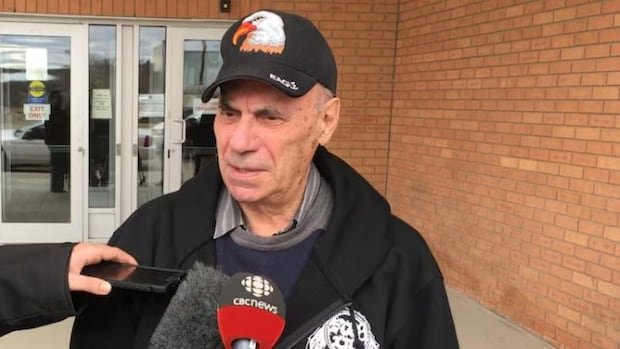
On the street, he was known simply as Father Andre.
Andre Poilievre, who spent his career working with at-risk youth and gang members, died earlier this week, his family confirmed. He was 88.
Poilievre didn’t look like a priest, favouring ball caps, sweaters and windbreakers to cassocks and collars. He drove a half-ton, and most days could be seen rolling through a Tim Hortons drive-thru with a teen in tow on the way to an appointment.
For those who encountered the rangy chaplain, his faith was defined by action.
“Father Andre, he was always the true definition of an advocate,” EGADZ executive director Don Meikle said.
“He didn’t have a problem with bucking the system.… A lot of people don’t like going against the police, a lot of people are scared to go against the system. He didn’t care.”
From Prud’homme to prison
Andre Poilievre was born in Prud’homme, a small town east of Saskatoon, on Aug. 12, 1936. In 2023, he was awarded an honorary Doctor of Laws by the University of Saskatchewan. The ceremony included a biography.
“He was ordained as a Catholic priest. While pursuing further education as an adult, he traveled to more than 25 countries to learn from groups that help marginalized communities. In Saskatoon, Father Poilièvre worked directly with at-risk youth and active gang members through his roles as a priest, chaplain, and teacher. His experiences as chaplain at the Saskatoon Correctional Centre helped inspire his life’s work,” it said
“In 2002, Father Poilièvre was approached by two young men seeking assistance in leaving the gang life. Together, the three of them founded STR8 UP. The program offers counselling, education, and support to people who have lived criminal lifestyles, helping them make positive changes in their lives.”
Senator Tracy Muggli was at that ceremony and recalls Poilievre saying he’d be more comfortable speaking to inmates at the Saskatoon jail than a convocation ceremony.
“You could hear a pin drop when he spoke, because he spoke as a true servant,” she said. “That’s what he was. He was a true servant to God.”
Muggli crossed paths with Poilievre when she was the Saskatchewan government’s director of mental health and addiction services. She remembers his compassion for people trying to leave the gang lifestyle.
“It’s incredible that a man who had such a heart and experienced so much love for humanity was able to create an organization to help so many people.”
STR8 UP
Stan Tu’Inukafe helped create STR8 UP with Poilievre. They met two decades ago when Tu’Inukafe was working with the John Howard Society and started hearing about a priest working with gang members.
They got together for coffee and realized they were on the same path.
“My first impression was, you know, here’s an individual that is like my grandpa,” Tu’Inukafe said.
“Someone that would sit down with you, talk with you with no judgment, that cared for you, was thoughtful. Wanted the best for you.”
Tu’Inukafe said Poilievre’s legacy at STR8 UP is about giving voice to people who had lost their voices.
“He humanized them.”
Robert Henry is an associate professor in the department of Indigenous studies at the University of Saskatchewan. Henry studies justice issues, including the gang lifestyle in the city and province.
He said Poilievre initially balked at working with him — “he just stated that he didn’t trust researchers” — but that they eventually developed a relationship.
Poilievre, he said, was all about building relationships, especially with young men and women struggling with the street lifestyle.
“It really resonated with a lot of the members, even if they were in and out and ended up going back into the street. He would never leave them there,” he said.
“So that was always there, that sort of relentless love and hope that he was always trying to give individuals.”