Amid growing pushback on women’s rights in some countries and a general backsliding of gender policies, persistent institutional and societal barriers prevent women from equally participating in peace and security processes.
But there is no peace or security without women — a statement the United Nations has been emphasising for the last quarter century.
“We know that when women call it, peace follows. When women call it, peace is sustained,” UN Women Deputy Executive Director Nyaradzayi Gumbonzvanda said at an event co-organised by UN Women in Brussels on Wednesday.
Policymakers, civil society leaders, and international organisations met in the Belgian capital on Wednesday to reflect on the progress made and challenges still faced by the Women, Peace and Security (WPS) agenda since its implementation.
On 31 October 2000, the UN Security Council adopted Resolution 1325, a landmark bill that acknowledged the disproportionate and unique impact of armed conflict on women and girls and called for women’s equal participation in conflict prevention and resolution, as well as peace processes.
The resolution laid the groundwork for the WPS programme, a framework that seeks to institutionalise the goals set out 25 years ago.
The anniversary goes alongside the 30th anniversary of the Beijing Declaration and Platform for Action, which laid the foundation for the WPS agenda five years prior.
While they have seen some successes over the past two decades, attendees said, they warned that not enough has been done to fully implement and actualise the agenda’s aims.
“Paper commitment is not enough, we must transform this into action that is visible, measurable, and inclusive,” Poland’s Minister for Equality Katarzyna Kotula said during her opening remarks.
This year’s anniversary is taking place in an increasingly complex and fractured geopolitical space and a changing security landscape marked by disinformation and hybrid warfare.
“Conflict is no longer confined by borders,” Kotula said, and warned of the threats posed by information manipulation and cyber violence.
Women at the heart of sustainable peace talks
“Women bring their lived experiences to the table,” Gumbonzvanda told Euronews.
“They also come as experts who are able to contribute to the solutions,” she added, noting that based on years of work by UN Women, it has become clear that peace talks including women tend to be more sustainable.
The Deputy Executive Director of UN Women drew on her own experience — she was born during the 1964-1979 Zimbabwe War of Independence — to emphasise the important role women played during that time.
“When early warning signs start to show, it is the women who care for each other and yet they struggle to be part of the solutions,” she explained.
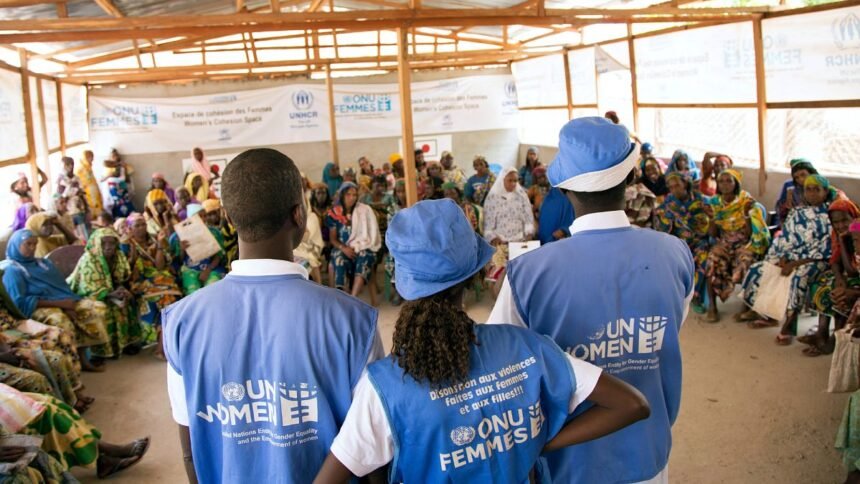
Women-led grassroots organisations were at the core of Wednesday’s discussions. “It’s not just about the top level; it’s the women on the ground,” one panellist pointed out.
Yet various barriers remain in place which prevent women from unlocking their full potential in peace and security processes.
A lack of adequate funding and resources for women-led organisations was identified and unanimously agreed on as a key hurdle.
Data by the Organisation for Economic Cooperation and Development (OECD) revealed that international aid from donors in 2024 fell by 7.1% compared to the previous year.
The OECD noted that this was the first drop reported after five years of consecutive growth.
Earlier this month, UN Women warned that the global aid cuts may force organisations helping women in crisis to shut down.
A report they published found that 90% of the 411 women-led and women’s rights organisations surveyed said they had been impacted by aid cuts.
The report also predicted that half of the organisations may have to shut down in six months if current funding levels persist.
“Resourcing community and women-led initiatives as part of WPS Agenda is an imperative, it is not a choice,” Gumbonzvanda told Euronews.
Kotula told Euronews that the European Democracy Shield, a special committee created to respond to new geopolitical challenges, should incorporate financing for women’s organisations.
Kotula emphasised the role civil society and women’s organisations played when the European Union was hit with back-to-back crises, from the COVID-19 pandemic to Russia’s full-scale invasion of Ukraine, which sparked a major refugee crisis.
“First in line were usually civil society and women’s organisations, it was on their shoulders. So that’s why it’s one of the reasons that when we now need the funding, it’s because we know they passed the test when it comes to [handling] crises, and we know we can count on them,” Kotula said.
The Polish minister for equality admitted that the topic of gender equality and gender-based violence has been pushed under the rug for far too long, but assured her efforts to incorporate both into Poland’s new national action plan.
“Poland had been facing backlash for many years, then we won the elections, and we opened the window a bit,” Kotula said.
She referred back to last year, when the definition of rape was changed under Polish law, and added that she now hopes to use this “window of opportunity,” to also crack down on the issue of gender based violence.
Military spending vs social defence
In 2024, global military spending reached its highest year-on-year rise since the end of the Cold War, a study by the Stockholm International Peace Research Institute (SIPRI) revealed.
The start of Russia’s full-scale invasion of Ukraine in 2022 and the uncertainty of European security under US President Donald Trump pushed the continent to rethink its defence readiness.
As a result, all European countries, with the exception of Malta, increased their military spending in 2024.
However, Founder and CEO of International Civil Society Action Network (ICAN), Sanam Naraghi-Anderlini, argued that shifting the focus to increased militarisation undermines the power of social defence.
“We are reducing our own security in the name of militarised security,” Naraghi-Anderlini told Euronews.
Naraghi-Anderlini, who hosts the podcast “If You Were in Charge”, said women peacebuilders take a radically different approach to conflict resolution. In stark contrast to armed conflict, they instead bring “a radical commitment to nonviolence.”
“Sitting and talking, not shooting, as a driving force,” she said.
The podcast host said women peacebuilders have the ability “to disarm intellectually, mentally and emotionally.”
Naraghi-Anderlini said that as a result, women are often stereotyped as soft, but in reality it is an extremely powerful quality when it comes to peace negotiations, where there’s often a lot of “mistrust, existential fear, anger and trauma.”
During her opening remarks, Naraghi-Anderlini outlined how her organisation successfully supported local communities with $11 million (€9.75 million), emphasising the significant impact was made with “just a fraction of the cost of weaponry and military equipment.”
“This kind of peacebuilding work is actually quite cheap, but it’s really important. So if it disappears, we’re really wasting investment and good work,” she told Euronews.
Naraghi-Anderlini said that while conflict is natural, the use of violence is a choice.
“And yet they’ve made it seem as if violence is inevitable, as if war is inevitable because it benefits the arms industry.”