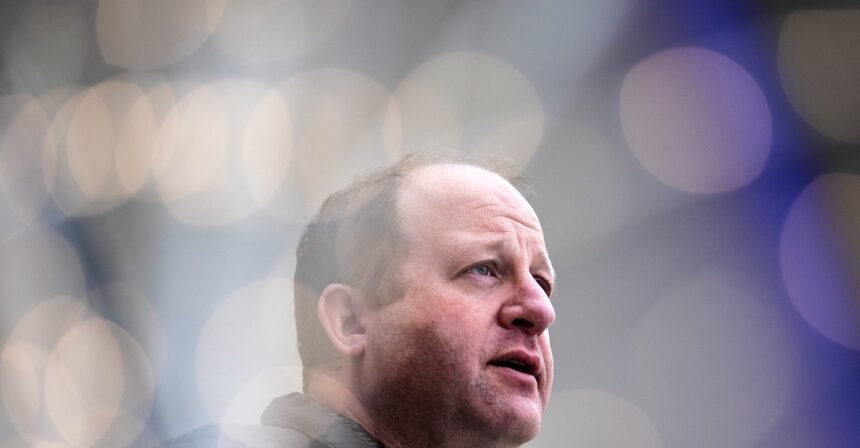
Politicians sometimes do silly things to draw attention to their favorite issues. In 2015, then-Senator Jim Inhofe famously brought a snowball onto the floor of Congress to argue against the existence of climate change. Representative Marjorie Taylor Greene toted a balloon to the 2023 State of the Union to mock the Biden administration’s handling of a Chinese spy craft. But in terms of sheer spectacle, few can top Jared Polis and his “forbidden” feast.
In 2015, Polis, then a Democratic congressman from Colorado, dined on hemp scones and washed them down with a glass of raw milk. The point was to highlight the purported absurdity of the government’s rules for what people can and cannot eat. He was pushing Congress to pass the Milk Freedom Act, a bill that aimed to make unpasteurized dairy easier for Americans to buy. At the time, the beverage was a delicacy for hippies in cities like Boulder, not a rallying cry for Robert F. Kennedy Jr. and the “Make America Healthy Again” movement. In May, the health secretary, who has said he drinks only raw milk, downed a shot of the stuff during a podcast taping in the White House.
Polis, now the governor of Colorado, still speaks fondly of his stunt. “Raw milk is relatively low-risk compared to many things that people choose to do in their everyday lives,” he told me recently. “We should lean into freedom,” he said, and allow “people to make their own decisions on what to eat.” (For the record, raw milk can lead to serious cases of foodborne illness.) I spoke with Polis not just to ask him about unsafe milk. Few prominent Democratic politicians want anything to do with RFK Jr. and his agenda to remake American health; Polis is the exception.
From the moment last year that Kennedy was picked to lead the Department of Health and Human Services, Polis has taken a different route than the rest of his party. Many quickly came out and said that Kennedy’s past anti-vaccine activism disqualified him from the position. “I’m excited by the news that the President-Elect will appoint @RobertKennedyJr,” Polis posted on X. “He helped us defeat vaccine mandates in Colorado in 2019 and will help make America healthy again.” During Polis’s first year as governor, in 2019, he allied with Kennedy in opposing a bill that would have made it more difficult for parents to get vaccine exemptions for their kids. Since Kennedy’s confirmation, Polis has worked directly with the Trump administration. In August, he got permission from Washington to ban the purchase of soda using food stamps in Colorado, a controversial policy that Kennedy has repeatedly held up as one of his priorities. So far, 12 states have signed on to test the idea—Colorado is the only one that is run by a Democrat.
When I asked Polis why he supports RFK Jr.’s soda agenda, his response was scattered. He told me that if people really want to drink soda, they still can, just like how Coloradans are free to buy marijuana or alcohol. “People with their own money can make whatever decisions they want,” he said. But the government “shouldn’t be subsidizing cavities and diabetes,” he added. He also claimed that banning soda from being purchased with food stamps was an act of “moral integrity.” The food-stamps program—formally the Supplemental Nutrition Assistance Program—is supposed to support nutrition, he said, and “soda has zero nutritional content.”
The response underscores the eclectic nature of Polis’s politics. While in Congress, he was at one point the only Democratic member of the House Liberty Caucus—a home of staunch libertarianism—but he also sat on the Congressional Progressive Caucus. As governor, he has taken a decidedly populist, and at times combative, approach to reforming the health-care industry; within a month in office, he set up an aptly named Office of Saving People Money on Healthcare. Polis’s varied political beliefs make him a lot like Kennedy, who was a Democrat until 2023. Kennedy has managed to bridge three specific tendencies—toward fiscal conservatism, social liberalism, and a belief that improving societal health is a moral imperative—and present them as one overarching ideology. During his confirmation hearing in January, Kennedy struck a similar tone in explaining the MAHA agenda. “This is not just an economic issue. It is not just a national-security issue. It is a spiritual issue, and it is a moral issue,” Kennedy said. “We cannot live up to our role as an exemplary nation, as a moral authority around the world, when we are writing off an entire generation of kids.” (An HHS spokesperson did not respond to a request for comment.)
Polis, in other words, may be the closest thing there is to a MAHA Democrat. When I asked him what he thought of that title, he pushed back, noting that MAHA is a bit too close to MAGA. “Unfortunately it’s only one letter away from an acronym that is something I’m staunchly opposed to,” he said. The governor also went out of his way to distance himself from Kennedy’s recent moves to roll back vaccine access. Kennedy’s decisions—namely his push to narrow approval of COVID vaccines—have “slanted the field against individual choice,” he explained. Although Polis opposes vaccine mandates, he is not an anti-vaxxer. Last month, the governor bucked Kennedy by signing an order allowing pharmacists to continue giving COVID shots without a prescription. “We will not allow unnecessary red tape or decisions from Washington to keep Coloradans from accessing life-saving vaccines,” he wrote on X at the time. Yesterday, Polis joined more than a dozen other Democratic governors to form a public-health alliance to counter RFK Jr.
Polis’s positioning seems politically savvy. Kennedy’s focus on tackling obesity and chronic disease by overhauling the American diet is popular—much more so than his policies limiting vaccines. (According to one poll by Healthier Colorado, a nonpartisan group, residents in the state support banning the purchase of soda with SNAP benefits—albeit by a narrow margin.) And by not openly identifying with MAHA, Polis avoids alienating himself from Colorado’s Democratic voters. “They think of it as Trump’s label,” Celinda Lake, a Democratic pollster who has surveyed voters on the topic, told me about MAHA. “If you put Trump in front of Cheez-Its, Democrats wouldn’t like it.”
Polis is not the only Democrat trying to do a similar dance. Jesse Gabriel, a Democratic state lawmaker in California who spearheaded the state’s recent effort to phase out ultra-processed foods in schools—another Kennedy priority—has sought to draw distinctions between his efforts and those of the administration. “Here in California, we are actually doing the work to protect our kids’ health, and we’ve been doing it since well before anyone had ever heard of the MAHA movement,” Gabriel said in a recent press conference.
Before RFK Jr. came along, Democrats were indeed the party of healthier diets. As my colleague Tom Bartlett recently wrote, “Let’s Move,” Michelle Obama’s campaign to reduce childhood obesity, has a lot of similarities with MAHA. Kennedy has pressured companies to stop using synthetic food dyes, prompting red states to pass food-dye regulations of their own. They are following in the footsteps of California, which was the first state to ban a dye, Red 3, back in 2023.
The GOP’s embrace of these food policies has put Democrats in an odd position. The party hasn’t quite figured out how to interact with the MAHA movement. Democrats might be serious about tackling chronic disease, but they’ve ceded that issue to Kennedy in recent months, likely because of trepidation about being seen as allies of the secretary. Democratic strategists I spoke with emphasized that their party needs to figure out a message that demonstrates it is more serious than the Trump administration in attacking these issues—especially one that can appeal to certain groups (namely suburban moms) that are gravitating to the MAHA message.
Even Polis, who is willing to go further than most other Democrats in aligning himself with RFK Jr., has struggled to articulate his own alternative to MAHA. (When I asked how he’d like his record as governor to be remembered, if not as one of a MAHA Democrat, he simply said, “Effective.”) As we spoke, it often felt like Polis and I were talking past each other. When I asked him why other Democratic governors weren’t pursuing a ban on buying soda using food stamps, he talked about his own opposition to Republicans’ recent cuts to SNAP. For the most part, Polis didn’t want to talk about Kennedy; he wanted to talk about his health-care achievements. Therein lies the predicament for Polis, and other members of his party: RFK Jr. has so quickly laid claim to issues of food and nutrition that it’s difficult to talk about them at all without invoking the health secretary.