Most 11-year-olds want to go to Disneyland for spring break. Mine wanted to see architecture. While there is no shortage of iconic buildings in our hometown of New York City, Pennsylvania arguably has a more esteemed collection. So last spring, we packed up my boyfriend’s vintage Mercedes station wagon and hit the road for five days of design hunting, food, and, if there was time, antiquing. A thousand miles later, we looked at the state in an entirely new way.
Day 1: The Brutalist
We began our drive early Sunday, so we could be at Canal House Station, a restaurant in Milford, New Jersey, before the lunch crowd. The founders, cookbook authors Christopher Hirsheimer and Melissa Hamilton, have created a magical space that highlights the season’s best produce. After a transportive lunch that involved fresh peas and rhubarb, we arrived at the Wharton Esherick Museum in Malvern, Pennsylvania, for our 2:30 tour.
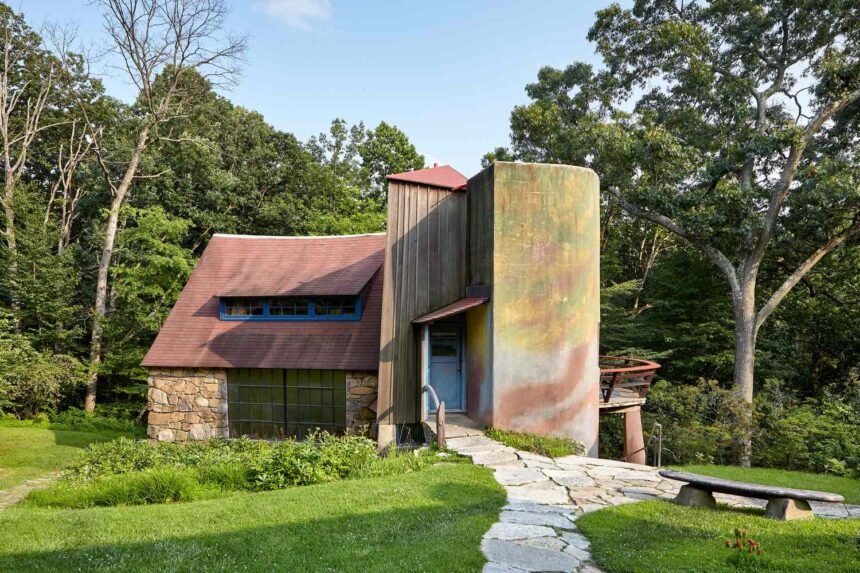
I’d never heard of Esherick, a polymath best known for his handcrafted furniture, but this museum had popped up when I searched for Louis Kahn, the Brutalist architect who was based in Philadelphia. While walking through the Hobbit-like home and studio that Esherick built from 1926 to 1966, it was hard to imagine him befriending Kahn—their styles were so different. But as stories of Esherick’s love of martinis and parties emerged, their connection made more sense. On the drive to Philadelphia, we stopped at Erdman Hall, the three-cube dorm Kahn built at Bryn Mawr College, and Frank Lloyd Wright’s magnificent, Japanese-inspired Beth Sholom Synagogue in the town of Elkins Park. Though the synagogue was closed by the time we arrived, it was worth the detour just to see the exterior.
We checked in to the Lokal Hotel Fishtown, a Modernist hotel in a trendy part of Philadelphia. Our two-bedroom duplex was perfect—except for the trains that regularly passed outside our windows. Next time, I would book a room on the hotel’s quiet side, or try Lokal’s Old City location.
From left: George Nakashima Woodworkers SA, Ltd. New Hope, PA; Beth Sholom Congregation
Day 2: One Night Only
We spent the day touring Philadelphia with the sunroof open, taking in such architectural highlights as Christ Church, finished in 1744; the Greek Revival–style Second Bank of the United States, completed in 1824; the International Style PSFS Building from 1932 (now a Loews hotel); Louis Kahn’s former office on Walnut Street (now an AT&T store) and the medical-research labs he designed at the University of Pennsylvania in the late 1950s; and the Comcast Center, the 58-story shimmering glass skyscraper by Robert A. M. Stern, completed in 2008.
After lunch, we drove four hours west to the small town of Acme, to stay in a house designed by the modern master himself, Frank Lloyd Wright. In the 1960s, two Pittsburgh couples commissioned Peter Berndtson, an acolyte of Wright’s, to build a pair of summer homes on a 130-acre site that would later become Polymath Park. The estate now also includes two Wright homes from the Midwest that were saved from demolition and relocated, including our home for the night: Mäntylä, a three-bedroom house from 1952.
My stepmother had driven from Virginia to join us, and it’s fair to say that the four of us didn’t talk (or eat) much that evening—we were so moved by our remarkable surroundings. It’s one thing to tour Fallingwater. It’s quite another to inhabit Wright’s concept of “compression and expansion” while walking barefoot to your bedroom across his trademark “Cherokee Red” concrete floors.
Christopher Little/Western Pennsylvania Conservancy
Day 3: A Classic Revisited
The winding, 25-minute drive to Fallingwater from Acme showed off the landscape that Edgar Kaufmann, a Pittsburgh department-store tycoon, and his wife, Liliane, chose for their weekend home. They commissioned Wright to design it in 1934. He sited the structure over a rushing waterfall, with cantilevered terraces.
I had visited Fallingwater decades ago, but was moved anew by this marvel—one of America’s greatest contributions to architecture. Details revealed by our fantastic guide (we sprang for the enhanced tour) seemed newly relevant, including the cold-plunge pool for Mrs. Kaufmann and the separate bedrooms and terraces for each family member.
More than a living work of art, Fallingwater is a place that teaches us to think closely about how we use our homes. After the two other tour-goers left (the 8:45 a.m. reservation turned out to be a smart move; we had the place to ourselves), my son grabbed my phone and snapped photos of each room so he could sketch them in the car. It was fascinating to see what caught his eye.
After lunch in the Fallingwater Café, we made our way to Pittsburgh, passing Kaufmann’s Department Store, now an amenity-rich apartment building. We drove on to the Industrialist Hotel, fittingly housed in a Beaux-Arts building. After check-in, we had delightful tapas at the award-winning Morcilla.
Day 4: Pittsburgh, Old and New
A walking tour of Pittsburgh’s old downtown spanned eras, starting with the Allegheny County Courthouse & Jail, designed by Henry Hobson Richardson and completed in 1888. Modern highlights included the hulking 1971 U.S. Steel Tower and the neo-Gothic PPG Place, designed by Philip Johnson and his partner, John Burgee, and completed in 1984, with 231 spires clad in black glass. Downtown was quiet, so we were happy to stumble upon Bluebird Kitchen for breakfast.
As in Philadelphia, there was so much architecture to see. After swinging by Mies van der Rohe’s Hall of Science at Duquesne University and I. M. Pei’s City View Apartments, we went to the Carnegie Museum of Natural History (great dinosaurs, confusing layout) and, at my son’s request, the kid-friendly Carnegie Science Center. While the 1991 building didn’t stand out, I was interested in its architect, Tasso Katselas, a Pittsburgh native who had been tapped to design a chapel (never built) at Fallingwater.
After an early dinner at the neighborhood joint Vandal, we raced the sunset to see a 1960s monastery that Katselas had built at St. Vincent Archabbey & College, in the town of Latrobe. Angular bay windows jutted out from the brick façade and glowed in the silent evening. Through the windows, we could see cassocked monks. I had read that Katselas spent time with the monks to understand how they live; his building spoke movingly of his dedication.
Day 5: A Post-modern Family
On our drive back home, there was one more architectural stop to make. In Harrisburg, we tried to find the Olivetti-Underwood Factory that Louis Kahn completed in 1970. It was so altered, we didn’t recognize it while idling out front. We consoled ourselves at the Antique Marketplace of Lemoyne, a shop so good that we’re planning a return. We also had an exceptional burger and fries at the Jackson House.
Then we made a beeline to New Hope, where the architect George Nakashima settled after being released from a Japanese internment camp in 1943. He mastered the live-edge wood furniture that would be embraced as a counterpoint to the rigidity of Modernism. His property, George Nakashima Woodworkers, is now a historic landmark. During our visit, my son was mesmerized by the towering stacks of Persian-walnut slabs.
Nakashima’s daughter, Mira, now in her 80s, leads the design studio, housed in a building she designed with her father that is surrounded by graceful Japanese maples and cherry trees. Also working in the studio are her grandson Toshi, daughter-in-law Soomi, and a dedicated team of woodworkers. To be there is to experience the harmony of nature and architecture. No wonder the tours sell out months in advance. (Luckily, we’d made an appointment to commission a table.) We signed up for the mailing list, eager to create our own tradition and, perhaps, become a family of designers, too.
A version of this story first appeared in the November 2025 issue of Travel + Leisure under the headline “Design Within Reach.”