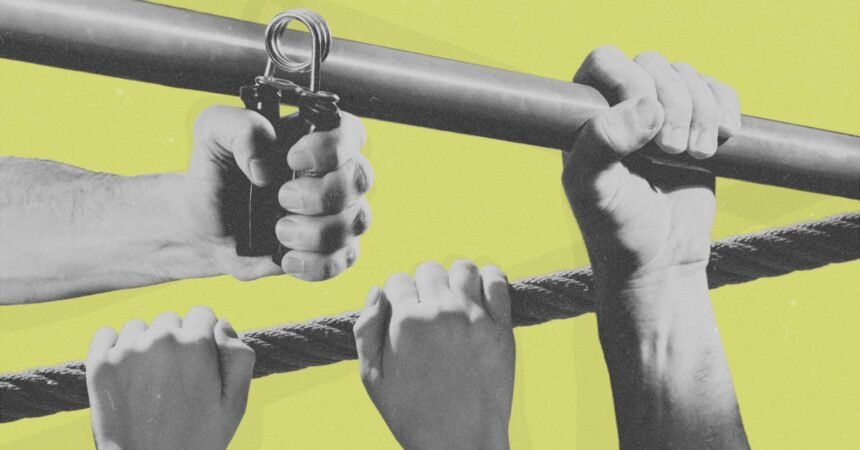
During a Zoom interview, Maury Purnell, 85, hangs in the air, firmly grasping a trapeze bar, answering questions and smiling, no less. He manages it all in a plaid button-up shirt instead of gym clothes.
“Several of my peers are having health issues,” he says. “I’ve been fortunate with all of that in recent years.” Purnell is enjoying unique health for his age, and research shows a clear relationship between what he’s exhibiting right now—impressive grip strength—and longevity. “It’s a strong marker of risk for future clinical outcomes, most notably premature death,” says Dr. Darryl Leong, a cardiologist at McMaster University in Canada.
But that doesn’t necessarily mean you should become obsessed with pumping a squeeze ball daily. Despite Purnell’s display of hand strength on the trapeze, he’s never focused specifically on improving his grip. It’s always been a byproduct.
Here’s why grip is a key indicator of health—and how to keep it strong.
What grip strength tells you
Grip strength is simply the amount of force with which you can squeeze your hand—whether that’s holding a handrail or cracking a walnut between your thumb and forefinger (ouch). A weak grip is associated with physical disability and dying earlier from all kinds of diseases, including heart disease.
It’s a valuable metric mainly because researchers have found it reflects a person’s total strength, not just in their hands, but across the body—and not just how much muscle they have, but how strong they actually are. Body scans don’t reliably show this. As we age, muscle often becomes more fat-laden and less useful, an issue that may not be apparent on scans, says Jennifer Schrack, an epidemiologist and director of the Center on Aging at Johns Hopkins.
Read More: 5 Things You’re Forgetting to Clean (But Really Should)
Muscle strength supports physical activity, which makes people healthier. “We know that physical activity is a significant indicator of cardiovascular health, and muscle strength enables people to be physically active,” Schrack says.
Another reason muscle strength is a key measure: it captures the health of various systems working together. Because it requires ample blood flow, it’s a marker of heart health. Strength also relies on nerve activation, so it demonstrates brain health as well. After a stroke, as people recover the use of their motor neurons, their grip strength improves, Leong notes.
The grip-strength dropoff
Like other markers of physical function and longevity, such as balance, grip typically stays strong into mid-life, then begins to dip in our late 40s or early 50s.
Researchers have identified average grip strength for every age. Staying above average suggests you’re aging well. “The trajectory can inform us about someone’s health and longevity,” Schrack says. “You can’t prevent the decline, but you can slow it down.”
On a device called a dynamometer, the average man younger than 45 can generate about 100 pounds of force. In terms of grip strength, Leong thinks that could roughly translate into carrying a 50-pound suitcase with one hand, though it depends on factors like hand position and suitcase shape. As they age, they lose several pounds every five years (which might mean going from being able to hold a heavy skillet with one hand to needing two hands, say). The picture looks similar for women, except on average they peak at about 65 pounds of force (equivalent to pouring a full kettle of water with one hand, roughly speaking).
Experts agree that low grip strength interferes with daily tasks at or below 35 pounds for women, and 59 pounds for men. However, higher minimums, 44 pounds for women and 78 pounds for men, may better predict poor health.
Read More: A Full-Body MRI Scan Could Save Your Life. Or Ruin It
Fast declines in grip strength could mean you’re not getting enough physical activity. They also warrant getting a doctor’s checkup. “Grip weakness might be downstream of other problems,” Schrack says, like the onset of a chronic illness, or the worsening of one already diagnosed. Schrack found that people maintained more strength when their chronic disease was relatively stable; chronic diseases often cause inflammation, leading to breakdowns in muscle protein and repair.
Such dropoffs can also lead to falls, the leading cause of injury and accidental death in seniors. When people with grip weakness lose their balance, they’re more challenged to grab a handrail or use their hands to break the fall. Plus, “if you have low lean mass, you’re more likely to have poor bone density, increasing the chance of a break,” Schrack says.
How to measure it
Large studies focus on grip strength—rather than other types of strength—mostly because it’s easy to measure. Getting someone to squeeze a dynamometer takes about three seconds, whereas measuring leg strength can take 30 minutes, involving time warming up, multiple muscle groups, and a more expensive measurement system.
To measure grip strength most accurately, researchers use a gadget that costs about $200, but some less-expensive versions also hold up, says Nathan LeBrasseur, director of Mayo Clinic’s Kogod Center on Aging. Squeeze these devices—with digital readouts and adjustable grips—once every few months to see if the numbers change. “The relative measure is most important,” LeBrasseur says. “A couple pounds in one direction doesn’t matter because you’re interested in bigger changes and trends.”
Read More: Are Allergy Shots Worth It?
You could also log your numbers over time for other strength moves like walking up stairs. Just be sure to control for factors like changes in body weight, LeBrasseur explains. Note, too, that because stairs require both strength and balance, they don’t specifically capture strength like grip tests do.
How—and when—to improve it
Recall that grip strength is so important because it represents a person’s overall strength—but overall strength is what’s really key to health, not just having a bone-crushing handshake. So if you can’t open the same jar of pickles that was no sweat five years ago, the answer isn’t to pump a grip strengthener while you binge watch TV.
Rather, the solution is to get plenty of physical activity, including cardio most days and strength training at least twice per week. “We really need an all-around exercise strategy,” Leong says. “Don’t limit yourself to hand squeezes.” Many moves for building strength work your hands in the process. There’s Purnell’s trapeze training, but also pushups, pullups, or just hanging from a pullup bar as long as you can.
If your grip is hardy enough, it’s a gateway to grabbing dumbbells, barbells, and exercise bands for strengthening the rest of your body—and reinforcing your grip. The same principle applies to carrying grocery bags instead of carting them. Use it or lose it. Grip or dip.
Until a few years ago, Purnell was a lifelong tennis player, a great grip and all-around workout. He continues to swim and lift weights. But his trainer, Karon Karter, points to a surprising strategy that’s strengthened his grip: working on posture. His grip gets stronger “as I focus on his postural muscles in the upper-mid back,” in addition to the arms and core, she says. Purnell holds a plank for two minutes. Slouched posture can reduce nerve activity, impairing grip mechanics, especially as we age.
Read More: The Surprising Health Benefits of Swearing
LeBrasseur thinks we should start monitoring grip strength around age 45, due to the declines that tend to happen at this point. “It’s important to be very proactive in this period for healthy aging,” he says.
To preserve as much grip strength as possible, start tracking it and optimizing physical strength in your 20s or younger, Leong says. “It sets the foundation,” he explains. Studies show that good grip strength in childhood tracks to grip strength in adulthood, and regular physical activity in midlife leads to having a firm grip as a senior.
You’ll most likely have to take the initiative with these measures, because physicians currently don’t measure grip strength at check-ups. Schrack thinks this needs to change. “Several things that we know matter when it comes to function, such as grip strength, are not measured by primary care doctors,” she says. “They should be measured in midlife and onwards, as a warning sign.”
Limits of grip strength
Grip strength is just one measure of how well the body is functioning, LeBrasseur notes, and buying a grip strength tester might become yet another fitness gadget that ends up gathering dust. Despite the link between grip strength and more years of healthy life, several interventions aimed at slowing down aging, such as limiting calories and taking metformin and rapamycin, don’t seem to improve grip strength—even though they may boost other important metrics like heart health and gait speed.
It’s possible we just haven’t yet found an aging intervention powerful enough to affect grip strength, LeBrasseur says. Besides exercise, that is.
In the meantime, exercise regularly to see how it strengthens your grip—and don’t wait, Leong says. “If you start thinking about this for the first time in old age, you’ll have quite a bit of catching up to do.”