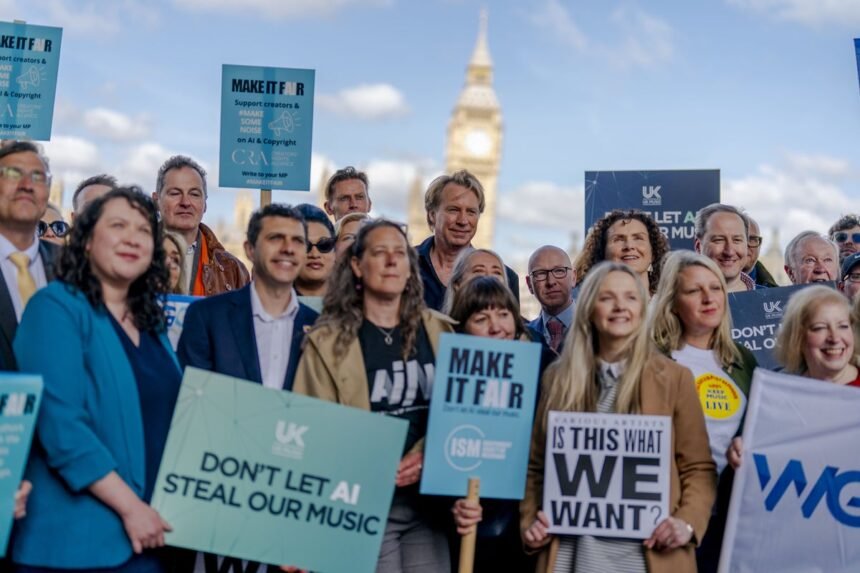
Peers have inflicted a heavy defeat on the Government for the third time over copyright protections for the creative industries against artificial intelligence (AI).
It came as the upper chamber joined artists and musicians, including Sir Elton John and Sir Paul McCartney, in speaking out against AI companies using copyrighted work without permission.
The House of Lords supported by 287 votes to 118, majority 169, an amendment to the Data (Use and Access) Bill, adding a commitment to introduce transparency requirements, aiming to ensure copyright holders are able to see when their work has been used and by who.
Peers backed independent crossbencher Baroness Beeban Kidron’s transparency amendments at report stage of the Bill, which were later voted down by MPs.
The unelected house supported her again during the first round of so-called ping-pong and now again in the second round of ping-pong, with the majority increasing each time.
Among the 287 to vote in favour of her amendment on Monday were 18 Labour peers, including former Labour deputy leader Tom Watson, now known as Lord Watson of Wyre Forest.
The Government has said it will address copyright issues as a whole after the more than 11,500 responses to its consultation on the impact of AI have been reviewed, rather than in what it has branded “piecemeal” legislation.
Lady Kidron, who directed the second film in the Bridget Jones series, rounded on the Government, accusing them of being “turned by the sweet whisperings of Silicon Valley”.
She said: “The Government have got it wrong. They have been turned by the sweet whisperings of Silicon Valley, who have stolen – and continue to steal every day we take no action – the UK’s extraordinary, beautiful and valuable creative output.
“Silicon Valley have persuaded the Government that it is easier for them to redefine theft than make them pay for what they stole.
“If the Government continues on its current intransigent path, we will begin to see the corrosion of our powerful industry, fundamental to country and democracy. It will be a tragedy and it’s entirely avoidable.”
The online safety campaigner explained that her new amendment accepts that the Government’s consultation and report will be the mechanism by which transparency measures will be introduced, and gives the Government free rein on enforcement procedures.
However, it does require the Government to ensure clear, relevant and accessible information be provided to copyright holders so they can identify the use of their copyrighted work, and that legislation to be brought forward within six months of the Government’s report being published, 18 months from the Bill’s passing.
Lady Kidron told peers: “If the Government is not willing to accept a time-limited outcome of its own report, we must ask again if the report is simply a political gesture to push tackling widespread theft of UK copyright into the long grass.
“Because failing to accept a timeline in the real world means starving UK industries of the transparency they need to survive.”
She insisted that UK copyright law as it stands is unenforceable, because “what you can’t see you can’t enforce”, and that without her amendment it will be years before the issue is legislated on, by which time the creative industry will be “in tatters”.
Former BBC children’s TV presenter and Liberal Democrat peer Baroness Floella Benjamin backed the amendment, saying it would “secure our children’s future and not sell them down the river”, assuring them that “their creativity will not be stolen”.
In a nod to Sir Elton’s comments on the issue, former Labour deputy leader and UK Music chairman Lord Watson said: “It’s a little bit funny this feeling inside that I rise to support Baroness Kidron’s amendment today, an amendment that my front bench so clearly opposes.
“But my lords, I’m still standing. I’m still standing because I do not yet believe that ministers have heard the clarion cry from our country’s creators that they need more from this Bill.”
Also backing the amendment was former EastEnders actor and Labour peer Lord Michael Cashman, who recalled character actress Claire Davenport cherishing the royalty cheques she would receive by rubbing them on her “ample bosom” and saying: “Now, I can eat”.
Responding, technology minister Baroness Jones of Whitchurch insisted that transparency “cannot be considered in isolation” and that the issue of copyright is “too important a topic to rush”.
She said: “Alongside transparency, we must also consider licensing, the remuneration of rights holders, and the role of technical solutions and any other number of issues relating to copyright and AI. This is why we consulted on all of these topics.
“We must also keep in mind that any solution adopted by the UK must reflect the global nature of copyright, the creative sector and AI development. We cannot ring-fence the UK away from the rest of the world.”
She added: “This is a policy decision with many moving parts. Jumping the gun on one issue will hamstring us in reaching the best outcome on all the others.”
The minister told peers: “We are all on the same side here. We all want to see a way forward that protects our creative industries while supporting everyone in the UK to develop and benefit from AI.
“This isn’t about Silicon Valley, it’s about finding a solution for the UK creative and AI tech sectors. We have to find a solution that protects both sectors.”
Earlier, peers ended their stand-off on two other amendments, one designed to require public authorities to record sex data based on biological sex, and another to change the definition of scientific research, which critics argued gave AI companies a “powerful exemption” to reuse data without consent.