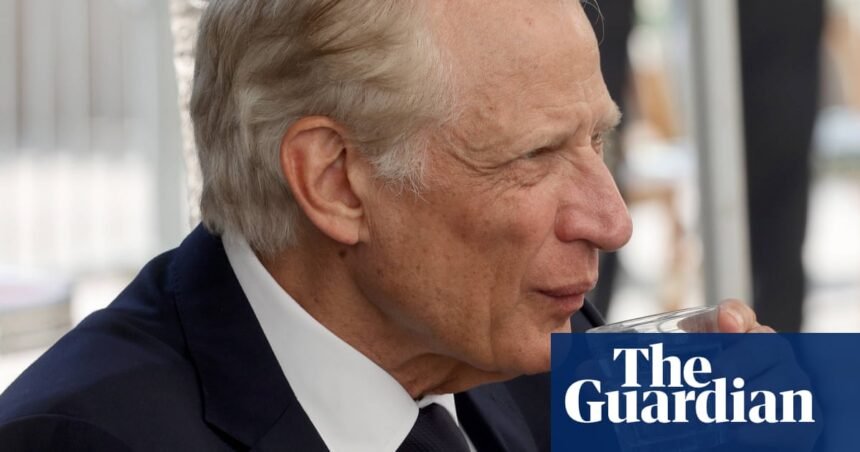
The former French prime minister and foreign policy chief Dominique de Villepin has launched a political party called Humanist France, with a view to a possible bid for the French presidency in 2027.
De Villepin, who was prime minister under the rightwing president Jacques Chirac from 2005 to 2007, is best known for his dramatic speech to the United Nations in 2003, setting out France’s opposition to a US-led Iraq war and warning of the “incalculable consequences” of military action in the region.
Despite leaving French politics over a decade ago, de Villepin has enjoyed a significant increase in popularity after recent media appearances criticising Israel’s war in Gaza. He has said the west is “closing its eyes” to what he called a scandalous “spiral of violence” and rising civilian deaths.
Recent polls showed de Villepin’s stance on the Middle East crisis has made him the most popular politician in France – and that he is particularly liked by leftwing voters, despite having led a rightwing government.
De Villepin, 71, told Le Parisien on Tuesday that too many parties in France were “tempted by populism, one-upmanship and stigmatisation” and France needed to move away from the identity politics polarising the country. He said his party, La France humaniste, was free to join and open to anyone from any political stance. It was a movement aimed at bringing together citizens and coming up with ideas, he said.
Asked about running in the 2027 presidential election, de Villepin said it was not the moment to “enter the presidential debate”. But he left the way open for consideration of a possible bid.
De Villepin told France Inter radio on Tuesday that the world was becoming a more dangerous place “because we’re now in a world without rules, without international law, where the law of the jungle, the law of the strongest prevails”.
A gaullist who historically positioned himself on the centre-right, de Villepin’s term as prime minister under Chirac was marred by the biggest street protests in decades, which forced him to scrap a controversial youth employment law.
Christelle Craplet, director of opinion at BVA pollsters, said de Villepin’s high popularity was not the same as a firm intention to vote for him. She said his popularity was greatest not among his traditional centre-right, but among supporters of Jean-Luc Mélenchon’s leftwing party, La France Insoumise, for whom Gaza was a key issue.
A recent BVA poll asking French voters a more specific question on who they would like to have an influence on French politics in the future, found de Villepin came relatively low down, in 17th position, far behind the far-right’s Jordan Bardella and Marine Le Pen, and the centre-right former prime minister, Édouard Philippe.
Craplet said: “Dominique de Villepin made an impression 20 years ago with his refusal of the Iraq war, and today his strong position on Gaza is also making an impression. He is popular because he has a strong voice on the Middle East conflict and part of the French electorate feel not enough is being said about Gaza. This is particularly true among those who sympathise with La France Insoumise.”
She said: “But I think that if tomorrow de Villepin had to set out his position on domestic French politics – the economy and social measures – support from left voters wouldn’t last. So I think it’s very paradoxical, and today it seems to me like a bit of a bubble.”
The 2027 French presidential race remains open. Emmanuel Macron, who has served two successive terms, cannot run again and it is uncertain who will represent his centrist party. The far-right leader Marine Le Pen was this year banned from running for public office after she was found guilty of embezzlement of European parliament funds. She is waiting for an appeals trial next year to see if she could run, or would be replaced by Jordan Bardella.