


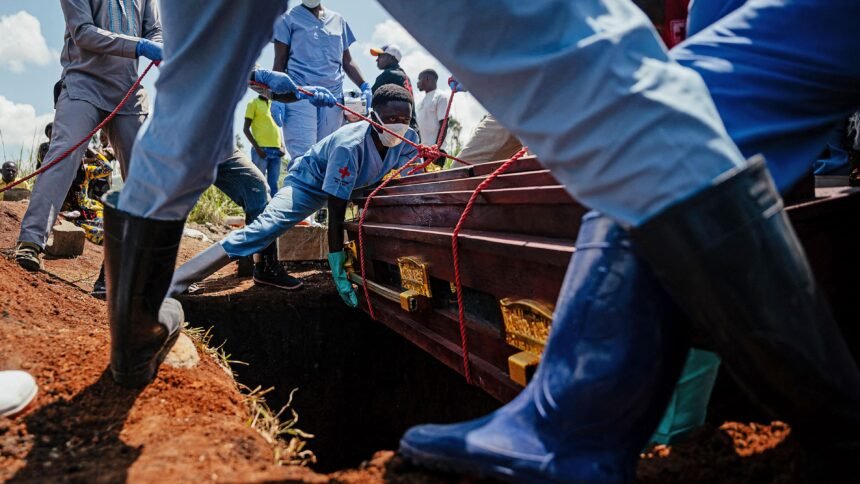
A woman had died. She had traveled from Mongbwalu, in the Democratic Republic of Congo, to neighboring Uganda, where she fell ill and rapidly declined. Her body was transported back to Mongbwalu, but during the journey, the casket cracked. So mourners moved her body into a new one, burning the broken one.
Ten days later, everyone who had helped with the coffin transfer also became sick and died. “They said it was witchcraft,” says Dr. Marie Roseline Belizaire, the World Health Organization (WHO)’s emergency director for Africa. Locals told her the story when she arrived in Mongbwalu to help with the WHO’s Ebola response. “They told me that they saw the casket flying, and that the casket came back to pick up all those who burned it.”
Battling an invisible virus is always challenging, but it’s far more difficult when rumors, misinformation, and spiritual beliefs in an affected region conflict with public-health practices. Mongbwalu, where the first cases in the Ebola outbreak raging through Congo and Uganda are believed to have emerged undetected, is a remote mining town in Ituri province that attracts migrant workers. Some of the symptoms of Ebola—fever, headaches, and body aches—can also be caused by exposure to the processes involved in the search for minerals. Malaria and tuberculosis, which can cause fever and bloody coughs, are prevalent in the area too. “So Ebola was the last thing to come into their mind,” Belizaire says. The region’s natural resources also make it a target for political instability, corruption, and violent conflict, which all create fertile ground for infectious diseases.

This Ebola outbreak likely started when an unsuspecting person encountered the virus, possibly by handling or eating the meat of wild animals. While Ebola has struck the continent before, most notably in 2014, health authorities are concerned about the speed with which cases are mounting. With more than 1,400 cases and 400 deaths recorded by early July, this outbreak, which was declared in May, is now the second largest on record. The U.S. Centers for Disease Control and Prevention (CDC) has raised its response to the highest level, reflecting the escalating urgency of the situation. “We have never seen an epidemic increase as fast as this one,” says Dr. Alan Gonzalez, deputy director of operations at Médecins Sans Frontières (Doctors Without Borders). “This is massive.”
It’s impossible to stop viruses like Ebola from finding human hosts and causing disease. But it is possible to contain them quickly, and global health experts are alarmed by the world’s worsening ability to do that. Our systems for responding to and confronting viruses are increasingly fractured and weakened, making everyone more vulnerable. In many important ways, the world is less prepared now than it was even a few years ago to address microbial threats.
“The current epidemic in the D.R.C. is a stress test that, as of now, the world is failing,” says Dr. Tom Frieden, who led the CDC during the 2014 Ebola outbreak and who is now CEO of the nonprofit Resolve to Save Lives.
Drastic cuts to global health and pandemic-preparedness budgets are giving viruses like Ebola the opportunities they need to spread. The U.S.’s role also looks markedly different than it did before President Donald Trump’s second term. Traditionally the largest supporter of global health security, both financially and through its scientific expertise, the U.S. is no longer a member of the WHO, which monitors pathogens and coordinates responses to emergency threats. The withdrawal led to 3,000 job cuts at the WHO and a retreat from some of the agency’s activities, including disease surveillance and response. It’s part of the U.S.’s shift toward an “America First” foreign aid strategy that favors more deals with individual nations for health funds—in exchange for data or mineral rights, for example. That transactional approach to aid is already weakening global health security, experts say.

Humankind has managed to survive past outbreaks, and it likely will overcome this one too. But in this game of microbial roulette, each encounter with a virus or pathogen heightens the risk that we won’t. “Every time [a virus] pops up, it has evolved along lines that are more and more concerning,” says Pardis Sabeti, a computational geneticist at the Broad Institute of MIT and Harvard who sequenced some of the first samples of Ebola from the 2014 outbreak. “Why do we let them pop up, see that it’s gotten worse, but when cases stop, we stop worrying? The next time it pops up, it might not be OK.”
We have at our disposal, she says, deeper knowledge about the genetic makeup of viruses, how they work, and how to confront them with antiviral treatments and vaccines. So why does each successive onslaught from the microbial world—as we recently saw with COVID—seem to get worse?
“We keep toggling between panic and denial when these events happen,” says Dr. Raj Panjabi, senior partner at Flagship Pioneering and former lead health-security official at the White House. “We don’t build our reflexes in between.”
We’ve seen this war between man and microbe before. The world had never encountered an Ebola crisis like the one that started in 2014, when the virus ravaged West Africa, eventually killing more than 11,000 people. Even with different political leaders in charge at the time, the disease spread undetected for far too long—as it did this year—and eventually became the largest Ebola outbreak ever recorded. Misinformation and distrust of public-health providers was pervasive then too. But as we face another outbreak, there are key differences—both in the virus and in the ways the U.S. and the world are responding to it.
For all of its destruction, the 2014 outbreak triggered scientific innovation; companies developed therapeutics, tests, and vaccines for that Ebola strain, called Zaire. Countries, including the U.S., and groups like the WHO stood up surveillance and laboratory systems to be better prepared for the next inevitable encounter. But there are multiple Ebola strains, and those vaccines, treatments, and tests aren’t effective against the rarer strain, Bundibugyo, sickening people today. Changes in U.S. policies under the Trump Administration have also compromised, and in some cases dismantled, some of the gains made.
Deep budget and personnel cuts, as well as attacks on vaccines, have hobbled health agencies, and there has been a Senate-confirmed CDC director for only 29 days of Trump’s second term. That office remains vacant. Until May, Bloomberg reported, so had the lead of the White House Office of Pandemic Preparedness and Response, which Congress established with bipartisan support in 2023 after COVID to launch a more coordinated response to global health threats.
The U.S. used to be part of a network of community workers, foreign aid groups, and government channels that make up the critical defense system against viral threats. That meant “you’re hearing updates on the programs, you’re hearing scuttlebutt about what’s going on in the area,” says Jeremy Konyndyk, who led the USAID office of foreign-disaster assistance during the 2014 outbreak and who is now president of Refugees International. It’s often how we’d detect the first signs of an emerging infectious disease. “If there were still a robust USAID portfolio of programs running in eastern Congo, someone would have noticed something,” he says.

But now, “the U.S. is flying blind to these things,” says Dr. Ashish Jha, who coordinated the COVID response in the Biden Administration and now leads the AI disease-surveillance company BioRadar. The Trump Administration’s decision to defund USAID in 2025 abruptly shuttered its programs and broke many of those chains of communication.
Ebola moved silently for weeks, and possibly months, before the first patient was reported: a nurse who came to the hospital in Bunia, Congo, with fever, vomiting, and bleeding on April 24. Local labs didn’t have the necessary equipment to test her sample, so it was sent to the capital in Kinshasa, which took days. In the meantime, she and other people with Ebola had been mingling in the community; some crossed the border into Uganda. It took another week or so for the WHO to receive reports of more cases, when it then declared the outbreak a public-health emergency of international concern.
The region’s skeletal health ecosystem was no match for fast-moving Ebola. It spreads by direct contact with body fluids: saliva, blood, vomit, urine, feces. The bodies of the recently deceased are especially contagious, as they often contain the highest levels of the virus. But burial and mourning practices in Congo are built around touching and handling departed loved ones during the funeral. Health care workers who impede these rituals for infection-control reasons often face hostility and violence; clinics have been attacked and burned down during this outbreak, furthering viral spread.
The best defense against such resistance came from a lesson learned during the 2014 Ebola crisis: the importance of engaging with trusted local leaders to inform communities about the virus. Without them, misinformation and conspiracies flourish. In Congo’s 2018 Ebola outbreak, the humanitarian group Mercy Corps worked with local governments to train leaders and Ebola survivors how to talk to their community about the risks of Ebola and the benefits of cooperating with health care workers. But because of instability in the area and shrinking funding, those trained community members are now gone. “I was asking one of the health doctors, ‘Where are those community leaders that we trained? Where are they?’” says Onesphore Bangenza, Mercy Corps’ Ebola response team leader. “They were supposed to be here; they have the trust of the community.” Now, he says, local health authorities have to start from scratch.
They are battling not only the loss of trained allies but also confusion about the Bundibugyo strain now circulating, and why people vaccinated in previous outbreaks are not protected. “I explain to them that Ebola has six sons and daughters,” says Belizaire. “And for the first child, we have a vaccine. But for the other children, we don’t.”
The U.S.’s commitment to global health typically begins with Congress, which has historically allocated funding to nongovernmental groups that tackle everything from HIV to maternal health and childhood vaccination programs. In 2025, Congress designated $2 billion to health programs, including $650 million for global health security: maintaining surveillance programs for infectious-disease threats and responding to outbreaks. But that $2 billion has not yet been formally released, and Administration officials at the State Department and the Office of Management and Budget have said the government was holding that funding for closing down USAID programs. “All of the money that relates to global health security threats like Ebola has come back to the State Department, and we are programming it,” a senior department official told TIME.

More broadly, the Administration’s plans to reframe foreign aid to focus more on bilateral agreements made directly with countries is centered on the principle that “foreign aid is not charity,” says the senior department official. “It’s a strategic tool for dealing directly with governments.” While the agreements themselves are strictly related to health, the official said, the Administration takes strategic benefits and security alliances into account during negotiations. In June, Secretary of State Marco Rubio testified before Congress that when it comes to doling out foreign aid, including global health funds, “we are going to reward those that are good to the United States; we’re not going to be as friendly to places that are not furthering our national interests.”
“At both the macro and micro level, we are seeing changes that we haven’t seen in 25 years,” says Vincent Lin, associate director of health policy and advocacy at the global nonprofit Partners in Health. “It’s a total reset of the system, and not something Congress agreed to or approved.”
The U.S. is contributing to the Ebola response, but not in the ways that would have once been expected. In briefings, the CDC’s incident manager for the Ebola response, Dr. Satish Pillai, said the CDC now has more than 400 personnel involved in the Ebola response, both in the U.S. and overseas, and has sent supplies like personal protective and lab testing equipment. The U.S. has also provided $270 million directly to combatting the outbreak, according to the State Department, including an additional $350 million for the outbreak and other humanitarian needs in Congo, Uganda, and South Sudan, and $50 million more to develop new treatments and vaccines. By comparison, in the 2014 outbreak, the U.S. provided nearly $2 billion in financial support, drawn from a package of $5.4 billion in emergency global health funding appropriated by Congress.
During his appearance before Congress, Rubio did commit to releasing $661 million in matched funding from other donors to the Global Fund to Fight AIDS, TB and Malaria “very quickly”—and said savings from closing USAID and addressing inefficiencies in foreign aid programs would be directed toward programs such as expanding access to a recently approved twice-a-year HIV-prevention medication.
Health leaders say the traditional financial support is not the only thing missing from this response. “The biggest deficit I feel is a loss of partnership with one of our most reliable technical partners in the world, the U.S. CDC,” says Dr. Chikwe Ihekweazu, executive director of the WHO Health Emergencies Program, who is deployed in Bunia. Recently, “we had a big partnerships meeting—we had the local and national public-health agency, the Africa CDC, but the missing partner in the room was the U.S. CDC.”
American health care workers who travel to support the outbreak response may also be more at risk now than in the past. The Trump Administration announced a controversial plan to build an Ebola quarantine and treatment center in Kenya, which currently has no confirmed Ebola cases, on an air base to manage Americans who might have been exposed to the virus. Dr. Craig Spencer, who contracted Ebola in 2014 after volunteering in West Africa with Médecins Sans Frontières, doubts whether such a makeshift facility will provide the same quality of care as established specialized centers in the U.S. He was evacuated to Bellevue Hospital in New York, where he received care that saved his life. “The U.S. military will famously put in incredible amounts of resources to rescue a helicopter or plane pilot who is down in Iran, and the tagline is ‘No man left behind,’” he says. “But when it comes to Ebola, our willingness to even consider allowing someone back into the country apparently ends.” The center was scheduled to open in late May but was blocked by a Kenyan high court after locals protested.

Being ready for Bundibugyo and other neglected viral strains requires investing in “what if” scenarios. “There are a dozen or so viruses out there that we know can cause really serious illnesses in humans,” Jha says. “We should be looking at all of the strains of all of those viruses and building vaccines and therapeutics against them now.” The WHO is currently taking this approach by concentrating its efforts on a few major viral families that are most likely to erupt.
The U.S. donated doses of an experimental antibody treatment for Bundibugyo that the first patients in a trial received in early July. But a Bundibugyo vaccine is needed to control the outbreak, and one that appears to work in animals already exists, says Teresa Lambe, head of vaccine immunology at Oxford University, who helped make it and one of the first shots for COVID. “When we started this work, we started it at risk, relying on the fact that I had a very generous philanthropic donation.” But those funds dried up; the barrier to creating the vaccine wasn’t scientific, but financial.
Several weeks after the WHO sounded the alarm on Ebola, the money to continue those studies finally emerged from the philanthropic and intergovernmental group CEPI, which supports vaccine development against global health threats. At the end of May, CEPI announced an investment of nearly $62 million to develop three Bundibugyo vaccines, including the Oxford candidate.
Lambe is now working with the Serum Institute of India to finish testing the experimental vaccine in ferrets and hopes to have doses ready to test in people in Congo this summer. Moderna, which partnered with CEPI to develop the first mRNA COVID vaccine, also received CEPI funding to develop an mRNA vaccine—which has the advantage of speed, as shown during COVID—against Bundibugyo. The final candidate, from IAVI, may take the longest to develop, around seven to nine months.
These time lags are measured in lives lost and more chances for the virus to find new hosts and spread—out of one country and into another, from one continent to another. In terms of money and lives, “building health systems is much cheaper than mounting an emergency response,” says Sheila Davis, CEO at Partners in Health.
Meanwhile, while attending to the new outbreak, experts also are working to make sure new treatments and vaccines become available for whatever comes next. “We are working with a no-regrets policy,” says Ihekweazu of the WHO.
He and other global health leaders agree on one thing: we have the tools and knowledge to confront and contain viruses like Ebola before they become epidemics or pandemics. But we lack the consolidated commitment to invest in the resources and workforce needed to use those tools and knowledge effectively. “We need to set up systems so the world isn’t scrambling, as if it’s never happened before, every time there is another emergency,” says Frieden. “This is not rocket science. We know what to do. But it does take dedicated resources and money.”


