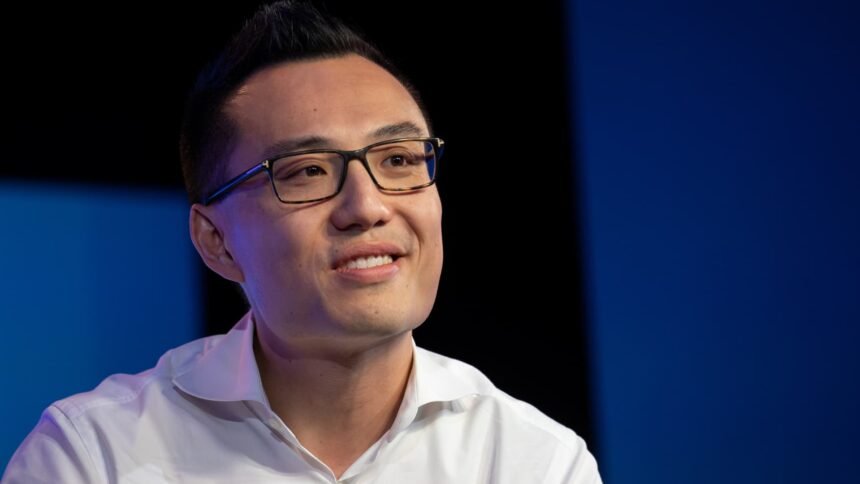
Tony Xu, co-founder and CEO of DoorDash Inc., smiles during the Wall Street Journal Tech Live conference in Laguna Beach, California, on Oct. 22, 2019.
Martina Albertazzi | Bloomberg | Getty Images
During the depths of the Covid pandemic, with restaurants around the country facing an existential crisis, DoorDash CEO Tony Xu had an unconventional proposal. He wanted to cut commissions.
Chief Business Officer Keith Yandell worried that such a move would result in a massive hit to profits ahead of the company’s planned IPO. But Xu made a persuasive case.
“If restaurants don’t thrive, we cannot,” Yandell told CNBC in a recent interview, recalling Xu’s perspective at the time. “We need to take a leadership position.”
The company ended up sacrificing over $100 million in fees, Xu later said.
Since starting DoorDash on the campus of Stanford University in 2013, the now 40-year-old CEO has navigated the notoriously cutthroat and low-margin business of food delivery, building a company that Wall Street today values at close to $90 billion. The stock has emerged as a tech darling this year, jumping 23%, while the Nasdaq is still down for the year largely on tariff concerns.
More than four years after its IPO, net profits remain slim. But that’s not getting in the way of Xu’s mission to become an industry consolidator, using a combination of cash and new debt to fuel an acquisition spree at a time when big tech deals remain scarce. Earlier this month, DoorDash scooped up British food delivery startup Deliveroo for about $3.9 billion and restaurant technology company SevenRooms for $1.2 billion.
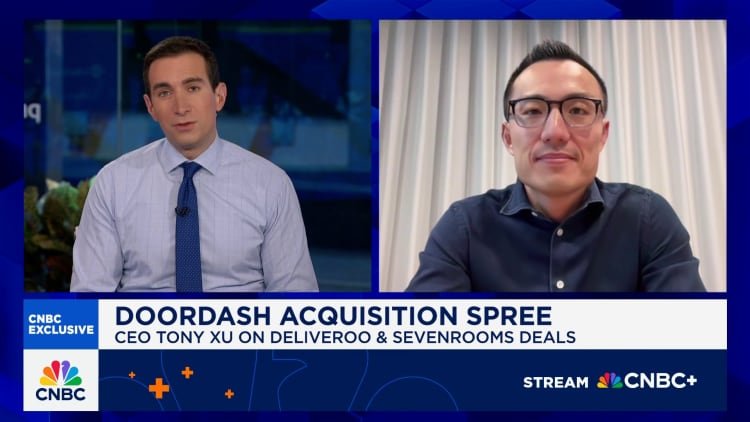
“What we’ve delivered for a customer yesterday probably isn’t good enough for what we will deliver for them today,” Xu told CNBC’s “Squawk Box” after the deals were announced.
This week DoorDash announced the pricing of $2.5 billion in convertible debt, and said the proceeds could be used in part for acquisitions.
Doordash food delivery service in New York City on Feb. 13, 2025.
Danielle DeVries | CNBC
The San Francisco-based company has a history with scooping up competitors to grow market share. In 2019, it bought food delivery competitor Caviar for $410 million from Square, now known as Block. About two years later, DoorDash said it was paying $8.1 billion for international delivery platform Wolt. The deal was its last big transaction until this month.
When DoorDash entered the food delivery market, it had to face off against the likes of GrubHub and Seamless, which later joined forces. That combined entity was bought late last year by restaurant owner Wonder Group. In 2014, Uber launched Uber Eats, which is now DoorDash’s biggest competitor in the U.S.
“It’s a very competitive market, and I think merchants do have choice,” Xu said in the CNBC interview. “What we’re focused on is always trying to innovate and bring new products to match increasing standards and expectations from customers.”
DoorDash didn’t make Xu available for an interview for this story, but provided a statement about the company’s acquisition strategy.
“We’re very picky, very patient, and conscious that, for most companies, deals don’t work out in hindsight,” the company said. “When we see an opportunity that brings value to customers, expands our potential to empower local economies around the world, and has a path to strong long-term returns on capital, we tend to push our chips in.”
Taking on the suburbs
DoorDash differentiated itself early on by cornering suburban markets that had fewer delivery options, while other players attacked city centers. When Covid shut down restaurant dining in early 2020, DoorDash capitalized on the booming demand for deliveries. Revenue more than tripled that year, and grew 69% in 2021.
Colleagues and early investors credit a customer-first focus for much of Xu’s success. Gokul Rajaram, who joined DoorDash through its Caviar acquisition, described Xu as “the best operational leader in the U.S.” after Amazon founder Jeff Bezos.
Restaurants haven’t universally viewed DoorDash as an ally. Commissions can reach as high as 30%, which is a hefty cut to fork over. Many restaurants have reluctantly paid the high fees because of DoorDash’s dominant market share, which reached an estimated 67%. In 2021, the company introduced three tiers of pricing, with a basic option at 15% for more price-sensitive businesses.
DoorDash needs the high fees in order to stay in the black. The company’s contribution profit as a percentage of total marketplace volume hovers below 5%.
Colleagues who have known Xu for decades say the food delivery entrepreneur hasn’t changed much since the early days of the company.
Yandell said Xu once took advice from his young daughter, who complained about a routing issue while accompanying him on food delivery orders. All employees, including Xu, are required to complete orders and handle support calls every year as part of the company’s WeDash program.
In a part of the country known for the pomp of its wealthy founders, Xu has a very different reputation.
Early workers recall memories of Xu pulling up in a dilapidated green 2001 Honda Accord to team events, or participating in company knockout basketball games referred to as “knockys,” next to the animal hospital in Palo Alto, which DoorDash briefly called its headquarters. Xu also personally approved every offer for the company’s first 4,000 employees.
Xu spends many mornings answering customer service complaints. He often drops his kids off at school and, after tucking them in at night, hops on calls with international regions, colleagues say. Xu is an avid Gold State Warriors basketball fan but has a soft spot for the Chicago Bulls, having spent many years in Illinois. Once or twice a week, Xu squeezes in a morning run, and will often do so while traveling to explore different neighborhoods and stores.
Xu was born in China and moved with his family to Champaign, Illinois, in 1989. Growing up, he played basketball and mowed lawns to save up for a Nintendo. He told Stanford’s View From the Top podcast in 2021 that the experience, and watching his parents hustle, taught him how to “earn your way into better things.”
His “characteristics became the company’s values,” said Alfred Lin, an early DoorDash investor and partner at venture firm Sequoia.
Xu often attributes his entrepreneurial spirit to his parents. His mother worked as a doctor in China, and juggled three jobs in the U.S. for over a decade, saving up enough to eventually open a medical clinic. His father worked as a waiter while pursuing a Ph.D. Xu said on the podcast that watching his mom gave him a deep understanding of what it takes to run a small business, which came in handy in DoorDash’s early years as he was trying to convert restaurants into customers.
‘Ten times harder’
Employees say Xu has a reputation for detecting hidden talents among his colleagues. Jessica Lachs, the company’s chief analytics officer, was working as a general manager assisting with DoorDash’s Los Angeles launch when Xu guided her toward her passion for data.
“He believes in leaning into the things you’re really good at, rather than trying to be mediocre at a lot of things,” she said.
After Toby Espinosa, DoorDash’s ads vice president, lost a deal with a major fast food company during his early years at the startup, Xu told him to work “10 times harder” and become an expert in his field. A few years later, the company secured the partnership, Espinosa said.
Grit and struggle defined the early years of DoorDash. The founding team of four managed deliveries around Stanford and Palo Alto though a Google Voice number directed to their cellphones.
DoorDash emerged out of a Stanford business school course known as Startup Garage, taught by Professor Stefanos Zenios. The class requires students to present a business idea, test it, and then pitch it to investors.
Zenios said Xu stood out with his data-driven approach and natural leadership qualities. The team tested two different ideas, including a platform that helped small businesses better track the effectiveness of their marketing, he recalls. Zenios called the idea to target suburban areas a “brilliant insight.”
Xu and his team entered Y Combinator in the summer of 2013. The three-month startup accelerator program is known for spawning companies like Airbnb, Stripe and Reddit. Every session culminates with a demo day in front of some of Silicon Valley’s biggest investors.
The DoorDash idea excited Paul Buchheit, creator of Gmail and a partner at Y Combinator. But like many other potential investors, Buchheit was skeptical about the economic model.
“You had a talented team of founders working on what I thought was an idea that had potential,” he said. “That’s basically the formula for a good startup.”
On pitch day, the company failed to lure any venture firms, but Buchheit later participated as a seed investor.
Shortly after demo day, DoorDash encountered Saar Gur of Charles River Ventures. Gur had been looking for a food delivery platform to back and was conducting due diligence on another company when a friend led him to DoorDash.
By the end of their first meeting, they were “finishing each other’s sentences,” Gur said.
Sequoia’s Lin initially passed on DoorDash after the Y Combinator pitch, but kept in touch with the team. Lin said he wanted to see data that showed the platform could penetrate beyond Stanford and Palo Alto, and retain customers. He ended up leading two institutional rounds, attaining a 20% stake for Sequoia at the time of the IPO.
“Tony always believed that his company would succeed, or they’ll find a way to succeed,” Lin said.
A food delivery messenger is seen in Manhattan.
Luiz C. Ribeiro | New York Daily News | Tribune News Service | Getty Images
Shortly after its Y Combinator stint, DoorDash hit an early roadblock. Following a Stanford football game, a rush of orders bombarded its delivery system causing massive delays, Xu told Y Combinator’s CEO Garry Tan in an interview this year.
The founders refunded the orders and spent the night baking cookies, then driving them to customers early the next morning.
Oren’s Hummus co-owner Mistie Boulton said DoorDash still takes that approach. The team comes to meet with her every quarter and she serves as a beta tester for new products.
The restaurant, which started in Palo Alto and has since expanded to a half-dozen locations across the Bay Area, was one of DoorDash’s first clients, latching onto the opportunity to reach more customers beyond its small establishment that frequently had lines snaking out the door.
“We just fell in love with the idea,” Boulton said. “The number one thing that encouraged and enticed me to want to work with them was Xu’s passion. He really is one of those people that you can count on.”
Wall Street is now counting on Xu’s ability to execute big deals, even with the company having this month surpassed 10 billion delivery orders worldwide.
The acquisition of Deliveroo, based in London, marks a renewed effort by DoorDash to expand its presence overseas, following the purchase of Finland’s Wolt three years ago.
The cash deal for SevenRooms, a New York City-based data platform for restaurants and hotels to manage booking information, takes DoorDash into an entirely new category. Xu told CNBC that DoorDash is a “multi-product company now that’s operating on a global scale.”
Following the acquisition announcements, which coincided with a disappointing earnings report in March, analysts at Piper Sandler reiterated their hold recommendation on the stock.
One reason for concern, they said, was that “integrating multiple acquisitions at once may create some noise near-term.”
Correction: A prior version of this story had an incorrect figure for total delivery orders.
WATCH: DoorDash CEO Tony Xu: Deliveroo & SevenRooms deals make us a multi-product company on a global scale