
Disclosure Day may not be Steven Spielberg’s greatest film: Who would ever dare to choose? But it’s the greatest film he could have possibly made in this moment, at a time when humans worldwide are feeling bewildered and blindsided by a new order in which compassion, creativity, and respect for the natural world have become traits to be crushed, not nurtured. Disclosure Day is majestic, unnerving, and more than little wacky, though its pure unhinged quality is probably its secret sauce. Spielberg is one of our most imaginative directors, but he’s also one of our most sensible. With Disclosure Day—which proposes that aliens, wherever they are, have much to teach us—he’s gone off his rocker a little bit, and magnificently so. It’s one thing to realize we’re not alone in the universe; it’s another to suddenly feel that we’re not alone in this world, and that’s the reassurance Spielberg gives us with Disclosure Day, in a not-so-secret code.
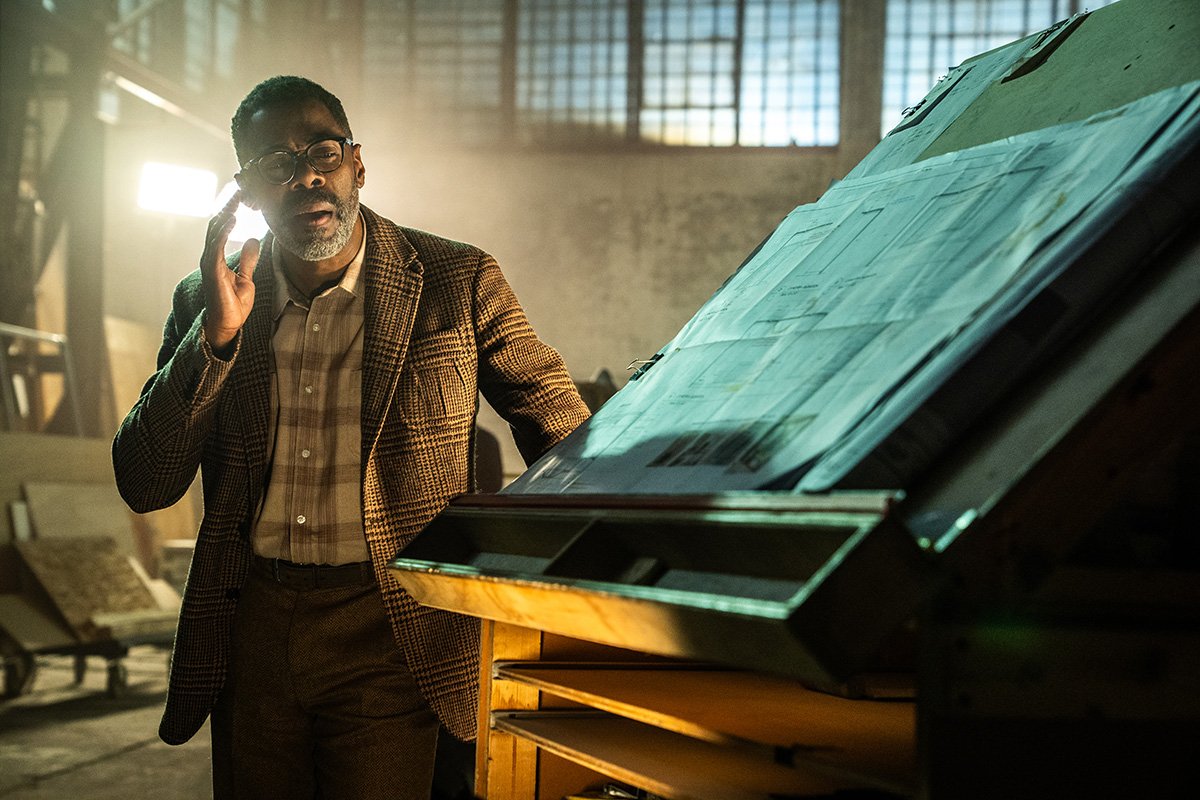
Written by David Koepp, Spielberg’s most frequent collaborator, from a story conceived by Spielberg, Disclosure Day zips two stories together like strands of DNA. Daniel Kellner (Josh O’Connor) is a government cybersecurity expert gone rogue. For decades the organization he used to work for, an evil racket known as Wardex, has been hiding important information regarding the existence of extraterrestrial life. Daniel has decided it’s time for the citizens of Earth to know the truth, but his possession of top-secret data has made him a target of Wardex’s top creep Noah Scanlon (Colin Firth). One of Daniel’s few allies is Hugo Wakefield (Colman Domingo), another Wardex renegade, one who practically beams with benevolence—this is a face you can trust. Daniel also has a new girlfriend, Jane (Eve Hewson), and the secret knowledge he’s hoarding has endangered her as well. But she too is withholding a truth: She’s a former nun who hasn’t yet apprised her recently acquired beau of her past.
If your head isn’t spinning yet—why not? And we haven’t even gotten to Emily Blunt’s Margaret Fairchild, a sunny Kansas City weathergirl whose specialty is a shivery shimmy of excitement whenever she has the pleasure of announcing novel upcoming weather, like a hailstorm. Her seemingly supportive live-in boyfriend, Jackson (Wyatt Russell), loves her when she’s adorable and manageable; he’s less than enamored when suddenly, at the breakfast table in their enviable loft, a raft of information begins flowing from her lips in fluent Russian, a language she absolutely does not speak. This is just after a cardinal has flown in through the window and greeted her with a friendly wink—though perhaps this emissary from the world of nature, or elsewhere, has also unlocked a superpower she’s forgotten she had.
But the film’s most chilling, most arresting moment is yet to come: On air, at work, Margaret is reeling through her usual cheerful weather patter when she stops short, as if stricken by a seizure, and begins speaking in a language of tongue clicks and glottal, metallic clacks—then she faints. Something strange is happening to Margaret—an MRI reveals nothing out of whack—he’s bewildered and terrified.
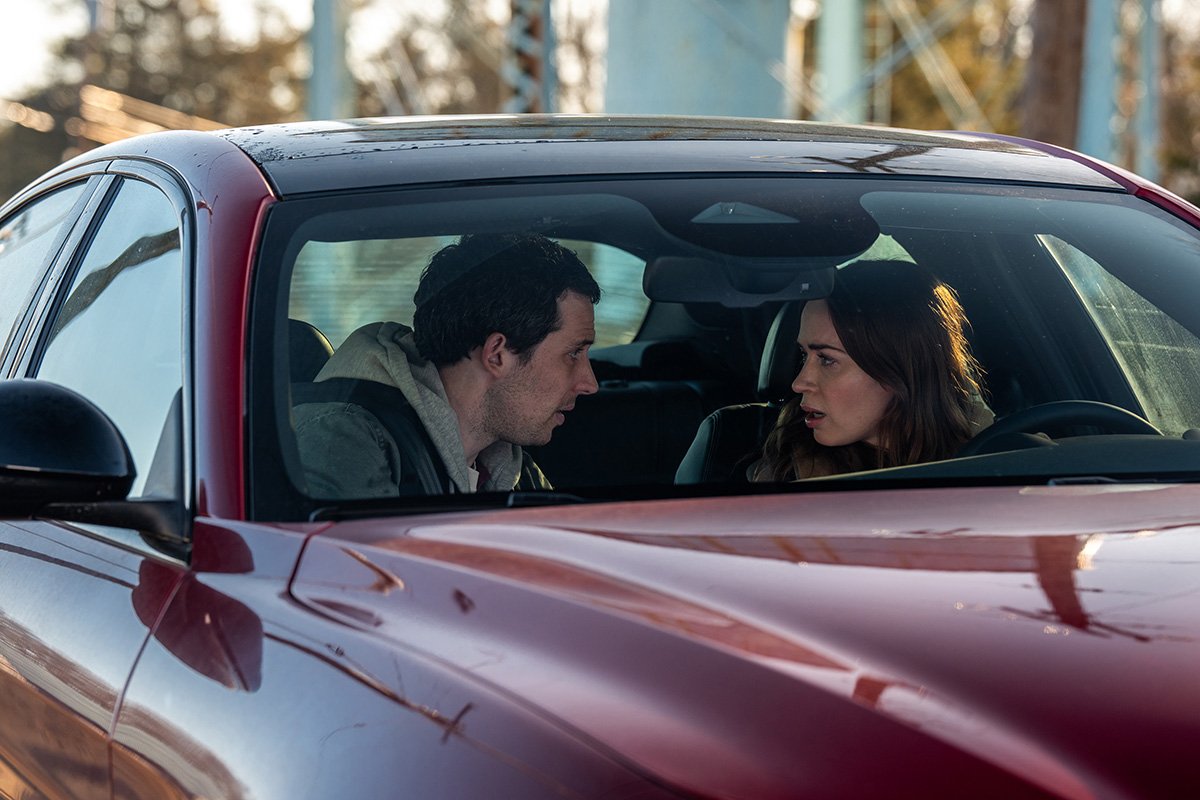
It becomes clear that Margaret and Daniel are somehow connected, a mystery that’s key to the ending of Disclosure Day. In getting to that ending, Spielberg summons his formidable powers to weave a story full of what is at times almost unbearable suspense; he speaks to our capacity for delight but also to our fears of the unknown. (I’m sure that Margaret’s weird clicking language will at some point show up, unbidden, in my dreams.) Spielberg has spent time thinking about telepathy and mind control, about Catholic and other strains of religious mysticism, about the ways our capacity for cruelty sometimes overrides our impulse toward generosity. This is a movie filled with ideas, but not at the expense of joy; there’s deep pleasure to be had in the filmmaking itself. This is Spielberg at the peak of his craft: His action sequences—including a stellar, terrifying one in which a car is dragged along by a speeding train—are shot and edited with the kind of visual clarity that most younger filmmakers have never bothered to master.
Yet Spielberg’s world is still largely one of wonder and curiosity. There are forest animals who insist on pushing into our backyards, reminding us that no matter how smart we think we’ve gotten, nature will always have its way. Disclosure Day gives us a child’s-eye view of Americana that would seem sentimental if it weren’t so alluring: There’s the beckoning quality of a roadside motel with a corny, perhaps not wholly defensible Native American-inspired name; the great promise of fire engines, which, with their ability to weave through lanes of traffic unimpeded, can always be relied upon to come to the rescue; the way crayons jumbled in a bowl conjure a synesthesia so potent we can actually smell their colors. All of these wonders, big and small, stem from Spielberg’s belief that we must have faith in things that we can’t see, whether it’s God or kindly aliens or merely the secrets of science that have not yet been revealed to us. How can we even presume to believe we’re alone in the universe? The movie Spielberg has made is simultaneously grand and humbling.
You can’t pull off this sort of thing without superb actors, and Spielberg has chosen from the best. O’Connor, as a man perplexed and burdened by a mathematical gift he doesn’t understand, almost vibrates with vulnerability: it’s as if he were receiving the secrets of the cosmos from his near-translucent pitcher ears. And Blunt, as his counterpart, a woman who’s been chosen for a role she at first does not want, is sensational. Margaret has discovered she has a gift that goes even beyond empathy; she can look at a person and, for just a moment, reflect that person’s soul. It’s a gift that fills her with anguish, and there are moments when she enters an almost trancelike state, her brain spinning with perceptions she can’t control or avoid. In these moments, Blunt seems to have entered a zone akin to the steady momentum of a gyroscope, a kind of spiritual whirring that has to find its own natural stopping point. This is an exhilarating, unsettling performance, one that seems keyed more to the music of the spheres than to anything you’d call technique.
But then, even though Disclosure Day absolutely qualifies as a big Hollywood entertainment, conventional on its surface, it still follows few established rules. Spielberg’s belief in the benevolence of aliens is one of his most touching traits, one you may not share if, as a schoolkid, you spent too many hours poring over accounts of alien abduction, often accompanied by crude, hypnosis-induced drawings, that focused mainly on terrifying needle probes. Spielberg’s vision has always been more in line with the optimistic innocence of the Canadian band Klaatu’s “Calling Occupants of Interplanetary Craft”—a song conceived by a band that had taken its name from Robert Wise’s 1951 science-fiction stunner The Day the Earth Stood Still, and later covered, with a piercing earnestness that has probably already traversed several billion solar systems, by Karen Carpenter and her brother Richard.
In the song’s view, as in Spielberg’s, aliens can save us from our mistakes and should be welcomed. If you’ve seen Close Encounters of the Third Kind and E.T., you already know how he feels about all that, and film pundits of today, tomorrow, and forevermore will have a field day combing through Disclosure Day to tease out threads from those movies, as well as Minority Report and several of the Indiana Jones installments. But to say that in Disclosure Day Spielberg is building on his favorite themes (extraterrestrials as friendly beings, the promises and threats of technology as we forge into the future) and his grand skills (for action sequences especially) is basically sounding the alert that water is wet. To think of movies as “explorations of themes” is to deaden them.
Besides, Disclosure Day feels not like a repetition but like a thunderclap culmination, the kind of movie you make when, at age 79, you’re not only at the peak of your skills, but you realize time is running out. What, exactly, do you want to say, and how do you find the pictures, the words? The pictures and words are all right there in Disclosure Day, an eleventh-hour plea to reconnect with all that makes us human, even if we need to invoke the help of imaginary aliens to do it. Spielberg has spoken freely about his belief in intelligent alien life, and he’d surely love to meet an extraterrestrial if the chance should arise. But Disclosure Day, more than a call to otherworldly occupants, is a starting place for everyone stuck here on Earth. As much as Spielberg would like to look to the stars for an answer, he knows there’s nowhere like home to start. It’s the place he phones first, hoping we’ll pick up.