


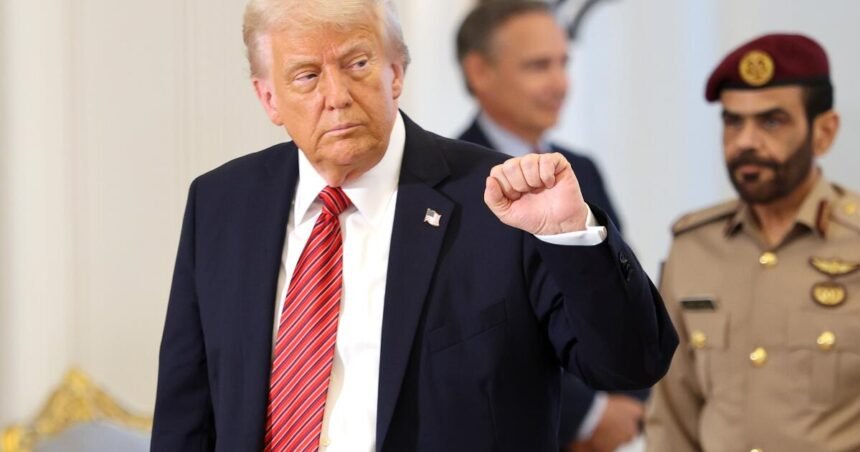
As President Trump parades through the Middle East this week, he will encounter a very different region than the one he experienced during his first term. True, the Israeli-Palestinian problem remains unresolved, as do the challenges emanating from Iran’s much-advanced nuclear program and the instability and dysfunction in Iraq, Lebanon, Libya, Syria and Yemen.
But this old wine is now packaged in new bottles. Beyond the garish headlines of Trump’s plan to accept a Boeing 747 as a gift from Qatar, new trends are emerging that will redefine the region, posing additional challenges for U.S. policy.
Of all the changes in the Middle East since Hamas’ Oct. 7, 2023, attack on Israel, perhaps the most striking is Israel’s emergence as a regional powerhouse. Aided by the administrations of Presidents Biden and Trump, and enabled by Arab regimes that do little to support Palestinians, Israel devastated Hamas and Hezbollah as military organizations, killing much of their senior leadership. With the support of the United States, Europe and friendly Arab states, it effectively countered two direct Iranian missile attacks on its territory.
Israel then delivered its own strike, reportedly destroying much of Iran’s ballistic missile production and air defenses. In short, Israel has achieved escalation dominance: the capacity to escalate (or not) as it sees fit, and to deter its adversaries from doing so. Israel has also redefined its concept of border security in Gaza, Lebanon, the West Bank and Syria by acting unilaterally to preempt and prevent threats to its territory.
Converting Israel’s military power into political arrangements, even peace accords, would seem like a reasonable next step. But the right-wing government of Prime Minister Benjamin Netanyahu seems uninterested in such options and is unlikely to be induced to change its outlook. Moreover, securing new, lasting agreements also depends on whether there are leaders among the Palestinians and key Arab states ready to take up the challenge, with all the political risks it entails.
But the Arab world remains in serious disarray. At least five Arab states are dealing with profound internal challenges, leaving them in various degrees of dysfunction and state failure. Amid this power vacuum, two alternative power centers have emerged. The first are the states of the Persian Gulf, especially Saudi Arabia, the United Arab Emirates and Qatar. Relatively unscathed by the Arab Spring and blessed with sovereign wealth funds, oil and natural gas, these stable authoritarian powers, particularly Saudi Arabia, have begun to play an outsize role in the region.
The second category comprises non-Arab states. Israel, Turkey and Iran are the only states in the region with the capacity to project significant military power beyond their borders. While each has suffered periods of internal unrest, they currently enjoy domestic stability. Each also boasts tremendous economic potential and significant security, military and intelligence capabilities, including the capability to manufacture weapons domestically.
One (Israel) is America’s closest regional ally, another (Turkey) is a member of NATO and a newfound power broker in Syria, and the third (Iran) retains considerable influence despite Israel’s mauling of its proxies Hamas and Hezbollah. Iran’s nuclear program keeps it relevant, even central, to both Israeli and American policymaking.
All three non-Arab states engender a good deal of suspicion and mistrust among Arab regimes but are nonetheless seen as key players whom no one wants to offend. All three are at odds — with each frustrating the others’ regional objectives — and all three are here to stay. Their influence will most likely only grow in the years to come, given the fractiousness of the Arab world.
In the immediate aftermath of the Oct. 7 Hamas attack, it seemed that the Palestinian issue was once again front and center, not just in the Arab world, but internationally. Those who claimed it had lost its resonance could point to the outpouring of sympathy and support for Gazan civilians as Israel’s war against Hamas led to a humanitarian catastrophe.
Moreover, the United Nations passed resolutions calling for an end to the war, many around the world condemned the war and Israel, the International Court of Justice took up the question of whether Israel is committing genocide, and the International Criminal Court issued an arrest warrant for Netanyahu (as well as for Hamas’ military commander, later found to have been killed).
Nonetheless, it has become stunningly clear that, far from pushing the Palestinian issue to the top of the international agenda, the Oct. 7 attack has actually diminished its salience and left Palestinians isolated and without good options. Continued U.S. support for Israel’s war against Hamas, despite the exponential rise of Palestinian deaths, has protected Israel from negative consequences; key Arab regimes have done next to nothing to impose costs and consequences on Israel and the U.S. as Palestinian civilian deaths mount. The international community appears too fragmented, distracted and self-interested to act in any concerted way in defense of Palestine.
Meanwhile, the Palestinian national movement remains divided and dysfunctional, giving Palestinians an unpalatable choice between Hamas and the aging president of the Palestinian National Authority, Mahmoud Abbas. The prospects for anything resembling a two-state solution have never looked bleaker.
How the Trump administration will process these developments remains to be seen. Clearly, it has adopted a pro-Israel view, with Trump musing about turning Gaza into a Riviera-style resort. He has deployed his special envoy to the Middle East to secure the return of hostages taken by Hamas but has yet to invest in any postwar plan for the beleaguered enclave. Indeed, he has left the strategy for Gaza to Israel, which in turn has resumed its military campaign there. Trump has also acquiesced to Israel’s pursuit of aggressive border defenses against both Lebanon and Syria, while enabling Israel’s annexationist policies in the West Bank.
Yet Trump is nothing if not unpredictable. In April, he announced new U.S. negotiations with Iran in the presence of Netanyahu, who himself has tried to persuade the president that the only solution to Iran’s nuclear program is military action. But if U.S.-Iranian negotiations do advance, or if Trump’s interest in Israeli-Saudi normalization intensifies, he may find himself drawn into the Middle East negotiating bazaar, dealing with the intricacies of day-after planning in Gaza and a political horizon for Palestinians.
These paths are already fomenting tension between Trump, who will not be visiting Israel on his Middle East trip, and a recalcitrant Netanyahu. But given Trump’s absolute control over his party, Netanyahu will have few options to appeal to Republicans if the White House proposes policies that he opposes. As most U.S. allies have already learned, if Trump wants something, he’s not averse to using pressure to get it.
Aaron David Miller, a senior fellow at the Carnegie Endowment for International Peace, is a former State Department Middle East analyst and negotiator in Republican and Democratic administrations and the author of “The End of Greatness: Why America Can’t Have (and Doesn’t Want) Another Great President.” Lauren Morganbesser is a junior fellow at the Carnegie Endowment for International Peace.


