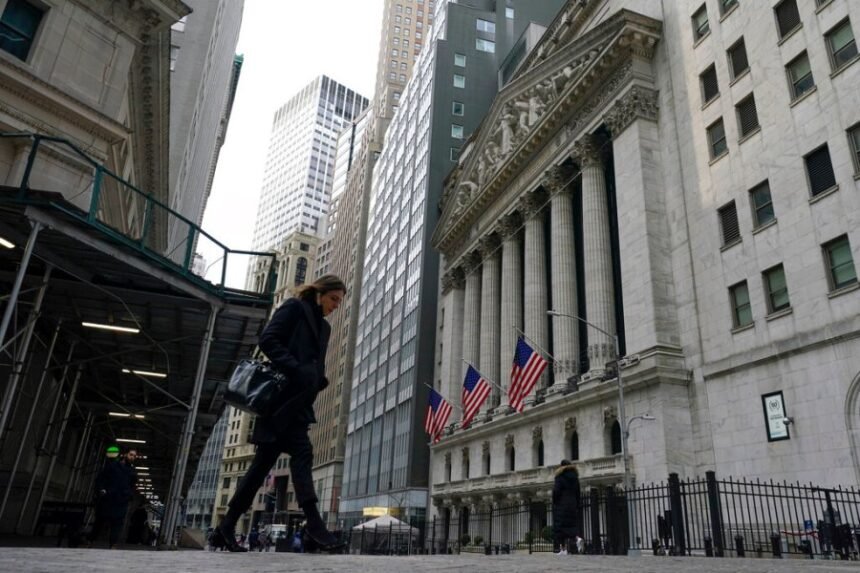
Spectacle often substitutes for substance, and nowhere is this more evident than in the latest tremors shaking Wall Street.
On May 21, a lackluster 20-year U.S. Treasury bond auction delivered what can only be described as a resounding vote of no confidence in Washington’s economic stewardship. The numbers were as stark as they were symbolic: a bid-to-cover ratio of 2.46 and a yield of 5.047 percent — the highest in five years.
The markets responded as they usually do to bad news in the Capitol Hill core: stocks tumbled, bond yields soared and the dollar retreated. Now, with Moody’s recent downgrade of the U.S. credit rating, concerns about fiscal instability have deepened, reinforcing investor skepticism about the sustainability of Washington’s approach. One could almost hear the groan of a global economy growing weary of underwriting President Trump’s illusions.
At the center of this financial unrest lies a paradox that has defined recent U.S. economic policy: the fantastical belief that one can cut taxes, ramp up spending, and somehow avoid the mathematical consequences. The latest offering from the House Republicans — an expansive tax-and-spend package aligned with Donald Trump’s post-presidential ambitions — illustrates the delusion in full color.
Advertised as a tonic for economic rejuvenation, the bill is projected to add $3.8 trillion to the national debt over the next decade. Not surprisingly, investors are beginning to ask whether Washington has any intention — let alone a plan — for reversing the fiscal tide. This concern has been magnified as the 30-year bond yield surged to 5.15 percent intraday on May 22 before settling at 5.05 percent, highlighting waning confidence in America’s debt trajectory.
Yet this story is neither new nor uniquely American. Japan, that other industrial behemoth weighed down by demographic decay and decades of tepid growth, held its own 20-year bond auction just a day earlier. It recorded its weakest demand since 2012. The yield spiked to levels not seen since the turn of the millennium. In both Washington and Tokyo, the bond markets are holding up an unflattering mirror: fiscal indiscipline, once tolerable and even fashionable, is losing its market cachet.
To be clear, the stakes are global. For decades, U.S. Treasurys have represented the financial equivalent of terra firma — a bedrock in turbulent times. The dollar’s status as the world’s reserve currency has been undergirded not just by the size of the U.S. economy but by an assumption of stability, predictability and institutional maturity. All three are now in question.
The sputtering auction of long-term debt, a financial instrument once deemed near-sacred by global investors, signals something deeper: an erosion of faith not just in fiscal management, but in the very political coherence of the United States.
The temptation in elite financial circles, and increasingly among central bankers, is to reach once more for the palliative of quantitative easing — anesthetic for the markets, if not a cure for the underlying disease. The Federal Reserve may indeed expand its balance sheet in the coming months, but such measures are the fiscal equivalent of painkillers prescribed for organ failure.
They may mask the symptoms, but they leave the rot untouched. Worse, they risk reinforcing a cycle in which fiscal irresponsibility is not only tolerated but incentivized, on the assumption that the central bank will always ride to the rescue.
This moral hazard is not abstract. It undermines the very foundations of democratic accountability. What incentive remains for lawmakers to make unpopular decisions — on entitlement reform, tax equity or defense spending — if the consequences of inaction are indefinitely deferred? In this sense, the current drama on Wall Street is a symptom of a broader malaise: the decoupling of economic decision-making from political courage.
Yet the White House remains allergic to introspection. The instinct is to externalize, to locate the cause of internal disarray in foreign villains — China, Russia, Iran — while studiously ignoring the unsustainable structure at home. If the bond market signals anything, it is that the margin for error is narrowing. Investors are not ideologues. They do not traffic in patriotic bromides. They want to know whether the empire can pay its bills.
And they are not reassured.
This should worry more than just Wall Street. For better or worse, the global economy is still chained to the health of the American financial system. A destabilized dollar or an imploding Treasury market would not merely dent U.S. prestige; it could spark global contagion, the effects of which would be felt from Lagos to Lahore, from São Paulo to Seoul. The dominoes may fall more slowly than in 2008, but fall they will.
Japan’s bond market woes further underscore this global fragility. Weak demand for its 20-year bond auction mirrors Washington’s struggles, suggesting that investors are recalibrating their appetite for long-term debt in major economies. The simultaneous erosion of confidence in both U.S. and Japanese fiscal policies could foreshadow broader financial instability ahead.
What’s needed is not another round of fiscal theatrics, but a sober reckoning. The United States must confront its own contradictions — between rhetoric and reality, between consumption and production, between global ambition and domestic decay. This means real decisions: revisiting the tax code to ensure the wealthy pay their share, reducing wasteful defense expenditures and investing in productive capacity rather than speculative finance. Above all, it means recognizing that empire is expensive — and often unaffordable.
As economist Herbert Stein once quipped with characteristic clarity, “If something cannot go on forever, it will stop.” The current U.S. fiscal trajectory is not merely unsustainable; it is absurd. The only real question is whether the correction will be orderly — or catastrophic.
The alarm bells have sounded, not just in economic data but in the global perception of American reliability. It is late in the day, but not too late — yet. If the world’s most powerful economy cannot demonstrate basic fiscal sanity, it may not be long before the privileges of empire begin to vanish, one auction at a time.
Imran Khalid is a physician and has a master’s degree in international relations.