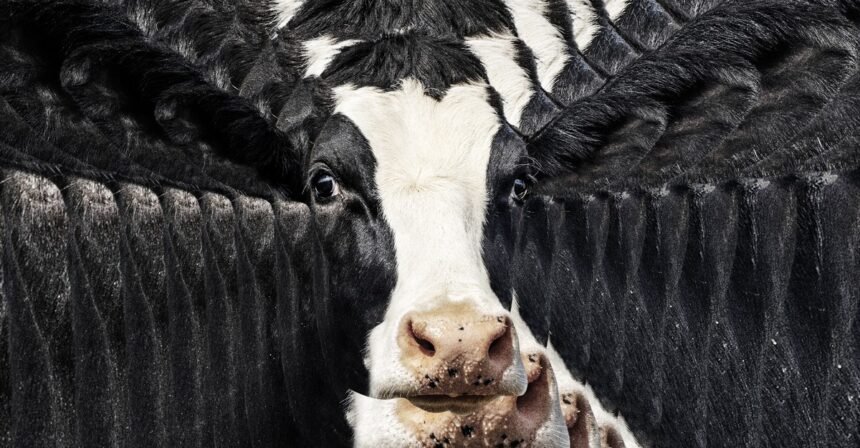
A not-insignificant number of TikToks aim to convince the viewer that beef-tallow moisturizer will not make your face smell like a cow. The beauty influencers who tend to appear in these videos—usually clear-skinned women rubbing tallow into their face as they detail their previous dermatological woes—describe the scent as “buttery” or “earthy” or grass-like. Many of them come to the same conclusion: Okay, even if the tallow does smell a little bit, the smooth skin it leaves behind is well worth it.
Beef tallow (as both a moisturizer and an alternative to seed oils) is one of many cow-based products that have crowded the wellness market in the past five or so years. Beef-bone broth is a grocery-store staple. Demand for raw milk has grown, despite numerous cases of illness and warnings from public-health officials that drinking it can be fatal. In certain circles, raw cow organs—heart, liver, kidney—are prized superfoods. Target and Walmart sell supplements containing bovine collagen (a protein found in cowhide and bone) and colostrum (the rich liquid that mammals produce for their newborn offspring); they promise healthier skin, a happier gut, and stronger immunity, and come in flavors such as watermelon lime, lemon sorbet, and “valiant grape.” You can buy cow-placenta pills for postpartum healing, or powdered bull testicle for testosterone support. The slightest interaction with clean-beauty Instagram can fill your feed with ads for beef-tallow lip balms, cleansing creams, sunscreen, and deodorants. (One brand even offers creamsicle-flavored beef-tallow personal lubricant, which is currently out of stock online.) Influencers praise tallow for clearing their acne and eczema—and offer discount codes so you can experience the same.
Even the government’s recent public-health messaging has veered toward the bovine. During his tenure as health secretary, Robert F. Kennedy Jr. has championed cooking in beef tallow (which he says is healthier than seed oils) and drinking raw milk (one of many items that he claims are suppressed by the FDA). Casey Means, President Donald Trump’s nominee for surgeon general, also supports raw milk; she has suggested that Americans can decide whether a given bottle is safe to drink by looking the dairy farmer in the eye and petting his cow. Means and Kennedy have largely avoided engaging with the many public-health experts who reject their views. But in May, after months of such critiques, Kennedy took shots of raw milk at the White House to celebrate the release of the “Make America Healthy Again” report.
Woo-woo, it seems, is becoming moo-moo. America has entered its cowmaxxing era.
Like most wellness offerings, cow products are marketed with vague health claims that are virtually impossible to confirm or deny, such as “deeply nourishes and supports the skin barrier,” “activate cellular health,” and “supports memory.” One of the many promises of the Ancestral Supplements Starter Pack of organ-based capsules is simply “vitality.” (The company also includes a disclaimer that the FDA has not reviewed said vitality benefits.) Advocates of these goods tend to be more specific in their praise. Raw-milk enthusiasts claim that unpasteurized milk contains bioactive chemicals that improve human health. In one video, a woman drinks raw milk that’s been in the fridge for more than a month; she claims it is safer to consume than store-bought pizza or salad and that it reduces rates of eczema, fevers, and respiratory infections. One smooth-skinned influencer, who says she hasn’t washed her face in two years, claims that beef tallow is “bioidentical” to the sebum produced by human skin. (It’s not, because it’s from cows.)
[Read: The real appeal of raw milk]
Some of these products are more likely to provide benefits than others. Bone broth is indeed rich in collagen (which, when produced by the human body, strengthens hair and skin). Whey powder, made from leftover cheese water, does contain protein. But very few studies support the idea that eating more collagen strengthens hair and skin. Whey protein can help build lean muscle, but the body can only absorb so much at a time. Some dermatologists say tallow can strengthen and hydrate the skin; others say it clogs pores and should be avoided. Other products can be downright dangerous: Just this week, Florida officials announced that 21 people fell sick after consuming contaminated raw milk.
At least part of the appeal of cowmaxxing is the cows themselves: The products evoke the pastoral ideal of a cow grazing freely in the plains, milked lovingly by human hands. It’s an image that’s been embedded in American culture for centuries. Consider how Laura Ingalls Wilder, who was no stranger to the harsh reality of farm life, described cow-raising in Little Town on the Prairie: “Warm and sweet, the scent of new milk came up from the streams hissing into the rising foam, and it mixed with the scents of springtime.” It’s enough to persuade a microbiologist to drink raw milk.
In 21st-century America, cows still summon images of fields and clover and wide blue sky, enough to trigger the human tendency to believe that what’s natural is “fundamentally good,” Courtney Lappas, a biology professor at Lebanon Valley College, told me. Her research has shown that some Americans prefer natural over man-made products even when the former is described as objectively worse—a phenomenon her colleague Brian Meier has called the “naturalness bias.” This tendency, which is prevalent across cultures, likely leads people to assume that unprocessed cow-based products are safe and healthy, she said. Tallow, some skin-care enthusiasts claim, is a healthier, safer alternative to conventional moisturizers, which supposedly contain toxic chemicals. The branding of such products, too, leans into the notion that natural is best: Fat Cow Skincare markets its tallow cosmetics as “pure skincare, powered by nature”; Heart and Soil sells capsules of “nature’s superfood” (that is, organ meats). Other brands invoke nature through the prehistoric, with names such as Primal Harvest, Primal Kitchen, Primal FX, Primal Being, and Primal Queen. Ancestral Supplements’ ad copy reads: “Putting Back In What the Modern World Left Out.”
[Read: How organ meat got into smoothies]
America’s current health landscape is the perfect setting for cowmaxxing to thrive. The naturalness bias is deeply ingrained in Kennedy’s MAHA campaign, which aims to improve public health by returning to a more natural lifestyle. In Kennedy’s view, beef tallow is superior to seed oil because it’s less processed (some people even render it at home). The carnivore and tradwife movements embody a similar message, promoting the consumption of raw cow organs and making butter from scratch. You may not know what’s in store-bought products, the thinking goes, but you do know what’s in tallow: pure, unadulterated cow fat.
And yet most modern cows live in a decidedly unnatural environment. The majority of U.S. cattle are fed genetically modified crops, and some genetically modified cows are allowed to be sold as food. Many cow-based wellness products bear the label “grass-fed,” which suggests cows that were raised on pastures rather than feedlots. But the label is not strictly enforced, and it doesn’t necessarily prohibit farmers from giving cows antibiotics or hormones. There’s no guarantee that a cow whose colostrum is harvested to be sold by a tradwife on Instagram had a happy, bucolic existence. Not to mention that colostrum, whey, and placenta do not come out of the cow in the form of powders or pills.
The spread of science misinformation, along with legitimate concerns about the state of public health in the United States, have left many Americans understandably confused about whether conventional science and Western medicine can be trusted in 2025. Getting to the bottom of, say, the seed-oil controversy requires engaging with thorny scientific debates that reference inscrutable research papers; embracing the natural and ancestral by opting for tallow is an attractively simple-seeming alternative. “It brings with it a sense of purity or wholesomeness that is desirable right now,” Marianne Clark, a sociologist at Acadia University who studies wellness trends, told me. In this sense, cowmaxxing is not so much a health endeavor as it is a spiritual one, its promise downright biblical: Cowliness is next to godliness.