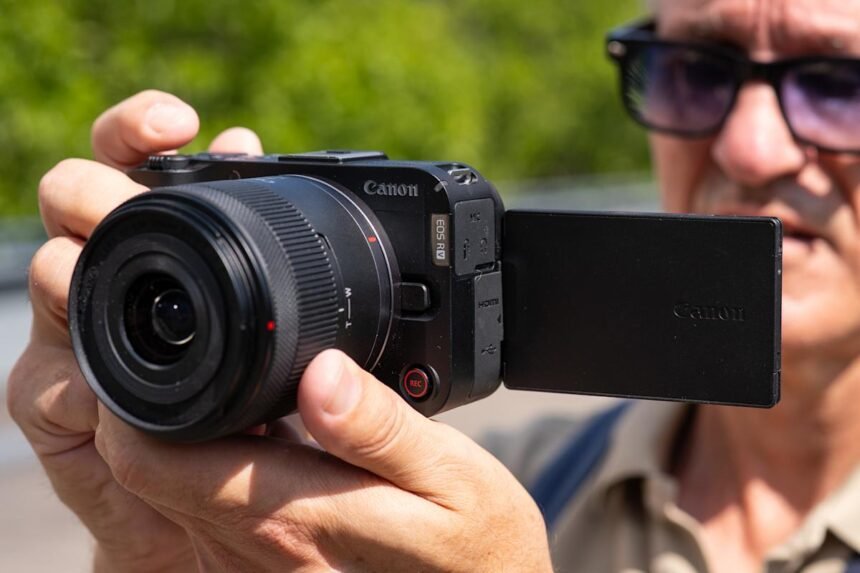
Canon has released 20 cameras since launching the RF mount in 2018, but it had one gaping hole in a key market: vlogging. Now, the company has patched that with the launch of the $700 R50 V that’s aimed at creators on a budget and designed to take on Sony’s ZV-E10 II.
The R50 V has the same 24-megapixel APS-C sensor as the R50, but adds vlogging-friendly features like 4K 60p video, C-Log3 for extra dynamic range, a livestreaming button and a side tripod socket for vertical video. It’s cheaper than the $1,100 ZV-E10 II and even costs a bit less than the older ZV-E10. After some lengthy testing, however, I found that it was missing some key features compared to its Sony rivals, particularly those that make vlogging easier for beginners.
Canon’s EOS R50 V is a solid budget vlogging camera thanks to the excellent video quality, but it’s missing important features compared to its rivals.
- Good photo and video quality
- Fast and accurate autofocus
- Cooling fan allows extended shooting
- Decently fast photo shooting
- Rolling shutter distortion
- No in-body stabilization
- Lacks rival’s vlogging friendly features
- Mediocre battery life
Design and handling
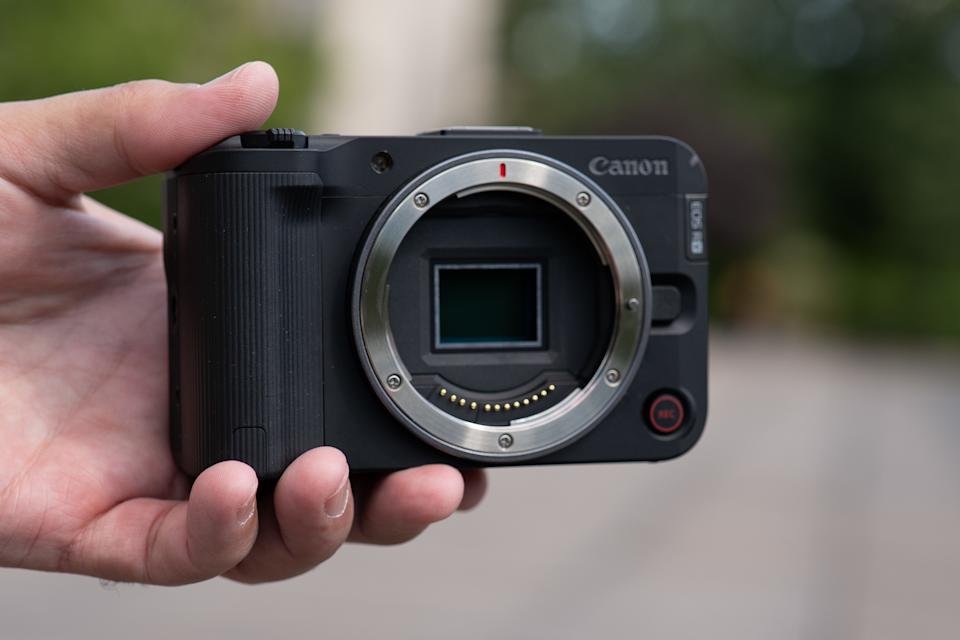
Like other vlogging cameras, the R50 V is stripped down both in terms of size and controls. It has a polycarbonate body rather than metal, which reduces toughness and weatherproofing but helps keep it light at just 323 grams. The grip is also smaller than the R50’s, so it’s not ideal to use with large lenses.
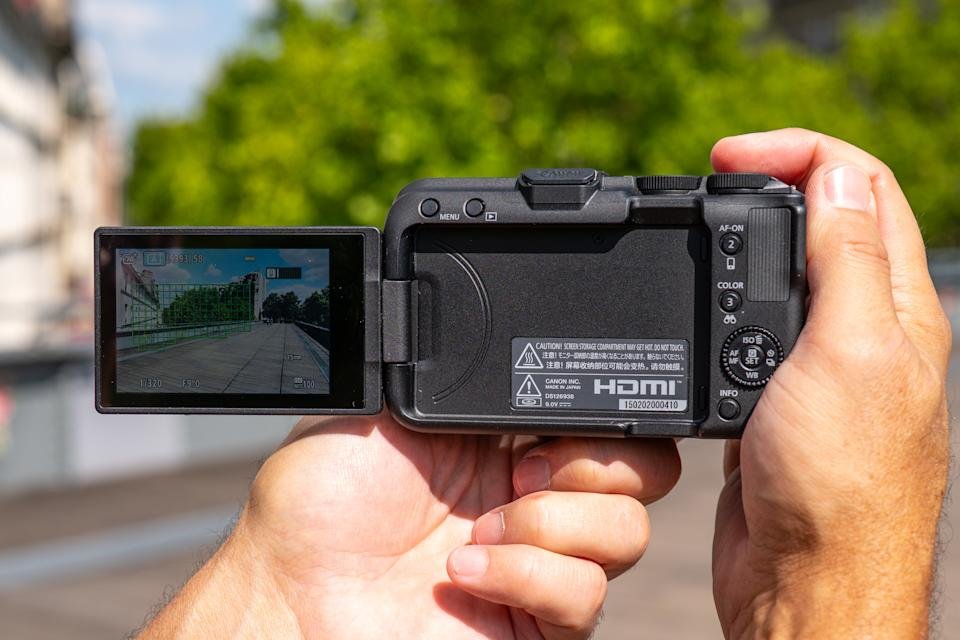
One key feature missing from the R50 is an electronic viewfinder. That’s also the case with the ZV-E10 II, but the lack of one can make it challenging to shoot in bright sunlight. On top of that, the rear display is low-res and isn’t particularly bright. However, it fully articulates and flips around for vloggers.
The R50 V is designed to be controlled via the touchscreen, so it has fewer manual controls than other Canon mirrorless models. It does have top, rear and back dials to set primary functions like iris and shutter speed. However, you need to use your thumb to control both of those which makes operation a bit awkward.
The front rocker is designed to control zoom on supported Canon lenses like the new 14-30mm f/4-6.4 IS STM PZ, which was released at the same time as this camera. It also has livestream and color buttons dedicated to creators, plus there’s a mode dial with six different video settings.
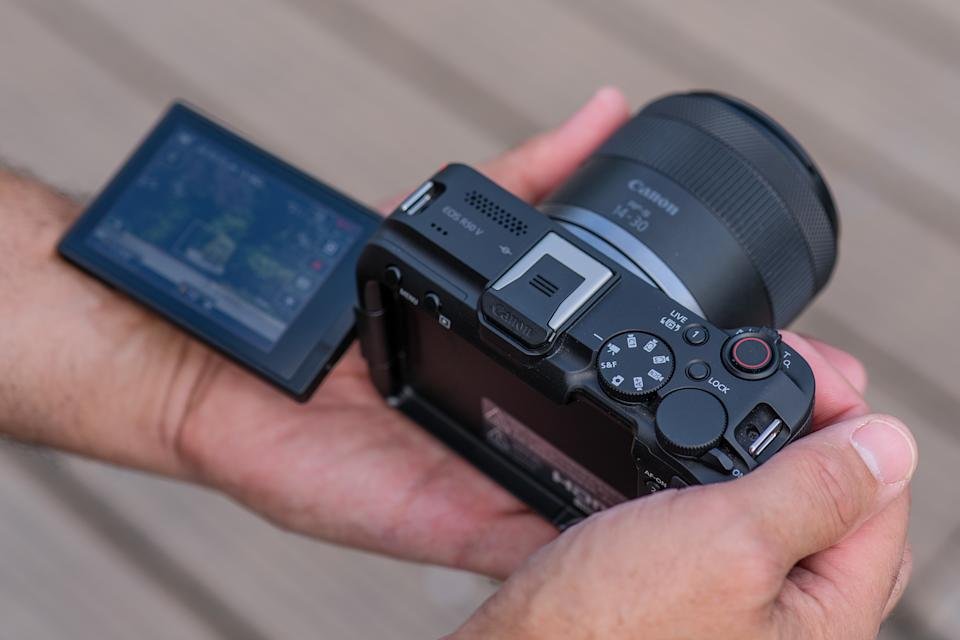
The menu system is typically Canon with color-coded pages for each category (video settings, autofocus and more). However, key settings can also be adjusted from the Quick (Q) menu using the touchscreen when vlogging. Functions in that menu can of course be reprogrammed to your preferences.
The R50 V has both microphone and headphone inputs along with microHDMI and USB-C ports. It uses Canon’s smaller EP-17 battery that delivers an hour of video shooting or 300 shots to a charge, both far less than the ZV-E10 II (113 minutes and 600 shots). It has just a single SD card slot, but fortunately it’s the faster UHS-II type. Finally, there’s a very handy feature for content creators: a tripod socket on the side to make it easier for solo vloggers to shoot vertical video.
Video
Video and vlogging is the R50 V’s primary strength compared to R50. It can shoot both supersampled 4K 30 fps and 4K 60 fps video, with C-Log3 and 10-bit quality. However, the 4K 60 fps setting requires a fat 1.56x crop, which reduces quality as well as bokeh. Sony’s ZV-E10 II, by contrast, only requires a 1.1x crop for 4K 60 fps video.
The Z50 V also lacks in-body stabilization. That means the R50 V relies strictly on optical lens shake reduction or electronic stabilization. To be fair, that’s to be expected in this price range and the ZV-E10 II is also missing in-body stabilization. The electronic system does a good job removing jolts from handheld video and can even smooth out walking if you try to move fluidly, but it can make footage look soft if movements are excessive. The “Enhanced” electronic mode, which applies a small crop, is designed to make handheld shots look “locked off” like you’re using a tripod.
Background blur and product showcase-type buttons are also noticeably missing compared to the ZV E10 II. That’s too bad, because creators use those features often to quickly focus on objects or blur the background behind a subject — without them, you’re forced to set those things manually.
Rolling shutter distortion is fairly noticeable on this camera with a scan rate around 30ms, compared to just 16ms for the ZV-E10 II. This means sudden pans or jolts can result in “jello effect” video. Meanwhile, video autofocus is rapid and reliable, even if your subject moves around. The AI-powered face and eye detection locks on firmly, and can also reliably track animals and vehicles.
Canon took a page from Panasonic and Fujifilm with the addition of a color button on the R50 V. It lets you quickly select shooting modes like standard BT.709, C-Log, HLG and PQ. Another setting offers filmic looks with modes like Portrait, Fine Detail, Faithful and Monochrome. And the last “color filter” mode allows for tinted video with shades like teal and peach, though the results looked a bit cheesy to me.
With a built-in cooling fan, the R50 V is more resistant to overheating than most small cameras. When recording standard 4K at 30 fps, I was able to shoot for 60 straight minutes with no sign of overheating. The issue doesn’t, er, crop up at 4K 60p either since that mode uses a reduced portion of the sensor.
Overall, video quality is a strong point, with sharp detail when using the 4K 30 fps oversampled mode. Colors are rich and accurate, and skin tones pleasing with a hint of warmness that Canon is known for. The 10-bit C-Log3 footage retains extra detail in shadow and highlight areas, providing outstanding dynamic range for such an inexpensive camera. However, 4K 60p video is considerably softer, and the 1080p 120 fps ultra slo-mo setting lacks sharpness even by HD standards. Low-light capability is average for an APS-C camera, with noise clearly visible starting at ISO 3,200 or 6,400. Beyond that, it becomes intrusive and harder to get rid of using noise reduction tools.
Photography
Though photography isn’t this camera’s raison d’etre, the R50 V performs decently in that regard. It can shoot fairly quickly for a small camera, with burst speeds of 15 fps with the electronic shutter or 12 fps with mechanical shutter. However, it can’t sustain those speeds for very long due to the small buffer that holds just 36 RAW images.
Autofocus is again a strong point, tracking subjects with ease and keeping photos sharp. As with video, AI-powered face and eye detection is quick and reliable for people, animals and vehicles. Rolling shutter is an issue with photos as it is with video, but since the R50 V has a mechanical first-curtain shutter, you only need the electronic mode for photos when silence is required. The lack of in-body stabilization means you’ll need to have a steady hand to take sharp shots at low shutter speeds, or you’ll want to shop for lenses with optical stabilization if that’s an issue.
Photo quality is identical to the R50 since it shares the same sensor. For normal shooting, I saw color-accurate photos with skin tones leaning on the warm side, as is typical with Canon’s color science. JPEGs strike a good balance between sharpening and noise reduction, while RAW files allow a decent amount of room to tweak images. As with video, low-light performance isn’t amazing, so I wouldn’t go past ISO 6,400 unless it’s too dark to film otherwise.
Wrap-up
Canon’s R50 V is a pretty good first try for a vlogging camera, hitting the mark in key areas like video quality and usability. However, its rival, Sony’s ZV-E10 II, beats it in nearly every area, offering even better video quality, higher photo resolution, faster autofocus, smoother electronic stabilization and neat features missing on the R50 V — like the product showcase.
That said, Canon is targeting a more budget-minded buyer as the R50 V costs just $700 (body only) compared to $1,100 for the ZV-E10 II. Vloggers constrained to that budget will still get a great camera that easily beats a smartphone when it comes to the final product. If you do have an extra $400 to spend, though, I’d recommend the ZV-E10 II instead.