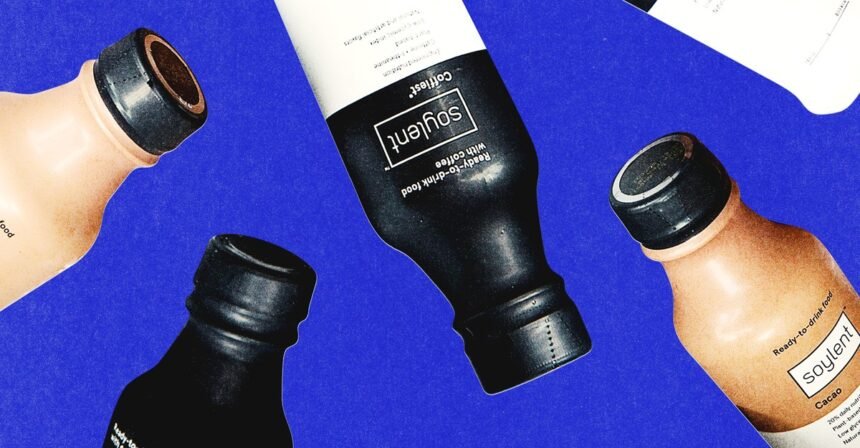
From the beginning, Soylent was shorthand for a certain kind of guy. A guy who worked in tech and probably wore a hoodie. A guy who, despite his six-figure salary, lived in an unfurnished apartment. Soylent Guy, above all else, did not have time for quotidian tasks such as cooking and chewing. One way you knew this was that he slugged the nutrient-dense slurry known as Soylent.
Remember Soylent? In the mid-2010s, Soylent promised to change the world by solving a timeless problem: Everybody has to eat. Instead of chopping vegetables or defrosting a meal, you could fertilize yourself, like a needy rhododendron, with a blend of oat flour, maltodextrin, brown-rice protein, canola oil, fish oil, and just enough sucralose to mask the flavor. For a brief moment, Soylent was beloved—at least in Silicon Valley, where venture capitalists helped turn it into a $170 million brand. It was also a dystopian punch line: What if you stripped life of all joy and bottled the result? Ha! In 2023, Soylent was sold off for a fraction of its former valuation.
John Coogan, who co-founded Soylent in his early 20s and now co-hosts the popular tech-business talk show TBPN, chalks up the company’s decline largely to inexperience. “We were always trying to be a little bit too clever,” he told me. But perhaps Soylent’s greatest fumble was that it came too soon.
You can find Soylent-like drinks almost everywhere these days. Fairlife—a line of protein shakes that bills itself as “a satisfying way to get the nutrition you’re looking for”—is so popular that it has become Coca-Cola’s fastest-growing U.S. brand. One of its competitors, Huel, recently sold to Danone for $1 billion. You can buy nutrition drinks from Rebbl and Ogain and Koia and Oikos, along with many, many other companies whose names have the wrong number of vowels.
If you are one of the many Americans who chugs these shakes on the regular, perhaps you might balk at the comparison to Soylent. (You don’t even wear a hoodie!) The point of nonfood nutrition is no longer to fuel yourself so that you can sit at a computer longer. You are instead becoming healthier, hotter, more beautiful, more jacked. The shakes are engineered for our protein-obsessed times. Fairlife’s Nutrition Plan shake, for example, comes with 30 grams of protein in a mere 150 calories. But many of the shakes do not stop at protein. They want to talk to you about adaptogens and your gut health, your antioxidants and your immune-boosting support. Only some of them explicitly identify as a meal replacement. Instead, they are “next-level nourishment” to “fuel every move.” They go from “gym bags to lunchboxes to morning smoothies” and match pace “with your everyday, get-strong hustle.”
Still, there is a striking resemblance to Soylent, and not only in form. These shakes aren’t meals, but they aren’t not meals. “There was a time when you had eggs for breakfast and a sandwich for lunch and a TV tray for dinner,” Leigh O’Donnell, an analyst at the market-research firm Kantar, told me. But we have become a nation of snackers. Instead of having three meals a day, she said, many Americans now eat “maybe six … somethings.” This is because of our lifestyles but also because of our newfound dietary needs. GLP-1s, for example, have created a new customer: people trying to mitigate potential muscle atrophy, a side effect of rapid weight loss, by consuming more protein, ideally in a form that doesn’t require eating all that much. The current high-protein, low-calorie, micronutritionally supplemented ready-to-drink shakes may not exactly constitute a “meal” in the conventional sense, but they certainly constitute a “something.”
The shakes are portable and easy and wildly efficient, in that they deliver a lot of meticulously calibrated individual nutrients and require no thinking. As a person who is not generally doing anything particularly demanding with my body (or, arguably, my time), I know that traditional eating should be just fine. All else being equal, eating food, not too much, mostly plants is probably superior to downing ultra-processed shakes. And still, I find myself drawn to these drinks. Food is fraught and confusing, but the shakes are reassuringly precise: This much protein! This much fiber! These carbohydrates! This unquantifiable but still notable immune-boosting defense! I am, as the protein-shake brand OWYN promises, getting “Only What You Need.” This was, of course, the promise of Soylent: You could glug down everything you needed and get on with it.
In recent years, “what you need” has only escalated. The list of nutritional necessities now “contains all these things that you didn’t even know you needed five minutes ago,” O’Donnell said, “whether it’s turmeric or potassium.” Obviously, you can be generally healthy, eating your beans and grains and salads, but can you reach the pinnacle of your potential? Can you maximize, in one single serving, your protein, your fiber, your ashwagandha, and your time? That’s the appeal of something like Ka’Chava, an “all-in-one nutrition shake” enhanced with antioxidants, probiotics, prebiotics, and digestive enzymes. Or consider Rebbl, which includes, in addition to protein and fiber, 2.2 milligrams of zinc and “adaptogenic Reishi mushroom extract.” Even Soylent itself has pivoted its messaging to keep up with the times, updating not only its recipe but also its mission. “We’ve shifted from being a meal replacement company to a complete nutrition company,” then-CEO Demir Vangelov told the tech newsletter dot.LA a few years ago. In an interview with Food Dive, he went further: “Every one of our consumers, they know what they believe they need in terms of protein, in terms of carbs, in terms of fiber and vitamins and minerals, and they’re curating their nutrition across their week to fit those needs.” (Soylent did not respond to several requests for an interview.)
Soylent had a bold, even ridiculous vision for a post-food future. So far, it has not materialized. After several days of searching, I finally got my hands on a bottle of Soylent through the magic of the internet. It tasted strikingly similar to the other shakes on the market—dominated by notes of their low-calorie sweeteners. Coogan, the Soylent co-founder, has given up the stuff. “I have a very regimented schedule now where I have breakfast with my team every morning,” he said. But when you walk into a grocery store and glance at the refrigerated row of shakes, with their minimalist packaging and maximalist promises, the original dream of Soylent can seem comparatively quaint. The goal is no longer to match food. The goal has become to transcend it.