With the Trump administration slashing budgets and threatening to revoke tax-exempt status for nonprofits, some Southern California social justice organizations have gone into a defensive crouch, hoping to wait out the passing storm.
They are not openly fighting President Trump’s program cuts. Some have scrubbed their websites of terms such as “equity,” “inclusion” and “transgender.” Others have been told they should drop land acknowledgments — proclamations paying tribute to the Indigenous peoples who were this region’s first human inhabitants.
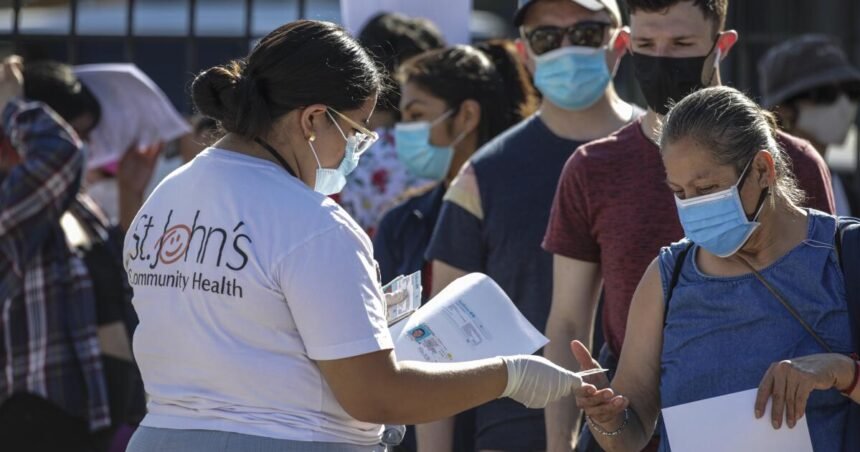
But other local nonprofits intend to fight. They have slammed Trump’s policies. They declined suggestions to alter their mission statements. They have gone to court. And one, giant St. John’s Community Health — which has provided care for the region’s working class and immigrants for 60 years — is launching a campaign to call out congressional Republicans it believes are enabling Trump budget cuts that they believe will cripple healthcare for the poor.
The venerable system of health clinics, based in South Los Angeles, on Thursday joined about 10 other nonprofits in launching a media campaign that will focus on half a dozen U.S. House districts where Republican lawmakers have supported the president’s initial budget plan.
The campaign by the newly created Health Justice Action Fund will promote the theme “Medicaid matters to me.” The organization plans to spend $2 million in the coming weeks to focus petitions, phone banks, social media and radio ads on six GOP lawmakers across the country, telling them that their constituents do not support cuts to the principal federal health program for the poor and disabled.
The Republican-controlled House and Senate have approved a Trump budget framework that calls for $880 billion in cuts over 10 years from operations overseen by the House Energy and Commerce Committee. Trump and other Republicans insist Medicaid won’t have to be cut. But the nonpartisan Congressional Budget Office disagrees, saying the desired savings can be achieved only by slashing Medicaid.
The new campaign to head off those cuts has been organized by Los Angeles-based St. John’s Health and its president and chief executive, Jim Mangia.
“The Medicaid cuts being proposed by Republicans and President Trump would be devastating to the health of low-income families throughout the United States,” Mangia, who has led St. John’s for a quarter of a century, said in an interview. “There are tens of millions of people who depend on Medicaid and, in California, Medi-Cal, for their basic healthcare. To cut that to fund tax breaks for billionaires is a perversion of what this country is supposed to be about.”
Mangia and his board of directors said they understand that their sprawling healthcare organization, with more than 20 locations in Southern California, could be targeted for calling out the president and his budget.
“Our posture is to fight,” Mangia said. “A lot of community health centers have been scraping their websites and taking words like ‘trans’ and ‘African American’ off their websites. We’re not going to do that. We are not going to erase the people we serve.”
Leaders of nonprofits that serve the poor, immigrants and the LGBTQ+ community have been engaged in intense conversations for weeks about how to respond to Trump and his policies, which explicitly aim to curtail services to some of those populations.
GOP Rep. David Valadao represents a Central Valley district where nearly two-thirds of residents rely on Medicaid.
(Irfan Khan / Los Angeles Times)
When Trump said last week that he might begin trying to revoke the nonprofit status of some groups, anxiety among the agencies spiraled to a new high, said Geoff Green, chief executive of CalNonprofits, which represents thousands of organizations with tax-exempt status.
“There have been financial stresses and budget cuts before,” Green said. “But now it’s not only financial stress, it’s direct targeting of their very existence and challenges to the values that are at the core of a lot of their work.”
Leaders of smaller organizations, in particular, don’t feel they have the power or money to take the Trump administration to court. Others, representing immigrants, worry that their leaders or their clients could be targeted for deportation if they protest publicly.
“For some people in this community this is like a kind of code-switching,” said an executive at one social justice nonprofit, who declined to be named. “They might change some terms on their websites, but it’s not going to change their mission. They want to avoid conflict or attacks, so they can come out the other end of this and do the good work.”
In one instance, a nonprofit declined to receive an award sponsored by a member of the California Legislature, because the organization worried the award would bring unwanted attention to its service to immigrants.
“At the end of the day, it’s about protecting the most vulnerable of us,” said the social justice executive. “Some organizations have more privilege, they have more resources. They can afford to go to court. They can be more bold.”
Public Counsel is among the public interest law firms whose contracts the Trump administration has threatened with termination. The potential loss of $1.6 million puts in jeopardy the Los Angeles-based firm’s representation of hundreds of immigrant children, unaccompanied minors who often have no adult support.
Public Counsel Chief Executive Kathryn Eidmann said she believes her organization has a duty to call out what it sees as an injustice: leaving vulnerable children without legal representation.
“We have a responsibility to stand up for our mission and to stand up for our clients and the rule of law,” Eidmann said. Public Counsel is seeking to intervene in court on behalf of “sanctuary” cities such as Los Angeles, which have been threatened with a loss of federal funding, and the firm has come to the defense of law firms targeted for providing pro bono representation to groups out of favor with the Trump administration.
Public Counsel and other nonprofit law firms continue to wait to see whether the Trump administration will honor a judge’s temporary restraining order, requiring that funds continue to flow to those representing immigrant children. As of Wednesday, the funding had not been restored, a Public Counsel spokesperson said.
Another L.A.-area nonprofit threatened with the loss of federal funding under Trump’s anti-DEI push is the Los Angeles Neighborhood Land Trust.
The group had won a $500,000 grant from the Environmental Protection Agency to help ensure that redevelopment along the Los Angeles River in northeast L.A. protects housing, jobs and services for working-class families. But the money stopped flowing this year, without any explanation from the EPA, said Tori Kjer, executive director of the land trust.
“To them, this is probably a waste of money,” Kjer said. “To us, it’s about equitable development and building in a way that supports everyone.”
Kjer said a staffer for a liberal House member urged her group to take a low profile and to, for example, delete the Indigenous land acknowledgments that are in the signature line of all its emails. She declined to do that.
“We are not going to change our ways because of Trump,” Kjer said. “In California, as a state and in this region, we are still very progressive. If we can’t keep this kind of work going here, we are in real trouble. We feel we need to resist, if even in a small way.”
The campaign to protest potential Medicaid cuts will focus on six House districts where use of the federally funded health system is high and where Republicans hold, at best, a narrow electoral advantage.
The targeted districts include David Valadao’s in the Central Valley and Ken Calvert’s in the Coachella Valley. Nearly two-thirds of Valadao’s constituents use Medicaid, while about 30% in Calvert’s district do so.
Residents in those districts will hear how the Trump budget plan threatens to cut Medicaid for “everyday people,” and how substantial reductions could threaten to shutter rural hospitals that are already struggling to make ends meet.
The Health Justice Action Fund was created as a 501(c)(4) by St. John’s and about 10 other healthcare providers, who have chosen to remain anonymous. The regulations governing such funds allow them (unlike the nonprofits themselves) to engage in unlimited lobbying and some political activity.
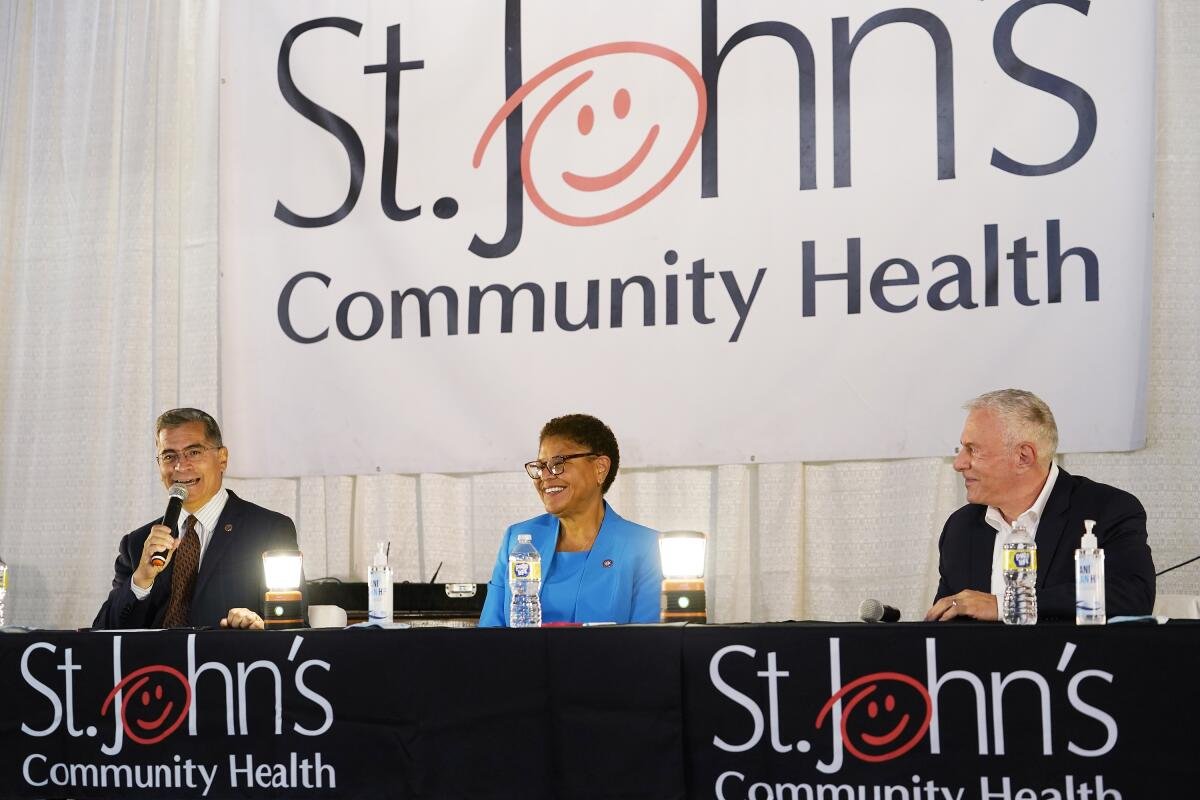
St. John’s Community Health President and Chief Executive Jim Mangia, right, on a panel in 2022 with then-Health and Human Services Secretary Xavier Becerra and L.A. Mayor Karen Bass.
(Damian Dovarganes / Associated Press)
The rules also allow contributors to remain anonymous, which Mangia said is necessary for some of his partners, who believe they will be targeted for retaliation if it becomes clear they tried to thwart Trump’s policies.
House Republicans who have been pressed about their position have contended, despite a contrary view from experts, that the Trump cuts can be executed without taking services from Medicaid recipients.
Valadao was among a dozen House Republicans who sent a letter to party leaders saying they would not support the White House’s plan if it will force cuts to Medicaid. Republican leaders have assured their wobbling colleagues that they intend to root out waste, fraud and abuse only, not cut Medicaid benefits.
Mangia said the campaign he and his allies are waging should make it extra clear to the House Republicans that Medicaid can’t be cut.
“There is a very scary environment right now,” Mangia said. “But someone had to step up and defend Medicaid and the basic healthcare it provides for so many people. We weren’t going to let this happen without a fight.”