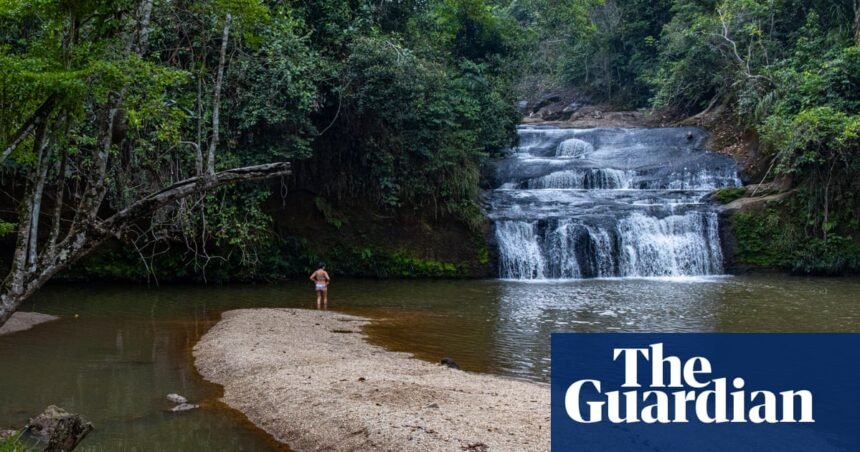
Ten years ago, violent conflict made it impossible for tourists to enjoy the natural riches of Mesetas. The town was one of the centres of the armed conflict that ravaged Colombia for decades, claiming nearly half a million lives.
But since the historic peace treaty in 2016, with efforts to uphold it now led by the leftist president, Gustavo Petro, the people of Mesetas have had their hopes raised for a better life, thanks to those natural assets.
While Mesetas, in the department of Meta, was beset by clashes involving the army, police, leftwing guerilla groups, rightwing paramilitaries and criminal organisations competing for territory, natural resources and control of drug trafficking across the country, the idea of a thriving tourist industry was unimaginable. But with the arrival of peace, came a growing number of visitors. And as the region’s unique biodiversity, which brings together three different ecosystems – Andean, Amazon and Orinoco – attracted more foreigners, local people began to recognise the great potential and value of the nature on their doorstep.
“We didn’t appreciate the beauty around us and we didn’t think people would be interested in coming here until others showed us that we have stunning waterfalls and impressive viewpoints,” says William Rodríguez, a peasant farmer from Mesetas, who is now involved in reforestation projects and rural tourism.
Mesetas’ most popular attractions include the Güejar River canyon and the Telares and Charco Azul waterfalls. Yet, residents and local groups are working to promote other attractions, such as Guácharos Canyon and the Danta waterfall. The area’s biodiversity is impressive, featuring species such as the western mountain coati, the Amazonian motmot, ocelots and giant anteaters.
As tourism increased, the positive effects were almost immediate: 2023 was – along with 2019 – the year with the lowest level of deforestation in Mesetas since the peace treaty was signed, according to Global Forest Watch reports.
Officials at the mountainous Sierra de la Macarena national natural park, an area of 630,000 hectares (1.6m acres) of rainforest, dry woodland, shrubland and savanna, attribute the imporvements in deforestation rates to environmental restoration and ecotourism projects carried out by local groups backed by the UN development programme (UNDP).
The Corredores de Paz (peace corridors) programme helped people in the region become more sustainbable by focusing on environmental conservation and tourism. As part of the project, 40 families helped to restore the river basin, with each family planting one hectare of native trees, including the sebipira (Caesalpinia pluviosa), pink trumpet (Tabebuia rosea) and Spanish cedar (Cedrela odorata).
Omaira Achury, who took part in the project, says: “Through the UNDP, we received the materials to fence the reforested area to stop cattle getting in. Now, the trees are one year old. The idea is to restore as much as we can.”
Another project saw community members launch a bird guide that mapped the region, with instructions on where to find certain species and notes on whether they were vulnerable or endangered. The guide now includes 800 species of birds in the area.
“Before, we didn’t give importance to birds and animals,” says Argenis Buendía, a member of the Catypsa co-operative, which brings together local people and signatories of the peace treaty in sustainable economy projects. “Now we learn to take care of nature.”
Jairo Roncancio, 25, a tourist guide and birdwatcher, believes that “the development of nature tourism has changed people’s mentality”. He recalls carrying rocks for his brother when they hunted birds with a slingshot. “Now, I’m in love with the birds, the river and nature in general,” he says.
People in the community see environmental protection as essential for tourism. Achury has 29 hectares (72 acres) of land, but now only nine are pastures for cattle breeding. The rest is kept as natural forest, with areas for agroforestry and avocado and wood plantations.
“We create a sense of belonging to nature. Before, people only worried about cutting down trees. Now, as a result of these mistakes, we must restore [nature],” says Achury. “We need water and forest to have life. Tourists need this, we need it, and the world needs it.”
According to Arbey Barrios López, a member of the Camaxagua Youth Corporation, a collective of young people who work in sustainable tourism and biodiversity monitoring in Mesetas, conservation areas such as the highest part of the Sierra de la Macarena mountain range are well preserved.
“At the foot of the mountain, we have ‘bald’ spots, as some people call them, with small remaining forest areas. Our commitment is to make these spots grow,” says Barrios.
after newsletter promotion
However, the armed conflict has been resurfacing in several regions of Colombia, including the Meta department.
“Recently, we heard that [armed groups] were offering 10 million pesos [£1,800] to young people. It is a strategy they use to recruit those with family problems or other issues,” says Luis Eduardo Molano, the head of Camaxagua. “When we see young people in this situation, we try to attract them to tourism and sports. Through kayak and rafting lessons, we are snatching them away from war.”
Although there have been no incidents in the area where the collectives operate, some fear that reports of violence in other parts of Meta are already affecting tourist activity in Mesetas. “I think that if the armed groups had not reappeared, our situation would be much better,” says Rodríguez, lamenting a fall in visitor numbers this year.
With the resurgence of the conflict, chronic problems linked to organised crime have also returned. Rodríguez and his wife removed their project from the internet after receiving extortion calls – which turned out to be not from guerrillas or militias but from inmates inside prisons.
“Many of us live entirely from tourism. That is why it’s worrying that the war brings chaos again,” says Molano.
Catypsa is also facing its own challenges after reports of threats from dissident groups of the Farc (Revolutionary Armed Forces of Colombia). Still, the collectives plan to maintain their projects and hope to expand, even as the UNDP project comes to an end.
“We hope that our organisation will soon have its own resources, and will continue to advance in a type of tourism that benefits the community as a whole,” says Barrios.
Camaxagua would also like to see greater government support for people in the area. “If we start paying communities for conservation services, if they become forest rangers, this would be more effective than having five professionals on 650,000 hectares,” Barrios says.
Nicol Castillo, Mesetas’ environment secretary, acknowledges the role the community plays in preservation and restoration but says her municipality has limited resources. “The administration needs to continue looking for alternatives,” says Castillo, adding that payments for environmental services or carbon credits are being considered.
Roncancio, who started birdwatching and monitoring the area’s biodiversity five years ago, compares the conflict with the country’s environmental issues. “If there was a peace treaty during the conflict, why not a peace treaty with nature?” he says. “I know it’s not easy – now, protecting the environment can cost us our lives.”