The long-running television show Cops became a propaganda boon to American law enforcement soon after its debut in 1989. The morality of the show is not complicated: The heroes are guys in uniforms braving danger to restore order. They face off against shirtless, drunken louts yelling in the street or barreling down the highway at 100 miles per hour.
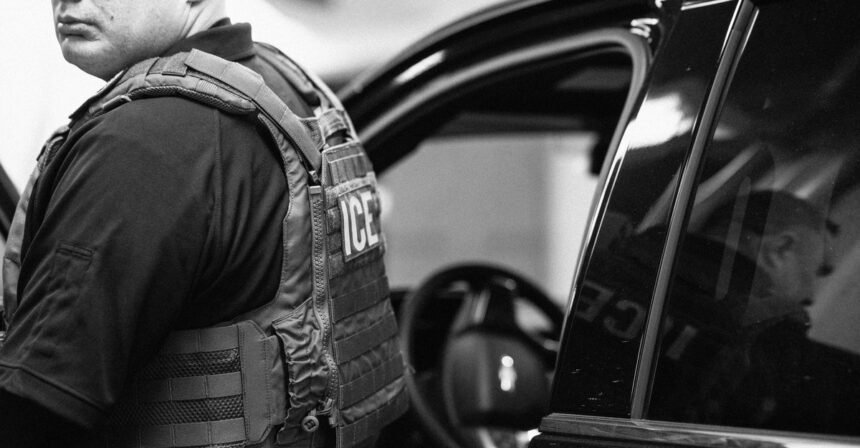
Immigration enforcement in service of President Donald Trump’s mass-deportation campaign has been the aesthetic opposite of a Cops episode. In social-media clips and grainy security-camera footage, U.S. Immigration and Customs Enforcement officers appear in dark clothing, some wearing masks or neck gaiters that make them look like bandits. The people they target may be walking down the street, sitting in a car, or otherwise going about their lives. Few are engaged in obvious criminal behavior.
In one recent example that went viral, ICE officers in Maryland stopped a 51-year-old mother and smashed through her car window to arrest her while her teenage daughter sat in the passenger seat filming and crying. In another, security-camera footage of the arrest of Rumeysa Ozturk—a student from Turkey whose visa was revoked over an op-ed—shows her crying out in fear as plainclothes officers swarmed her on the street and put her in a car. (She was released on Friday.) A Massachusetts neighborhood devolved into chaos last week when ICE officers arrested a distraught teen trying to stop them from hauling away her mother.
Many Americans have recoiled at these scenes, comparing officers’ tactics to those of authoritarian regimes. Yet the arrests in the videos do not show conduct outside the bounds of typical ICE protocol. This is what immigration enforcement looks like. It’s messy and emotional, and requires officers to arrest people for an offense that many Americans do not view as a crime.
Which points to a bigger problem with Trump’s mass-deportation campaign, the signature domestic-policy promise of his second term. Whenever public attention on immigration shifts from the border to U.S. streets, support for aggressive enforcement tends to erode. It happened during Trump’s first term. It’s happening even faster now.
Immigration was one of Trump’s best-polling issues when he took office in January, and his rating on the issue continues to rank higher than his overall job approval. But in the past two months, Trump’s immigration approval rating has seen a double-digit downturn. A Washington Post/ABC News/Ipsos survey of 2,464 adults in late April found that 53 percent of respondents disapproved of Trump’s handling of immigration, compared with 46 percent who approved. Other polls taken around the 100-day mark of Trump’s presidency found similar results.
A president’s approval numbers on immigration can be misleading, because the measurement contains two distinct components. One element is about stopping illegal border crossings. Trump’s border crackdown has pushed unlawful entries along the Mexico border to their lowest levels since the 1960s. The president continues to receive high marks there. But a quiet border does not provide a dramatic visual image.
The other part of a president’s immigration performance relates to people who are already here. Polls show far less enthusiasm for aggressive ICE enforcement that sweeps up immigrants without criminal records in U.S. communities. A recent Pew Research Center poll found that only about one-third of Americans want to see the deportation of all immigrants living in the country illegally. Among the 51 percent of poll respondents who said that at least some immigrants should be deported, support for deporting violent criminals is nearly universal, but backing drops to the single digits when it comes to people who are married to a U.S. citizen or who came to the U.S. as children.
Alexander Kustov, a political scientist at the University of North Carolina at Charlotte who studies immigration, attributes some of the slump in Trump’s approval to the “thermostatic” effect of bold executive action that generates backlash. Kustov told me there’s an even simpler explanation, however. Trump is “not doing what most people want,” he said. He’s doing much, much more. He’s overreaching.
“I think there’s this tendency to assume that if people are skeptical or dislike immigration, they would just be happy with anything, but there are limits,” Kustov told me. “People don’t like chaos at the border. But if you just randomly and mindlessly deport people without due process, it’s also actually pretty chaotic too.”
Republican lawmakers have been advancing a budget-reconciliation bill that would provide the Department of Homeland Security with tens of billions of dollars in additional funding to carry out Trump’s mass-deportation campaign. By this summer, his administration may finally have the money to scale up ICE detention facilities, hire even more private contractors, and ramp up deportation flights. This massive injection of capital is poised to arrive right at the moment the president’s political capital is slipping away.
Soon after Trump designated Tom Homan to be the White House border czar, Homan began playing down expectations that ICE would round up immigrants en masse. ICE would focus on national-security threats and violent criminals, he said—“the worst of the worst.” It sounded like moderation.
That type of selective immigration enforcement does not make for much of a mass-deportation campaign, however. It wasn’t what Trump promised on the trail. I asked Homan in late December how he would be able to sustain public support, given that aggressive immigration enforcement on U.S. streets, filtered through bystanders’ cellphone videos, is so politically perilous.
“We need to show the American people we can do this and not be inhumane about it,” he told me. “We can’t lose the faith of the American people.”
Trump and his top officials took a different path when they returned to power, opting instead for a shock-and-awe campaign that sent migrants to Guantánamo Bay on military jets and banished others to a nightmarish megaprison in El Salvador. ICE operations on U.S. streets, and rumors of them, have left immigrant neighborhoods across the country on edge. Immigration attorneys and advocacy groups are reenergized, winning in court and bringing media attention to the most sympathetic or outrageous cases.
The president and his aides have tried to stay on offense by playing up the criminality of the immigrants taken into custody, most recently by lining the White House lawn with mug shots of criminal suspects and offenders. Homan and other Trump officials have been trying to have it both ways: claiming they’re focused on criminals while moving aggressively to boost their arrest numbers using enforcement tactics that net a much broader range of noncitizens. ICE says three-quarters of the immigrants it arrested during Trump’s first 100 days had criminal records, but the agency did not provide a breakdown of their crimes. Traffic offenses, drug crimes, and immigration violations—such as reentering the United States after a deportation—are typically the leading categories.
Trump officials and the president’s supporters blame the news media for his slumping immigration approval numbers. The president “is going up against a very hostile media that is going to spin all of his efforts however they see fit,” Andrew Arthur, a former immigration judge and federal prosecutor, told me. Arthur—a fellow at the Center for Immigration Studies, a think tank that seeks tighter borders—pointed to recent reporting that said ICE had “deported” a toddler who is a U.S. citizen. The toddler’s mother had been deported and opted to bring her daughter, but the child was not “deported” in a legal sense, he said.
“Many in the media have bought into this idea that is pushed by amnesty proponents that when somebody is here and has any equity, they should be here forever,” Arthur told me. “You can’t have border security if all somebody has to do is get past the Border Patrol agents. It’s impossible.”
Pendulum swings on immigration have followed every election cycle in which Trump has run. He took office the first time with public opinion largely favorable to his hawkish build-the-wall rhetoric.
In 2016, just 30 percent of Democrats told Gallup they wanted to increase immigration. Four years later, after Trump implemented harsh enforcement policies such as the separation of parents from their children at the border, known as Zero Tolerance, Democratic attitudes were more pro-immigrant than at any point in the previous 15 years. Overall, only 28 percent of Americans told Gallup in a 2020 survey that immigration should decrease. “Abolish ICE” became a political rallying cry.
Yet by the end of President Joe Biden’s term, after record numbers of illegal crossings, the damaging imagery was not ICE arrests, but the throngs of people streaming across the border unchecked. The percentage of Americans who wanted immigration to decrease reached 55 percent—the highest level since 2001. Republican attitudes shifted the most, but Democrats and independents also moved to the right, surveys showed.
Former DHS officials told me the Biden team overreached in its own way, misinterpreting Americans’ disgust with Trump policies. It wasn’t a mandate to ease up at the border or allow millions of people to enter. “They took it too far,” one former DHS official told me. The official, who did not want to be named because they do contracting work with the government, also said Biden’s more selective approach to ICE enforcement was ultimately a benefit to the agency and helped rehabilitate its public image.
Tom Warrick, a former DHS official who served under both Republican and Democratic presidents, said the current administration would be smart to spend heavily building up the immigration court system and providing more due process, not less. The administration could attempt to clear backlogs in the court system by recruiting retired lawyers to work temporarily as immigration judges. Polling shows that a majority of Americans aren’t opposed to deportations per se, but believe that the government should follow the law and give detainees a fair hearing.
Warrick told me it won’t be easy for the Trump administration to simply ignore public opinion and forge ahead with three and a half more years of harsh tactics. If it does, that could feed the sanctuary-jurisdiction movement that Trump officials are trying to stamp out. “State and local governments are going to be more and more reluctant” to cooperate with ICE, Warrick said. If the administration tries to punish those who refuse, “they’re going to make heroes out of their opponents.”
Stephen Miller, the architect of the administration’s immigration policies—and the political messaging behind them—has led the attack on due-process rights for ICE detainees. Last week he said the White House is considering wartime measures that would suspend people’s constitutional right to challenge their arrest and imprisonment. ICE is not required to publicly release the names of those it arrests. Stripped of habeas protections, the immigrants in the grainy videos being seized off the street could be quickly deported with no recourse to challenge their detention. But most wouldn’t show up in any video at all.