Most investors just aren’t seeing this e-commerce company’s bigger picture.
Got an extra $1,000 you’re ready to invest for a while but don’t know which stocks to buy? If so, you’re not alone. The past few weeks have been full of tariff-driven turmoil. The beginning of earnings season has only added to the uncertainty.
There’s arguably at least one name, however, that’s worth stepping into here no matter what the foreseeable future may hold. That’s Shopify (SHOP -2.34%). Although the company’s first-quarter results were partially disappointing, those lackluster numbers were also arguably already baked into the stock’s price, while none of its likely future growth is.
One disappointing data point was all it took
If you’re not fully familiar with Shopify, the company helps others establish, manage, and promote their own online store. From digital shopping carts to inventory management systems to online-payment processing, Shopify offers it all. That’s why roughly 5 million businesses have chosen Shopify’s technology as their e-commerce solution since it launched as an alternative to Amazon all the way back in 2006.
Shopify’s first-quarter report last week didn’t quite live up to expectations. Namely, although revenue of $2.36 billion and operating per-share earnings of $0.25 (the reported per-share loss of $0.53 reflects a one-time charge) each topped their respective estimates of $2.33 billion and $0.18 per share, the company only facilitated sales of $74.75 billion worth of goods and services versus analysts’ consensus prediction of $74.8 billion. Sales-volume guidance for the quarter currently underway also fell short of forecasts.
The bears latched on to these red flags, dragging Shopify stock down more than 6% at one point on Thursday to reaccelerate a sell-off that’s been underway since the latter half of February.
There’s a reason, however, those sellers changed their mind later that very day and are still keeping Shopify shares propped up. That’s the bigger-picture growth that’s still underway despite a couple of disappointing numbers from the company’s Q1 results and Q2 outlook.
You’d be wise to take that cue.
Plugged into a trend that won’t be stopped
Sure, Shopify’s gross merchandise volume numbers weren’t quite what investors were hoping for.
Take a step back and look at the bigger picture, though. Last quarter’s revenue still grew to the tune of 27%, extending a well-established trend. Non-GAAP operating income improved from $201 million in the comparable quarter a year earlier to $329 million this time around, also extending an established trend.
SHOP Revenue (Quarterly) data by YCharts
The current quarter’s gross sales volume and revenue outlook also call for year-over-year growth in the mid-20% range, which is not only still healthy, but in line with analyst estimates. And that’s only a taste of what the analyst community expects over the course of the coming three years.
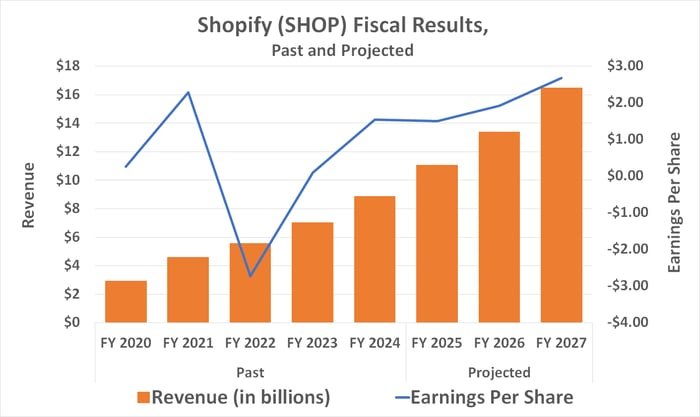
Data source: StockAnalysis.com. Chart by author.
This growth pace is likely to persist for far longer than just the next three years, though.
See, Shopify isn’t just plugged into a cyclical growth trend. It’s also plugged into a secular, sociocultural change that’s not likely to ever be undone.
In this case that change is a shift in consumer preference — most people would rather purchase directly from a brand than go through a third-party intermediary like Amazon, particularly when factors such as sustainability or social causes are on consumers’ minds. PwC reports, in fact, that roughly two-thirds of U.S. shoppers have made at least one purchase directly from a particular brand’s own website, with that number likely to continue rising as brand-driven “stories” play an ever-growing role in consumers’ spending.
Brands encourage it too, of course, since they typically pay online malls like Amazon and eBay between 10% and 15% of every sale their platforms facilitate. On their own, they keep all of this commission.
Brands also like the option of building a deeper relationship with customers than is typically possible through a third-party selling site.
A noisy near term doesn’t change the promising long term
So why are Shopify shares struggling of late?
Perception and uncertainty have a lot to do with it.
Although Shopify’s business may or may not be directly impacted by newly raised import tariffs, it’s difficult to imagine an environment in which the company and its customers aren’t at least indirectly impacted by tariff turbulence. Most investors are simply playing defense now, even if only by letting go of stocks that had performed exceedingly well through mid-February.
As the brilliant investor Benjamin Graham reminds us, though: “In the short run, the stock market is a voting machine. But in the long run, it is a weighing machine.” Shopify stock’s recent weakness reflects voting rooted in fear and worry. Given enough time, however, Shopify shares will almost certainly reflect the annualized growth rate of more than 24% (through 2029) that research firm Global Market Estimates expects of the direct-to-consumer selling market Shopify serves.
Or this might help. Despite the stock’s recent pullback and relatively disappointing guidance, the majority of the analyst community still rates this ticker as a strong buy. These same analysts also collectively say this stock’s still worth $113.71 per share, which is 25% above Shopify’s present price. That’s not a bad tailwind for a new $1,000 position.
Just prepare to be patient with this investment, which has proven it can be volatile.
John Mackey, former CEO of Whole Foods Market, an Amazon subsidiary, is a member of The Motley Fool’s board of directors. James Brumley has no position in any of the stocks mentioned. The Motley Fool has positions in and recommends Amazon, Shopify, and eBay. The Motley Fool has a disclosure policy.