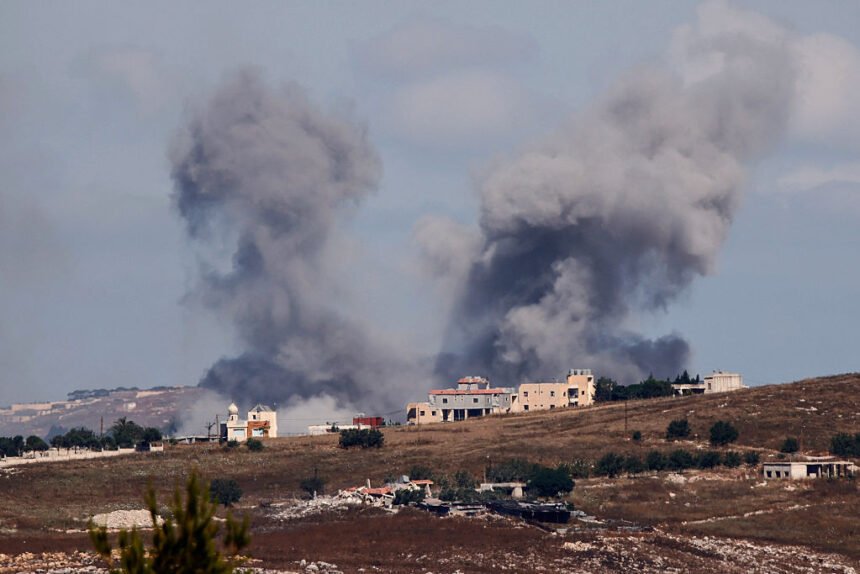
Israel and Hezbollah agreed to a cease-fire Friday, a U.S. official told TIME, after a fresh exchange of strikes risked derailing Washington-Tehran talks for a permanent truce in the Iran war.
The halt in hostilities is understood to have come into effect at 4 p.m., local time.
President Donald Trump later told NBC News that he had spoken with Israel and asked them to agree to the cease-fire, referring to the development as “a positive.”
There has yet to be an official confirmation of a cease-fire in Lebanon from either Israel or Hezbollah. TIME has reached out to the relevant parties for comment.
The next round of Israel-Lebanon talks are scheduled to take place in Washington from June 23–25, the U.S. State Department said Friday afternoon, after U.S. Secretary of State Marco Rubio shared a call with Lebanese President Joseph Aoun.
Rubio underscored that “Lebanon’s bilateral negotiations with Israel represent the only feasible path to reconstruction, economic recovery, and ending recurrent cycles of violence,” a spokesperson said.
The U.S. and Iran peace talks were set to start anew in Switzerland Friday after the memorandum of understanding was signed earlier in the week, but they were abruptly postponed amid the flare-up of violence.
The White House on Thursday night said Vice President J.D. Vance would not be travelling to Europe to lead the U.S. delegation as “the plans for the upcoming technical talks have not been finalized.”
“The logistics of these negotiations have never been simple or predictable, we look forward to beginning technical talks as soon as possible,” a spokesperson said.
Lebanese broadcaster Al Mayadeen reported that Iran’s delegation postponed their travel to Switzerland due to the hostilities in Lebanon.
The latest exchange of strikes between Israeli forces and the Iran-backed Hezbollah militant group killed at least 18 people in Lebanon, according to the country’s Health Ministry.
Aoun condemned the intensified fighting as a “dangerous escalation.”
Israel reported four of its soldiers were killed by Hezbollah militants. “Israel will not tolerate attacks on our soldiers or our territory, and it will exact a very heavy price from Hezbollah for these attacks,” said Israeli Prime Minister Benjamin Netanyahu, following the overnight unrest.
The Israel Defense Forces (IDF) said it had struck “80 command centers, terrorists, launch positions, and additional terrorist infrastructure” across southern Lebanon in response to what it described as “Hezbollah’s repeated and blatant violations” of the initial cease-fire.
Read More: G7 Leaders Call For ‘Immediate Cease-Fire’ in Lebanon as They Welcome U.S.-Iran Peace Deal
The renewed fighting was a significant test of the U.S.-Iran memorandum, as the first term states that upon signing, “the United States of America and the Islamic Republic of Iran and their allies in the current war” declared the “immediate and permanent termination of military operations on all fronts, including in Lebanon.”
But Israel was not a party to the negotiations, and Netanyahu earlier this week ruled out any immediate withdrawal of troops from Lebanon.
Trump and Vance have both aired their frustrations with Israel amid efforts from Washington and Tehran to finalize a permanent truce in the Iran war during their own extendable 60-day cease-fire.
Esmaeil Baghaei, Iran’s Foreign Ministry spokesperson, on Friday said the United States bears responsibility for the Israeli strikes in Lebanon, citing the first clause of the memorandum. Tehran will “take all necessary measures to protect its interests, security, and rights and those of its allies,” he said.
Throughout negotiations, Tehran has been adamant that any cease-fire with Washington must also end the hostilities between Israeli forces and Hezbollah, and that any permanent truce must lead to Israel withdrawing its forces from southern Lebanon.
J.D. Vance’s warning to Israeli officials
Vance on Thursday warned the Israeli government to get on board with the U.S.-Iran agreement amid criticism from ministers including Itamar Ben-Gvir and Bezalel Smotrich.
“If I was in the cabinet of the Israeli government, I might not be attacking the only powerful ally that I have anywhere left in the entire world,” Vance told reporters at a White House briefing.
Vance stated that two-thirds of Israel’s defense weapons have been built and paid for by Americans, insisting: “Anybody in Israel who thinks their biggest problem is the President of the United States needs to wake up and smell the reality of the situation that country is in.”
While Netanyahu has not made any public comments about the deal since the memorandum was signed, Israeli media outlets aligned with Netanyahu have criticized Trump and his team.
Trump has publicly criticized Netanyahu’s approach to Lebanon. In an interview with Axios previewed Friday, the President claimed “Israel would have been eviscerated” if it weren’t for him.
The U.S. President had taken a softer approach during his closing remarks at the G7 summit in France on Wednesday.
Referring to Netanyahu as a “good man,” Trump said the Israeli leader “gets a little excited sometimes” and admitted they have a “dispute over Lebanon.”
He referred to an Israeli strike in Beirut as “unnecessary.”
Trump said Lebanon is “something we’ll have to work on a little bit… it’s a very small piece of the puzzle, actually, but it still makes a lot of noise.”
Since the Israel-Hezbollah fighting reignited in March, early on in the Iran war, at least 3,912 have been killed in Lebanon, with 11,873 wounded, according to the country’s Health Ministry.