Updated at 11:05 p.m. ET on April 27, 2026
To understand the significance of someone running a marathon in less than two hours, you also need to understand that, until recently, the notion of this actually happening was truly, utterly absurd. Sure, a physiologist named Michael Joyner had floated the idea that such a feat might be humanly possible in a journal paper way back in 1991. But his peers laughed off the idea, and not much changed over the succeeding decades. In Runner’s World in 2014, I predicted that it would happen in 2075. Frankly, even that forecast seemed overly optimistic to me, but I figured I’d be dead by then, so no one would be able to call me on it.
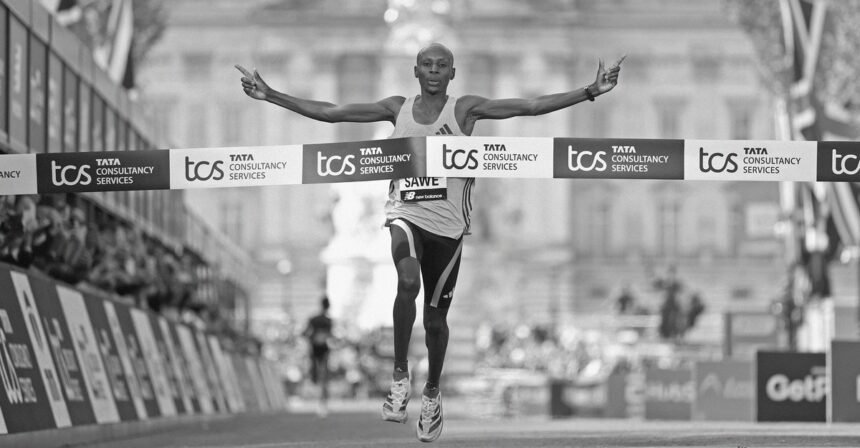
Well, I was wrong. Yesterday morning, the two-hour marathon barrier finally went down. A relatively unheralded 31-year-old Kenyan named Sabastian Sawe won the London Marathon with a time of 1:59:30. That is, for reference, 26.2 miles run at an average of 4:34 a mile—or, put another way, a pace that most recreational runners would struggle to sustain for more than a few seconds, if they could hit it at all. Perhaps even more arresting was the fact that the man who took second place, Ethiopia’s Yomif Kejelcha, also ran under two hours, finishing just 11 seconds behind Sawe.
The feat was the culmination of a shift—or, perhaps more aptly, a total disruption—in marathoning over the past few years, in which the eventual breaking of the mythical two-hour mark went from an impossibility to a guarantee. When sports are young, they progress by leaps and bounds. The first marathon over the now-standard distance of 26 miles, 385 yards, contested at the 1908 London Olympics, was won in 2:55:19. Progress in the succeeding decades was rapid, but by 1991 the sport was mature, professionalized, and lucrative. When Joyner made his prediction, the world record was 2:06:50 and had advanced by less than two minutes since the 1960s. Logic dictated that future decades would see even slower progress, as runners approached insurmountable limits in factors such as how much training they could handle and how much fuel their muscles could store.
The turning point came in 2016, when Nike announced its Breaking2 project. The famous Kenyan runner Eliud Kipchoge and two others were chosen as the centerpieces of a multimillion-dollar attempt to engineer every detail of a sub-two-hour marathon: nutrition, hydration, training, shoes, weather, drafting, pacing, and so on. On a Formula 1 track in Monza, Italy, in May 2017, Kipchoge ended up running 2:00:25, astonishingly and unexpectedly close to the barrier. He ran virtually the entire race behind an arrowhead formation of six pacers who blocked the wind for him; the pacers swapped in and out throughout the race, intentionally violating the rule that all competitors must start at the same time, which meant it didn’t count as a world record. But at that moment, the conversation shifted from when to if.
What remained unclear after Breaking2 was how Kipchoge had run so fast. Was he simply a generational talent? Was it the drafting, which aerodynamics experts argued could shave several minutes off his time all by itself? Or was it the shoes? Nike had unveiled a radically new design for Breaking2, incorporating a curved carbon-fiber plate into a thick wedge of springy midsole foam, which external lab data suggested would make runners several percent faster. Two years later, when Kipchoge ran 1:59:41 under similar non-record-eligible conditions at Ineos’s 1:59 Challenge in Vienna, those questions still lingered. But it was clear that the shoes really worked. National and international records at every distance were falling, and every major shoe company had come up with its own version of Nike’s plate-and-foam supershoe design.
Now that everyone has supershoes, you might think the playing field is level. In reality, the innovation arms race has continued. The exact workings of the plate-and-foam architecture still aren’t fully understood, so shoe companies keep tinkering and producing better shoes. For yesterday’s record-setting marathon, Adidas launched a new shoe featuring an ultralight midsole foam that reduced the overall weight of the shoe to just 3.4 ounces. Sawe was wearing the shoe; four of the top five men’s finishers, including Sawe, are sponsored by Adidas.
It’s hard to overstate how strange this situation is for the running world, which used to pride itself on being the simplest and most gear-agnostic sport. Every year since time immemorial, shoe companies have launched new shoes with the promise that they will be game changers. Until 2017, this was never actually true. But now the record books keep being rewritten. Kipchoge brought the official record down to 2:01:39 in 2018, then 2:01:09 in 2022. The following year, another Kenyan, Kelvin Kiptum, ran 2:00:35 at the Chicago Marathon. This was proof that Kipchoge wasn’t an irreplaceable freak of nature—and invited only more questions about the shoes and what it means to compare runners year by year. Could Sawe have broken two hours in different shoes? Could he even have done it in last year’s shoes? Head-to-head comparisons are difficult: Kipchoge, now 41, is past his competitive peak, and Kiptum was killed in a car accident at age 24, just a few months after setting his world record.
Then there’s the question of drugs. If sprinters on steroids was the cliché of the 1980s, blood-doping endurance athletes has become a similarly familiar trope. Kenya, in particular, has been singled out as a serial offender: More than 140 runners from the country are currently serving doping suspensions, including the women’s marathon world-record holder, Ruth Chepngetich, who tested positive for drugs in the summer of 2025. (Kipchoge and Kiptum have not faced any formal doping accusations.) In this respect, Sawe and Adidas have been prescient. In the two months prior to last fall’s Berlin Marathon, Adidas ponied up a reported $50,000 to have World Athletics’ Athletics Integrity Unit test Sawe 25 times. Berlin turned out to be too warm for a fast time, but Adidas and Sawe continued the arrangement this year. “I wanted people to know that whatever happened in the race, I was not to be doubted,” Sawe told the running website LetsRun.
Sawe’s extraordinary performance justified the extraordinary precautions. In London, a pack of six runners broke away early, tucked behind three pacemakers until the halfway mark, reached in 1:00:29—which, you’ll note, is considerably slower than two-hour pace. Sawe looked barely conscious, conserving his energy, his eyes locked onto the back of the pacemaker in front of him. One of the pacemakers continued until just after the 25-kilometer mark, by which time the pack had been reduced to three. Once that final pacemaker dropped out, Sawe came alive and began to turn the screws.
If the magic of Kipchoge’s unofficial sub-two-hour race was in the drafting, then Sawe having to lead for more than 10 miles should have doomed him. Instead, he got steadily faster. Only in the final few miles did the BBC’s race commentators suddenly realize that history might be beckoning. You can’t blame them: Nobody could have foreseen how much Sawe would accelerate. He ran the second half in 59:01—a time that, on its own, would be a national record in all but a handful of countries. And glued to Sawe’s shoulder until the final mile was Kejelcha, the Ethiopian runner, waiting for him to falter. Sometimes top runners prefer to minimize competition when they’re chasing world records so that they don’t need to worry about getting passed if they misjudge the pace. But in this case, it seems likely that Sawe’s acceleration was fueled at least in part by the desperate desire to shake off his persistent shadow.
All told, Sawe’s breakthrough—the head-to-head throwdown, the drug-testing program, the dramatic finale—was exactly how you’d script an all-time performance. He did everything right—which is why I feel bad about the lingering hint of anticlimax I feel in myself and sense in my running friends. The truth is, Sawe’s performance was only the second-most surprising marathon result of the weekend. At a marathon in Toledo, Ohio, an unheralded local 25-year-old named Vincent Mauri won in 2:05:55, beating the previous course record by more than 13 minutes. This makes him the fourth-fastest American in history. These are both, in their own way, performances for the ages, unless next year’s shoes turn out to be even better.
This story originally misstated Sawe’s time at the halfway point of his record-setting marathon as 1:00:26.