In 1902, more than a century before the Trump tariffs turned global trade upside down, people from around the world were racing to set up shop on the island of Gulangyu. At the time, many of the world’s great powers were opening consulates on this islet near Xiamen, China, eager to stake an economic claim on the Middle Kingdom. On Gulangyu, new arrivals from the United States, the United Kingdom, Japan, and 10 other nations forged a pluralistic society, one that built terraced seaside gardens, winding lanes, and villas that wouldn’t look out of place in the south of France. This unique architectural tradition and cultural legacy is today recognized by UNESCO, which added Gulangyu to its list of World Heritage sites in 2017.
Algirdas Bakas
If you’re anything like me, you’ve probably never heard of Gulangyu or, for that matter, Xiamen, the city of 5 million just an eight-minute ferry ride away. So, for me, it was a revelation to wander the charming pedestrian streets of Gulangyu, taking photos, ducking into tea shops, and shopping for postcards. Everything—every snippet of Chinese I heard, every pagoda and vista I saw in the Shuzhuang Garden—was wildly novel. It felt completely different from anything I’d ever seen before, an epiphany in an increasingly homogenous world.
Algirdas Bakas
What’s more, by the time I arrived in Gulangyu, I had been feeling that way for several days. I’d had similar experiences in Dongtou, Pingtan, and Zhoushan—three other coastal Chinese destinations that I had never heard of until a couple months before I arrived. I had been somewhat uncertain whether it was even possible to visit mainland China as a tourist, given the fraught political and economic situation between the U.S. and the People’s Republic. Before I went on the trip, at least one of my well-traveled friends had told me the idea of going seemed, if not foolhardy, too difficult to be worthwhile.
Algirdas Bakas
But I did have confidence in Viking: the T+L reader favorite resumed its operations in mainland China in September 2024 after a five-year hiatus. Previously, Viking had offered river cruises along the Yangtze with add-on visits to places like Beijing and Xi’an. The company’s ocean cruises between Hong Kong and Shanghai aboard a 465-cabin ship represent something completely fresh.
Algirdas Bakas
So, last November, I followed the lead of those early-20th-century trailblazers and made for the coast of China, flying to Shanghai to board the Viking Yi Dun.
Algirdas Bakas
Funnily enough, the one thing that didn’t surprise me on my 10-day cruise was the ship itself. That’s because the Yi Dun is more or less a carbon copy of all the other ocean ships in the Viking fleet. The public spaces are Scandi-chic, with blond wood, wool accents, and plenty of comfortable seating; a pool deck with a movable roof allows for indoor-outdoor operation. The brand’s trademark central Atrium is a hub of activity, as is the line’s usual World Café, an all-day buffet. The dishes it served—Beijing-style soy-sauce noodles, dumplings, wok-fried vegetables, crackly fried chicken with fiery Tien Tsin chiles—were a highlight of my trip.
Algirdas Bakas
My fellow passengers were fascinating—and extraordinarily well-traveled. Even so, several people indicated that they’d always assumed China would be too difficult or expensive to visit—that is, until Viking emailed them. Most were making the cruise part of a larger China itinerary, combining it with tours of Beijing, Xi’an, or Chengdu. One traveler mentioned that he was planning to spend at least four extra days in Hong Kong, seeing as he was in the neighborhood.
Algirdas Bakas
I, too, felt like I’d won the travel lottery, getting to see places that had been closed to Westerners (and indeed many Chinese people) for years because of COVID restrictions. By sailing with Viking, I suddenly had the keys to some of China’s most interesting cities. What’s more, I never once had to wait in line, buy tickets, arrange transportation, make restaurant reservations, or handle any other logistics.
Algirdas Bakas
While many of the places I saw were tourist attractions, they never felt touristy—in part because, from the minute we left Shanghai, I didn’t see a single Westerner who wasn’t traveling on the Yi Dun. At the Xichan Temple in Fuzhou, for example, there were hardly any visitors save for a dozen of us from the ship and a Chinese couple taking wedding photos in traditional costumes. At a time when it seems like the entire world is crashing the gates of museums and trampling the downtowns of Europe, touring China, ironically, felt like the cure for crowds.
One morning, on an excursion from the port of Zhoushan, several dozen of us were treated like VIPs as we toured the centuries-old lanes of the fishing village of Dongsha. Like other seaside enclaves, Dongsha was founded as a trading post and, in turn, became a venue for cross-cultural exchange. In that spirit, Viking had arranged for us to be greeted by a dragon dance—which several passengers joined—and performances of traditional Chinese theater and puppetry. When I’ve seen these sorts of shows in the past, they’ve always struck me as contrived. But, perhaps because of my own unfamiliarity with pre–Cultural Revolution China, they offered a compelling window into an aspect of the society that I hadn’t previously thought much about.
The next afternoon, we arrived in Wenzhou, an industrial port about halfway between Shanghai and Xiamen. As we docked next to massive gantry cranes and stacks of shipping containers, it was hard to imagine that anything especially scenic could be close at hand. But the archipelago of the Dongtou district was just a short bus ride away, giving me the chance to walk several miles along a seaside promenade that felt like something out of California’s Central Coast: pine-covered cliffs, boulder-strewn beaches, and, on the breeze, the scent of seaweed being farmed offshore. For all the natural beauty, the most memorable part of the day was when a group of Chinese tourists walking by insisted on getting a photo with our group—Western tourists being considered even more of a noteworthy sight than the marvelous views.
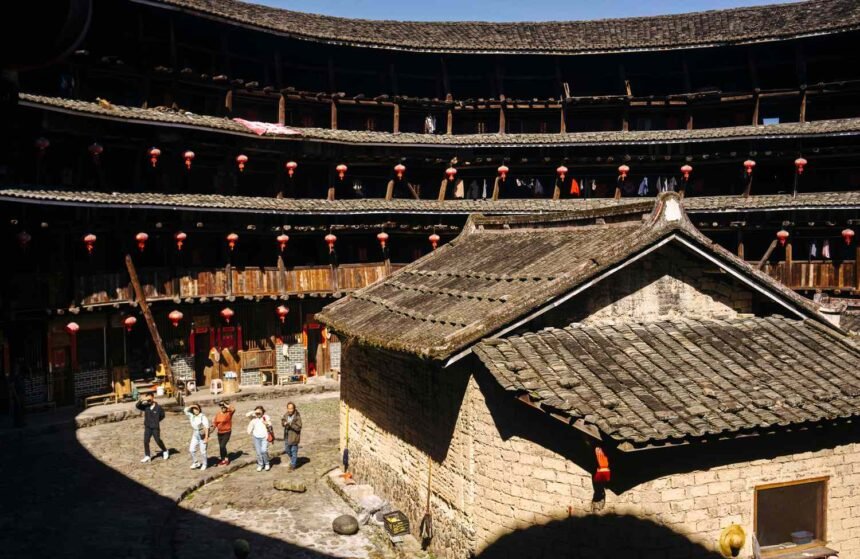
As the Yi Dun continued south, the surprises continued. In the Sanfang Qixiang district of the city of Fuzhou, a group of us had one of the trip’s most memorable meals, which began with faux shark’s fin soup and sesame shrimp and continued with platters of fried cod, wilted greens, seafood noodles, and lotus-root tips, which were arranged on the lazy Susan in the middle of our round banquet table. Another day, we toured the UNESCO-listed Tulou district, where the Hakka community developed an architectural form that fuses the ideas of collective defense with apartment living. These tulou, some of which date back to the 13th century, are like enclosed villages for hundreds of people: sturdy walls surround an open-air courtyard at the center of a square or circular floor plan. Today it’s possible to visit several of these buildings, where people continue to live and work—and welcome visitors to shop for souvenirs, many of them handmade on site.
In Xiamen, a dozen of us spent two nights off the ship, at the excellent Andaz, so we could do more sightseeing on land while the Yi Dun traveled south, spending a day and a night at sea. That gave us the opportunity to visit, after dark, the Eighth Seafood Market, where all manner of sea creatures were for sale—and often cooked to order: fresh clams, nearly translucent shrimp, live dogfish, oysters, sea urchins, squid, porgies, crabs of seemingly every conceivable size and color. Many vendors seemed shocked that I’d wandered in; I wouldn’t have missed it.
To catch up with the ship, which would soon dock in Shenzen, Viking arranged for our group to take a bullet train. I’ll admit to being something of a #railfan, so I found the idea of racing through the countryside on one of China’s superfast trains appealing. It was also, I discovered while boarding at Xiamen, a study in how China and the U.S. have perhaps more in common than we Americans think: I passed the time before departure by browsing in airport-style shops. Once on board, I was a little underwhelmed. We may have been zipping along at 142 miles per hour, but I felt like I was riding the Amtrak Acela.
But then we came to the outskirts of Shenzen, the megalopolis that is today home to 18 million people. We alighted from our train and boarded a bus that would take us back to the Yi Dun for a final night. Along the way, we drove past miles and miles of skyscrapers, a boomtown of mind-boggling scale, conjured to serve the relentless growth of this city. Though I didn’t have time to explore, one thing seemed certain: there was much, much more to see.
A version of this story first appeared in the December 2025/January 2026 issue of Travel + Leisure under the headline “Surprise and Delight.”