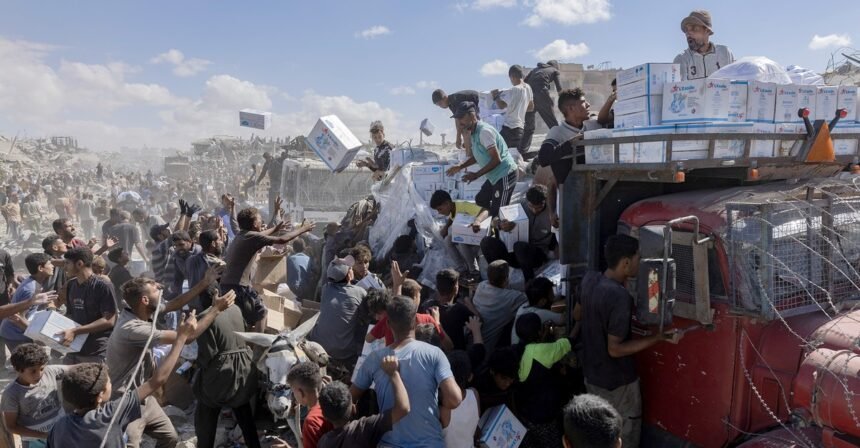
Immediately after Hamas and Israel agreed to the first phase of President Donald Trump’s peace plan, food and medical supplies were supposed to start flooding into the Gaza Strip. Like other key aspects of the agreement, that influx did not go exactly as planned. Some food, fuel, medical supplies, and other resources are moving, but the flow of aid remains clogged.
The success of the Gaza cease-fire—which Trump has called perhaps “the greatest deal” of any he’s made—depends on the United States’ continued involvement. Top U.S. officials, including Vice President J. D. Vance and Secretary of State Marco Rubio, have flown to Israel, trying to shore up the cease-fire. (Israeli media, The Wall Street Journal reports, have taken to calling the visits “Bibisitting.”) On the immediate agenda is “giving people some food and medicine,” Vance said during a press conference last week.
Faced with humanitarian crises in the past, the White House could lean on USAID’s experience with global aid and its expertise in postwar recovery. But since DOGE was unleashed on the U.S. government, that agency essentially no longer exists. Work on aid in Gaza was not exempt, former and current aid workers told me: The Trump administration fired people actively working on this conflict, and the State Department now must figure out, largely on the fly, how to help aid reach Gaza.
As much as the Trump administration has undermined American aid around the world, its interest in peace between Israel and Palestine shows that the U.S. still intends to be very involved in humanitarian work in some places. Gaza is both the most high-profile test yet of Trump’s decision to slash the United States’ humanitarian capacity and the best available example of what relief work his administration is capable of when it is extremely invested.
In the first 12 days of the cease-fire, the UN’s World Food Programme brought in an average of just over 700 tons of food a day, a WFP spokesperson, Martin Penner, told me. The UN says cooking gas has also entered the Gaza Strip for the first time since March. Excluding weekends, when crossings into Gaza may be closed, enough aid trucks have entered on average to meet the minimum laid out in the cease-fire deal, according to a source with direct knowledge of State Department activities. But the World Food Programme says it would need to bring in twice as much food to reverse pockets of famine. The program’s meal distribution in northern Gaza, the epicenter of the Strip’s starvation, began only about two weeks into the cease-fire, Penner said. Twice during the cease-fire, the Israeli government has said it would restrict the flow of aid into Gaza: once in response to the slow release of deceased hostages, and then after a spate of violence. The source with direct knowledge of the State Department told me that humanitarian aid is now “widely accepted” to be a phase-two priority—still a goal, but one that follows the completed exchange of both Israelis’ and Palestinians’ remains.
At least some State Department officials key to pursuing that goal were not at work early during the cease-fire. Instead, they were furloughed by the government shutdown, according to one current and one former federal employee. (They, like other current and former aid workers I spoke with for this story, requested anonymity for fear of retribution.) During the first week of the cease-fire, the Trump administration pulled those officials back into the office, the current and former federal employees told me. The furloughed staff were able to get up to speed quickly, according to the current employee and the source with direct knowledge of events in the department.
But those workers represent just a fraction of the effort that the U.S. once put toward ensuring aid was entering Gaza. Before Trump took office, for example, a team of about 30 USAID experts in D.C. and the Middle East had been working full-time on providing humanitarian relief in the Strip, Andy Hall, a former USAID officer who worked on the Gaza response, told me. American involvement was key to aid getting in at all: As NPR has reported, almost nothing entered unless top officials called Israeli Prime Minister Benjamin Netanyahu, his adviser Ron Dermer, or his defense minister. At least one USAID official met daily with COGAT, the Israeli military agency that has controlled what aid enters Gaza, Paul Martin, a former USAID inspector general, told me.
UN agencies and other NGOs also participated in those meetings. But because the U.S. has a better working relationship with the Israeli agency than the UN does, the Americans made a difference in securing humanitarian access to Gaza, according to three sources with direct knowledge of the meetings. Eri Kaneko, a spokesperson for the UN’s Office for the Coordination of Humanitarian Affairs, told me that “it’s no secret that the UN and our partners have not always seen eye to eye” with COGAT, and that the UN would “welcome the support from the U.S. and other member states to ensure we’re able to deliver lifesaving aid swiftly.” Samantha Power, the top USAID official under Biden, said in a January interview with Politico Magazine that UN officials relied on USAID to lobby Israel to renew the visas of its staff so that they could continue working in Gaza.
Then the Trump administration fired every humanitarian expert employed by USAID, and many of those employed by the State Department. The USAID staffer detailed to Israel’s aid-coordination board was fired by early February, Martin told me. This doesn’t mean that the U.S. has abandoned the project permanently: In response to a request for comment, the White House directed me to the State Department, which told me in an email that officials have met with the Israeli military unit coordinating aid and directed me to its October 16 X post announcing that a disaster-response team, working without pay during the shutdown, was helping “surge and coordinate aid into Gaza.” (The person who responded did not provide their name. They did not say whether any American representatives kept attending the daily board meetings after USAID collapsed.)
Still, the federal government’s push to cancel foreign aid meant that it entered the cease-fire deal with a smaller team just assembled. In July, when the United Nations put out its own plan for surging food and medicine into Gaza in the event of a cease-fire, the State Department was still hiring the people currently coordinating its Gaza relief work, the current federal employee and one of their colleagues told me. “The lack of engagement by the U.S. on the response in the interim has undoubtedly affected the level of preparedness for ‘day 1’ of a peace deal,” the current federal employee told me.
The Trump administration’s approach to aid in Gaza has also weakened the UN’s work there. Without USAID to intervene, Israel has, as my colleague Franklin Foer wrote in August, pursued “a string of policies that seem intended to permanently push the UN out of Gaza.” Israel refused to renew the visas of top officials at at least three UN agencies operating in Gaza and de-registered major aid groups that had been working in Gaza for decades.
Beginning in May, after Israel halted all aid to Gaza for 11 weeks, the Gaza Humanitarian Foundation, a months-old nonprofit, became the primary food supplier in Gaza. The U.S. was directly involved in this venture: It was designed by American management consultants (along with Israeli officials and businessmen), staffed by American security contractors, and funded in part with American taxpayer dollars. Whereas the UN system once ran about 400 aid sites, GHF never ran more than four. According to food-security experts, extreme malnutrition in Gaza, already high, skyrocketed after GHF took over; according to Netanyahu, the foundation failed to prevent looting by Hamas. (In an email, a GHF spokesperson wrote that the non-profit was “the only organization that delivered aid directly to the Palestinian people including women, children and elderly.” He also noted that GHF was now down to three distribution sites, all “temporarily paused during the ongoing hostage exchange.”)
Now, though, the Trump administration is counting on the United Nations to help fulfill the cease-fire’s goals. Last month, in front of the UN’s General Assembly, the president essentially called it a coalition of paper pushers. But his cease-fire plan explicitly calls for the UN to distribute aid, alongside the Red Crescent and “other international institutions.” He’s also dispatched American troops to Israel to help ensure aid groups are allowed to do their work; American diplomats are set to join them.
Exactly how all of these pieces will fit together is unclear. Usually, civilian groups lead relief efforts and coordinate with the military for protection. In this case, roughly 200 U.S. soldiers are setting up a civil-military coordination center, which has also been given the job of facilitating the flow of humanitarian aid into Gaza. The person with inside knowledge of the State Department said that the UN will play a role in the civil-military collaboration, but American officials are still determining its precise shape. At last week’s press conference, Trump’s son-in-law Jared Kushner (a senior adviser in the first Trump administration, whom the president has said he “called in” to work on the cease-fire) said that coordination between the United Nations and Israel has so far been “surprisingly strong.”
Trump’s cease-fire has undeniably improved conditions in Gaza. But humanitarians’ job there is particularly difficult. Many of the people whom the UN is rushing to serve are starving, enough to require urgent medical treatment in addition to food. When starving people can’t trust that relief will come, they take what they can find, Tess Ingram, a UNICEF spokesperson who was in Gaza City when we spoke earlier this month, told me. Early in the cease-fire, as a convoy of trucks carrying food rolled into southern Gaza, Palestinians stripped them bare in 20 minutes mid-route, The New York Times reported: “Young men fared best. Children had to look for what openings they could.” How much better their situation gets will depend in part on how well the new American approach to aid works.