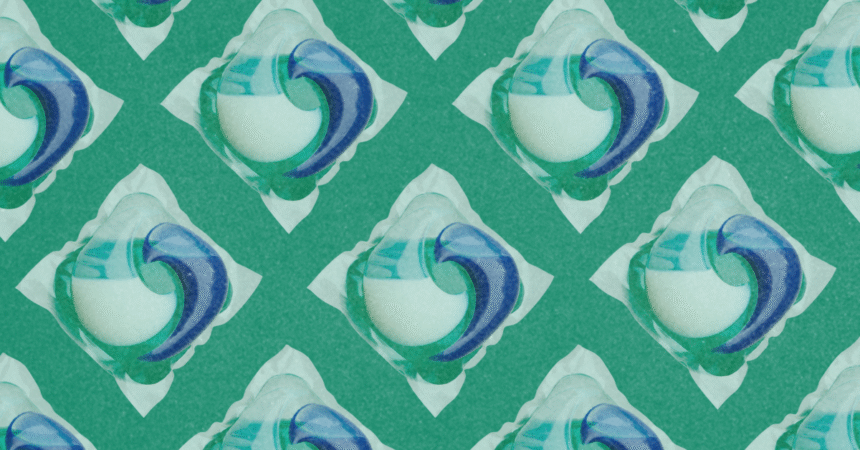
Plastic is everywhere in most kitchens: cling wrap seals food instantly; disposable utensils require no washing; and dishwasher pods skip the hassle of measuring powders or liquids.
All of that convenience involves a major downside, though. After plastics are used, they often break down into tiny pieces, called microplastics, that wind up in the environment and, ultimately, our bodies.
In the case of dishwasher pods, companies have tried to design the plastic films to dissolve harmlessly. Even so, some researchers are concerned these pods may persist in the environment, ultimately adding to other plastic-related exposures that science is increasingly linking to chronic diseases.
Here’s the latest research on how dishwasher pods might affect health.
The unique plastic used in pods
Plastics production has doubled in the past two decades, and only 9% of it is successfully recycled. The resulting microplastics are so widespread, they’re found in places as remote as ocean trenches and as close as human breast milk.
Although much more research is needed, several studies point to the toxic effects of exposure to microplastics. For example, a study last year found links between microplastics exposure—especially when consumed through food—and harms to reproductive, digestive, and respiratory health.
Dishwasher pods sometimes get lumped into the same category as microplastics, but technically they’re different. The pods—used for laundry as well—are wrapped in a type of plastic called polyvinyl alcohol, or PVA. During production, PVA is processed to make it more water-friendly, so the plastic can dissolve readily into water.
Read More: Can a Multivitamin Make Up for a Bad Diet?
In the final product, the plastic films are tough enough so they won’t rupture when touched with wet hands, but malleable enough that the detergent “gets out and does its job” in the dishwasher, says Lauren Duffy, an environmental toxicologist and senior scientist at the Environmental Working Group.
The remaining PVA molecules, once they’ve dissolved in water, fall outside of the definition of microplastics since they’re liquid instead of solid. Because the residue washes away, most experts agree there’s little risk of toxicity from directly consuming anything left over on your plates.
However, that doesn’t mean the PVA has disappeared, says Sherri Mason, a chemist and plastics pollution researcher at Gannon University. “To say it dissolves just means you can’t see it,” she says. Water still contains the PVA molecules when it leaves the dishwasher for your pipes, headed for the nearest wastewater treatment plant.
What happens—or doesn’t happen—at the treatment plants is key to whether people should be concerned.
What happens to the PVA?
Scientists like Duffy say most evidence shows that treatment plants have the right conditions to further break down the detergent-grade PVA into forms that can’t build up in the environment or body.
In 2021, Belgian researchers tested this type of PVA—following international guidelines for assessing chemicals—and found it degraded enough to be safe in 1-2 months. Detergent-grade PVA, with its balance between firmness in your hand and dissolvability, enables microbes at the treatment plants to eat it up—and break it down—more effectively than other plastics.
For these reasons, dishwasher pods are approved by the U.S. Environmental Protection Agency (EPA)’s program certifying safer products, called Safer Choice, and EWG’s Verified program. (Only pods containing powder are certified; pods with liquid increase the risk of kids accidentally consuming them.) “We’re confident we’ve evaluated detergent-grade PVA in a responsible way,” Duffy says.
Read More: How to Keep Your Heart Healthy in Your 20s, 30s, 40s, and Beyond
Other researchers aren’t so sure about the pods. U.S. water treatment plants are designed to decontaminate solid and liquid waste only, not other chemicals in water, Mason explains. Charles Rolsky, executive director and senior research scientist at the Shaw Institute, a nonprofit focusing on the links between environmental and human health, says that many studies, including his own, suggest PVA can pass through wastewater treatment without completely degrading.
It all depends on the temperatures, types of microbial communities, and other environmental factors at the plants. The tests that follow international guidelines occur in a “very controlled environment, but that may contrast [with] some real-world conditions,” says Varun Kelkar, an environmental engineer who researched plastics at Arizona State University as a doctoral student.
Kelkar believes the molecules frequently enter rivers and oceans, where their interactions with marine life and other contaminants are unknown, he says. In a 2021 study, Rolsky and Kelkar estimated PVA’s presence in the environment and found it was prevalent, especially given its “massive production.”
Rolsky agrees with many others that these PVA remnants are too dissolved to define them as microplastics—but for him, that’s precisely the problem. “There’s a time period during which PVA hasn’t biodegraded enough, and it has an impact,” he says. “It’s a plastic turning into something we can’t even define.”
“There’s certainly some evidence in the literature that the film doesn’t fully degrade,” says Christopher Kassotis, assistant professor and environmental toxicologist at Wayne State University in Michigan.
But other research has found that “treatment plants naturally host a diverse community of microbes that can biodegrade PVA,” says Dan Selechnik, director of environmental health and safety at the American Cleaning Institute, an industry group.
“The science isn’t completely settled,” says Duffy of the Environmental Working Group, while adding that bacteria degrade PVA even in lab conditions considered less hospitable than the ones you’d find at treatment plants. She also notes that Rolsky’s research may group detergent-grade PVA with other types of PVA—used in fishing gear and textiles, for example. Because those are less water-soluble, they’re slower to break down. “It’s easy to jump to conclusions and make worst-case projections about detergent-grade PVA if it’s assumed to act like other PVAs,” she says.
Does PVA accumulate in the body?
If PVA molecules do slip past treatment plants, what then?
Some research indicates no clear harm because the dissolved molecules don’t appear to build up inside the body. “Water-soluble compounds are less likely to accumulate in fatty tissues,” Duffy says.
In 2022, Italian researchers searched the breast milk of 34 women for contaminants and observed plastics in 26 samples. Inspecting various qualities of the plastics, they found only 2% was PVA. None of it resembled detergent-pod PVA, with “no film-like pieces you’d expect,” Duffy says. (The majority of the plastic came from everyday products like grocery bags and food containers.)
Fish seem unaffected as well. When Japanese scientists studied their bodies for a type of PVA similar to detergent pods, the amounts were much lower than the EPA’s threshold for evidence that it’s collecting in tissues. In 2023, the EPA cited this research among other studies in rejecting a petition by several nonprofits—including Rolsky’s Shaw Institute—to regulate detergent-grade PVA.
Read More: 11 Symptoms Foot Doctors Say You Should Never Ignore
Rolsky notes other research suggesting that low exposure to water-soluble PVA can disrupt growth in frogs and fish.
Even if detergent-grade PVA doesn’t cause harm directly, it’s still possible that it carries other toxic contaminants, potentially aiding their journey into our bodies. PVA’s chemical structure, though, makes it less likely to stick to pollutants like pesticides, Duffy says. The EPA has reached the same conclusion, and water-soluble PVA doesn’t bind to heavy metals, according to a 2021 study.
Rolsky and Kelkar maintain that the pods threaten health and the environment. “This isn’t a toxic material by itself,” Rolsky says. “But it’s going into the environment at high levels. Even if small amounts have mildly negative effects as vectors, we need to investigate the cumulative impact,” he says.
How to limit everyday intake
The cumulative impacts of plastics are growing. Plastic is made of petrochemicals, and petrochemical companies are increasing their plastic outputs to make up for lower sales of oil and gas. Plastic production is projected to double or even triple by 2050, despite the studied health and environmental hazards.
“The best thing is to use less plastic,” Mason says, adding that if people stop buying it, companies will make less of it. For her, this principle means avoiding dishwasher pods. She uses a liquid detergent packaged in recyclable aluminum.
But in a plastic-filled world, it’s hard to remove every exposure. To maintain sanity in the kitchen, you might focus on limiting plastic that touches your food—a common route into the body.
“I choose my battles,” Kossatis says. Rather than stressing about every toxic plastic in his midst, he concentrates on reducing microplastics consumption. He uses wooden and metal utensils instead of plastic ones and steers clear of plastic food containers.
Also consider other materials inside your dishwasher. If the interior has plastic tubs or racks, they could be leaching microplastics into the water system. (Higher-end dishwashers may come with stainless steel tubs, while most racks have plastic coating.) The same issue applies if you’re washing plastic containers. “It’s potentially a greater risk than the pods,” Kassotis says. “I don’t run the dishwasher very often.”