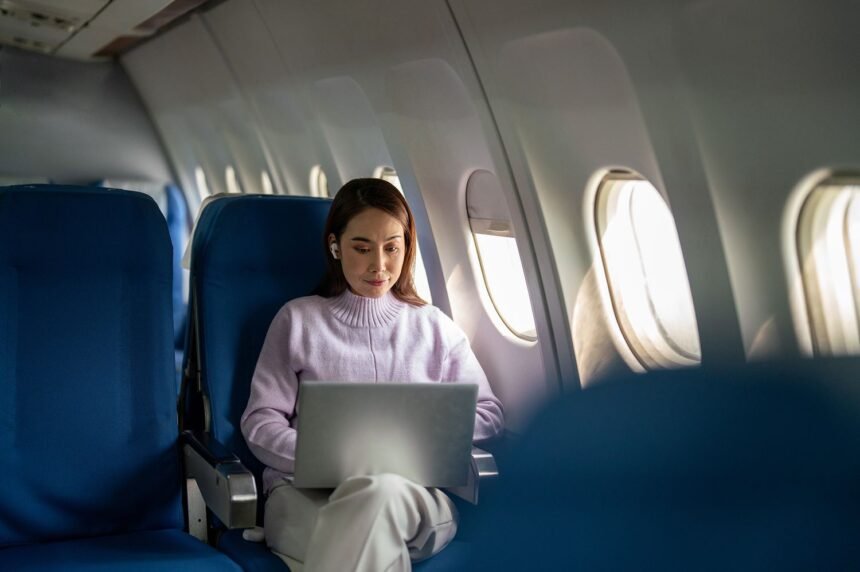
If staying connected to the internet during a flight is important, it’s crucial to be strategic about the seat you choose.
That’s because Wi-Fi speed on planes can vary significantly depending on where on the plane you are, gaming top-up platform LDShop shared with Travel + Leisure. Most aircraft use either satellite-based internet or air-to-ground systems to communicate with cell towers. but both methods can struggle to distribute a Wi-Fi signal evenly.
“People don’t usually realize that their seat choice can make or break their Wi-Fi experience,” Faye Hwang, the business development manager at LDShop, said in a statement shared with T+L. “Understanding how these systems work gives you a real advantage when booking your next flight.”
According to Hwang, the swiftest Wi-Fi speeds are typically found in the middle section of the plane, close to the rows that align with the wings. That’s due to the fact Wi-Fi equipment tends to be installed on the fuselage roof.
Window seats in this section get an even better signal since they’re closer to the plane’s external antennas.
“Think of it like being near your home router,” Hwang said. “The closer you are to the source, the stronger your signal will be. Passengers in the middle cabin sections usually experience 20 [to] 30% faster speeds than those at the front or back.”
Another important factor is the number of active Wi-Fi users. Heavy usage nearby can make the signal sluggish, but turning off automatic app updates and closing background applications that constantly sync data can help. Emergency exit rows may also feature slower Wi-Fi due to the thicker walls and additional equipment around them.
But an internet upgrade won’t always solve the problem: these premium packages may give travelers access to more bandwidth, but they are still using the same equipment.
“For occasional travelers, stick to standard packages but choose your seat wisely. That middle cabin positioning will serve you better than any expensive upgrade,” Hwang said, adding, “Smart timing makes as much difference as seat selection. I always connect during the first hour after takeoff when fewer passengers are online. Avoid peak usage times like meal service when everyone’s bored and reaching for their devices.”
The advice comes as airlines across the United States are introducing free onboard Wi-Fi. JetBlue and Delta Air Lines already offer free connections, while American Airlines plans to roll it out next year and United Airlines has been slowly adding the perk to its aircraft.