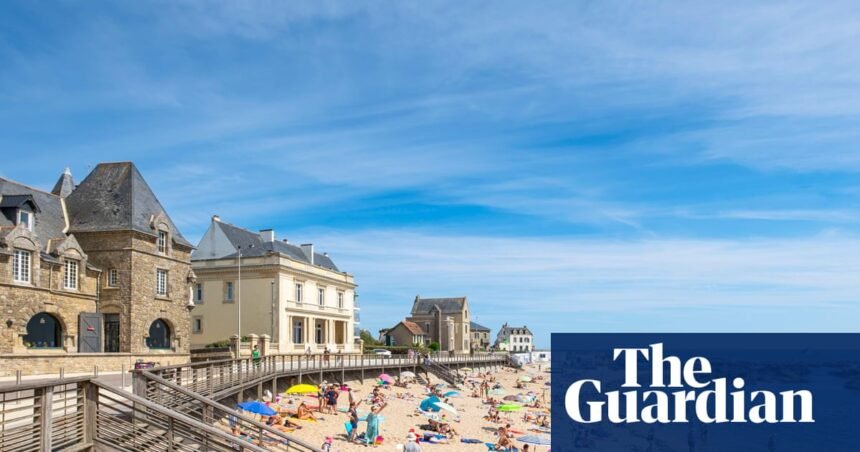
The saying goes “curiosity killed the cat”, as if being nosy is a bad thing. As I stood knee-deep in the cool Atlantic Ocean, marvelling at the beauty and emptiness of the Plage de Port Lin, I decided this was nonsense: without this little detour, “just to have a look”, I’d never have discovered Le Croisic, on the Guérande peninsula. The downside is that time isn’t on my side: it’s past 5pm and I’m supposed to be at the big resort, La Baule-Escoublac, six miles east by now. But the presqu’île (a “nearly island”), as the French call it, tucked in the corner where Brittany meets Pays de la Loire, is calling out to be explored.
First, though, a late afternoon dip in the sea is too hard to resist, and I wade into the water, sharing a delighted smile with fellow swimmers. Two elderly women in flowery swimming caps nod a cheery “Bonsoir” as I take my first strokes. Afterwards, I wander up the coast a little way. A row of belle epoque villas overlook the rocky coastline, and I climb down on to the sand in front of them to look west at the enchanting view of the small headlands jutting into the sea and scattered black rocks in silhouette.
Back in the car, I hazard that I have just enough time to do a circuit of the peninsula if I delay my evening dinner reservation in La Baule, and so I follow the coast road west, spotting menhirs, small sandy coves and a golf course along the way. As I approach the town of Le Croisic, there are more people out for a stroll beneath the towering maritime pine trees and I park up again to join them for a while.
At the jetty that usually sees passengers boarding the foot ferry to the islands off the coast, such as Belle-Île-en-Mer and Hoëdic, I notice a crowd of people aren’t queueing, but fishing. Old men and teenage boys are peering over the railings, with nets lowered down on lines; there’s a jolly camaraderie and their chatter carries on the breeze.
In the sea behind them, I spot the Trehic jetty, an 850-metre stone pier that snakes into the bay nearby – its end point marked by a lighthouse – as well as the tip of the Pen Bron peninsula on the other side of the bay, which seems so close it could be within swimming distance. Its proximity reminds me what the two peninsulas embrace: 2,000 hectares (4,940 acres) of marshland and the salt ponds from which the famous Guérande salt crystals are harvested. The thought of sprinkling it on my dinner makes my stomach rumble, and so I head on to La Baule, taking a detour through the main town, along the pretty harbour front with its yachts and quaysides.
After checking into the Hotel des Dunes, I wander out for dinner. There’s a holiday vibe in the town and restaurants are full of families and friends dining together, black-clad waiters whirling between them with trays aloft. I arrive for my reservation at Restaurant Le M (starter, main course and dessert from €18.90), and tuck into briny oysters from Brittany and grilled fish with Mediterranean vegetables.
La Baule-Escoublac first welcomed tourists in the late 19th century, after the opening of the railway line, and became a sophisticated resort. Today, it is a mix of modern apartments, belle epoque-era timber-framed architecture, cafes, restaurants and souvenir shops. Away from the main drags are desirable 19th-century villas shaded by the cypress and pines that were planted in the early 1820s to stabilise the dunes. It is undeniably touristy, but that’s no surprise for a place with such a good beach.
The next morning, I wander down to the seafront and inhale the ozone before wandering along the shore, sitting for a while on the golden sand.
Some 15 minutes north of La Baule-Escoublac is impressive Guérande – its name familiar from the eponymous salt – with its mighty walls, towers, moats and grand medieval gate, La Porte Saint-Michel. Inside, it is a delight: bunting flutters above streets packed with bakeries, arty boutiques and creperies.
The sun is shining, so I take a table in the main square on the terrace of the creperie Chez Lucien and soon I’m tucking into a crispy golden galette complète, with ham, cheese and a gooey egg at its centre, and a cup of cider. I might strictly be in the region of Pays de la Loire, but the identity here is resolutely Breton, and the salt harvested from the nearby marshes has been a key ingredient in Brittany’s famous salted butter for centuries.
To find out more about the fascinating process of harvesting the sel de Guérande, I head out to the marshes. At the shop and visitor centre of the Terre de Sel cooperative (salt marsh tours from €10.50), I meet Simon Pereon, a paludier or salt harvester, who has agreed to show me how he and his 220 fellow paludiers enact the process of salt harvesting between June and September. Salt has been prized in these parts since Roman times, when soldiers were sometimes paid in salt (hence the origin of the word salary), but the marshes as we see them today date from around 1,000 years ago.
As we drive to Simon’s ponds, I start to see the appeal of working under the big skies and open air, and the reason he followed in his father’s and grandfather’s footsteps. “The government classes us as ‘farmers’,” he explains, “but we work with seawater and the whole landscape is balanced between the land and the sea.” With a long, toothless rake called a las, he moves the seawater between a labyrinth of shallow rectangular ponds that don’t drain, due to the clay mud beneath, coloured pink by the algae that thrives here. As the water moves between each pond it becomes increasingly concentrated as the sun evaporates the water and leaves the salt behind.
Simon sweeps the las across the ponds and the water ripples gently: the process is hypnotic. By the end of each day, he has raked the salt into neat piles on the dykes between ponds. “In summer, we harvest 50kg every day. The job has evolved over the years, with tractors and other machines, but for the actual salt harvesting, we still use the identical process that’s been around for centuries.”
The tranquillity has been passed down the ages: I hear little more than the calls from the avocets and ibis in the neighbouring lagoon. “I start at daybreak,” Simon says, “and for the first few hours of the day, I see the sun rise, listen to the birds, and there’s no one around. At the end of the day, too, I just watch the sun go down.”
It sounds like bliss and, after I take another detour later that day through the salt marshes – the clouds in the reddening sky are reflected in the mirror-like ponds – I am reassured that curiosity can only be a good thing.
The trip was provided by Pays de la Loire Tourism; accommodation provided by Hotel des Dunes in La Baule (doubles from €65 room-only). Brittany Ferrieshas crossings from Portsmouth to St Malo from £229 return for a car and two people, including en suite cabin on the outward, overnight leg
Amuse Bouche: How to Eat Your Way Around France by Carolyn Boyd is published by Profile, £10.99. To support the Guardian, order your copy at guardianbookshop.com