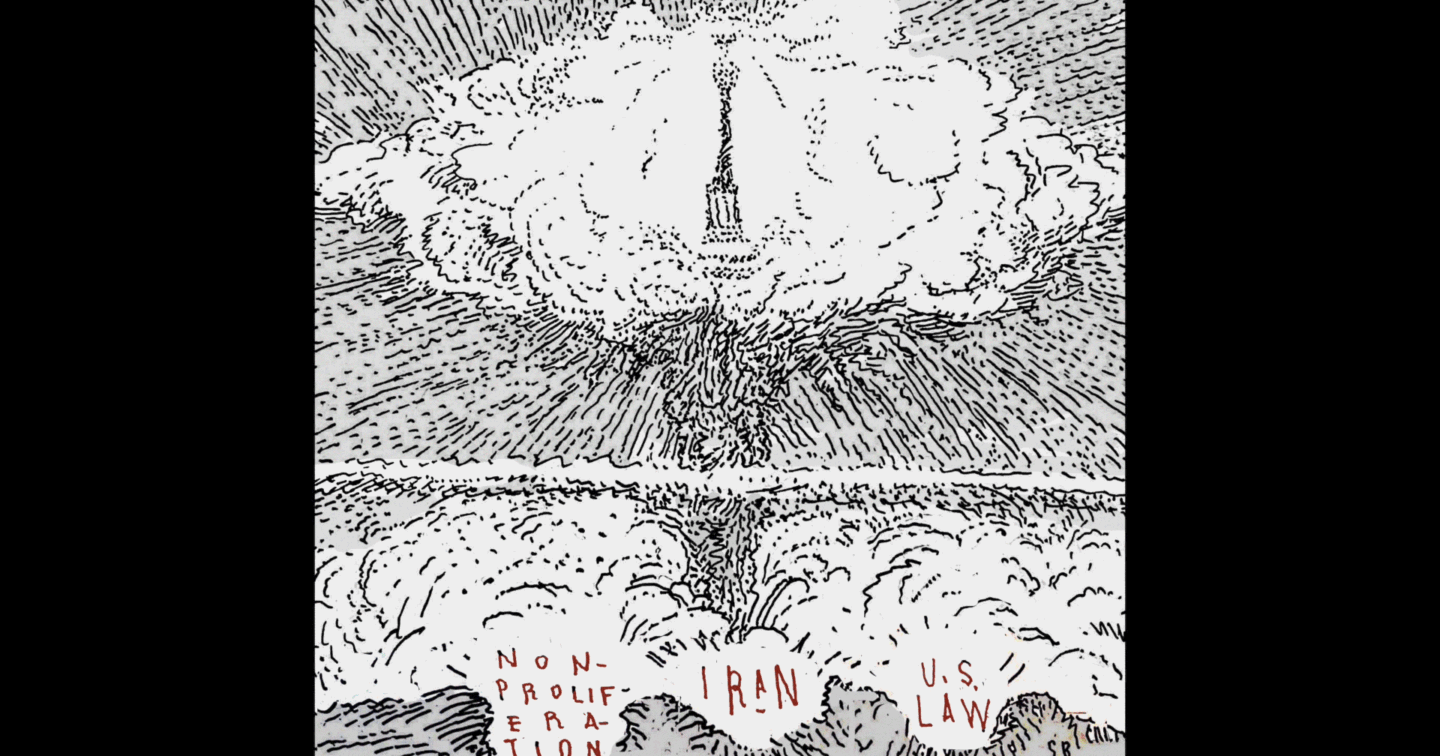
California’s fight to rein in President Trump’s deployment of troops to Los Angeles hinges on a 19th century law with a a blood-soaked origin and a name that seems pulled from a spaghetti western film.
In a pivotal ruling this week, Senior U.S. District Judge Charles R. Breyer ordered the federal government to hand over evidence to state authorities seeking to prove that the actions of troops in Southern California violate the Posse Comitatus Act of 1878, which forbids soldiers from enforcing civilian laws.
“How President Trump has used and is using the federalized National Guard and the Marines since deploying them at the beginning of June is plainly relevant to the Posse Comitatus Act,” Breyer wrote Wednesday in his order authorizing “limited expedited discovery.”
The Trump administration objected to the move and has already once gotten a sweeping Breyer ruling that would’ve limited White House authority over the troops overturned by the 9th Circuit Court of Appeals.
This time, the Northern District of California judge made clear he would “only allow discovery as to the Posse Comitatus Act” — signaling what could be the state’s last stand battle to prevent Marines and National Guard forces from participating in immigration enforcement.
The Posse Comitatus Act dates back to the aftermath of the Civil War when the American government faced violent resistance to its efforts to rebuild Southern state governments and enforce federal law following the abolition of slavery.
The text of the law itself is slight, its relevant section barely more than 60 words. Yet when it was enacted, it served as the legal epitaph to Reconstruction — and a preface to Jim Crow.
“It has these very ignoble beginnings,” said Mark P. Nevitt, a law professor at Emory University and one of the country’s foremost experts on the statute.
Before the Civil War, the U.S. military was kept small, in part to avoid the kinds of abuses American colonists suffered under the British.
Authorities back then could marshal a crew of civilians, called a posse comitatus, to assist them, as sometimes happened in California during the Gold Rush. States also had militias that could be called up by the president to pad out the army in wartime.
But law enforcement by the U.S. military was rare and deeply unpopular. Historians have said the use of soldiers to enforce the Fugitive Slave Act — which saw escaped slaves hunted down and returned to the South — helped spark the Civil War.
In recent weeks, the Trump administration has used constitutional maneuvers invented to enforce the Fugitive Slave Act to justify using troops to round up immigrants. Experts said leaders from the antebellum South demanded similar enforcement of the law.
“The South was all for posse comitatus when it came to the Fugitive Slave Act,” said Josh Dubbert, a historian at the Rutherford B. Hayes Presidential Library in Ohio.
But by the time Congress sent federal troops to begin Reconstruction in earnest in 1867, the landscape was very different.
After white rioters razed Black neighborhoods in Memphis and mobs of ex-Confederate soldiers massacred Black demonstrators in New Orleans in the spring of 1866, “most of the South [was] turned into military districts,” said Jacob Calhoun, a professor of American history at Wabash College and an expert on Reconstruction.
“Most scholars, let alone the American public, do not understand the scale of racial violence during Reconstruction,” Calhoun said. “They only send these troops in after unimaginable levels of violence.”
Freedmen voting in New Orleans, 1867.
(Heritage Images via Getty Images)
At the polls, Black voters were met by white gangs seeking to prevent them from casting ballots.
“For most of American history, the idea of an American army intervening in elections is a nightmare,” Calhoun said. “[Posse Comitatus] is reemphasizing this longstanding belief but for more nefarious purposes.”
The Posse Comitatus language was tucked into an appropriations bill by Southern Democrats after their party won control of Congress in the election of 1876 — “possibly the most violent election in American history,” Calhoun said.
Historians say white lawmakers in the post-war South sought to enshrine their ability to keep Black men from voting by barring federal forces from bolstering the local militias that protected them.
“Once they’re in control of Congress, they want to cut the appropriations for the army,” Dubbert said. “They attach this amendment to [their appropriations bill] which is the Posse Comitatus Act.”
The bill won support from some Republicans, who resented the use of federalized troops to put down the Railroad Strike of 1877 — the first national labor strike in the U.S.
“It is a moment in which white Northern congressmen surrender the South back to ex-Confederates,” Calhoun said. “With the Posse Comitatus Act, racial violence becomes the norm.”
Yet the statute itself largely vanished from memory, little used for most of the next century.
“The Posse Comitatus Act was forgotten for about 75 years, from after Reconstruction to basically the 1950s, when a defense lawyer made a challenge to a piece of evidence that the Army had obtained,” Nevitt said. “The case law is [all] after World War II.”
Those cases have largely turned on troops who arrest, search, seize or detain civilians — “the normal thing the LAPD does on a daily basis,” Nevitt said. The courts have stood by the bedrock principle that military personnel should not be used to enforce the law against civilians, he said, except in times of rebellion or other extreme scenarios.
“Our nation was forged in large part because the British military was violating the civil rights of colonists in New England,” Nevitt said. “I really can’t think of a more important question than the military’s ability to use force against Americans.”
Yet, the law is full of loopholes, scholars said — notably in relation to use of the National Guard.
Department of Justice has argued Posse Comitatus does not apply to the military’s current actions in Southern California — and even if it did, the soldiers deployed there haven’t violated the law. It also claimed the 9th Circuit decision endorsing Trump’s authority to call up troops rendered the Posse Comitatus issue moot.
Some experts feel California’s case is strong.
“You literally have military roaming the streets of Los Angeles with civilian law enforcement,” said Shilpi Agarwal, legal director of the ACLU of Northern California, “That’s exactly what the [act] is designed to prevent.”
But Nevitt was more doubtful. Even if Breyer ultimately rules that Trump’s troops are violating the law and grants the injunction California is seeking, the 9th Circuit will almost certainly strike it down, he said.
“It’s going to be an uphill battle,” the attorney said. “And if they find a way to get to the Supreme Court, I see the Supreme Court siding with Trump as well.”