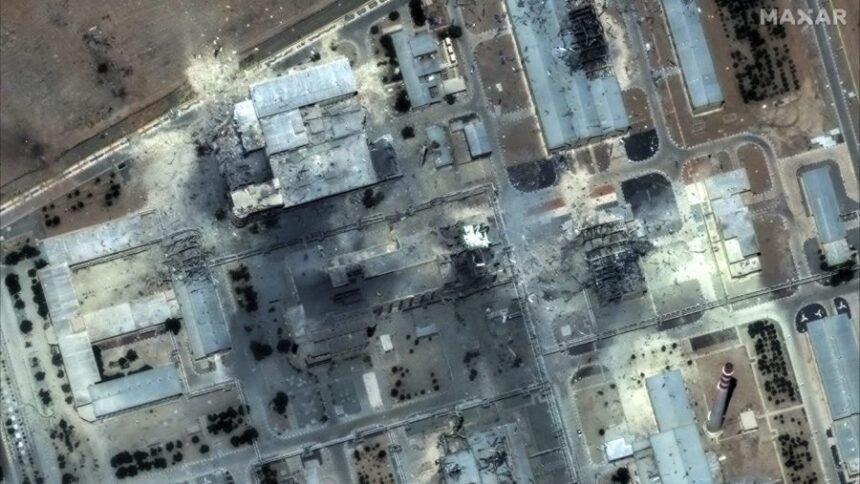
As the dust settles on Iranian sites hit by U.S. bombs and missiles over the weekend, there’s growing tension over how much the military operation set back Tehran’s nuclear program.
The Trump administration is blasting assessments from U.S. intelligence agencies about the damage inflicted by strikes on three Iranian nuclear facilities, while apparently endorsing an Israeli assessment.
And Director of National Intelligence Tulsi Gabbard said Wednesday that “new intelligence” confirms “Iran’s nuclear facilities have been destroyed.”
At the center of the discourse are Defense Intelligence Agency (DIA) findings, widely reported Tuesday, that called into question statements made by top Trump administration officials describing Iran’s nuclear facilities as “obliterated.”
The preliminary classified report assessed the attacks had set Iran’s nuclear program back several months, rather than the years or even decades Trump has claimed.
The DIA found the bombing did not destroy the main components of Iran’s nuclear program, failing to collapse the underground buildings of the Fordow Fuel Enrichment plant and the Natanz Enrichment Complex.
What’s more, the assessment found the strikes likely did not destroy much of Iran’s stockpile of highly enriched uranium, as it was moved before the bombing.
Instead, the 14 GBU-57 Massive Ordnance Penetrator bombs dropped on Fordow and Natanz — as well as armaments that struck at Iran’s Isfahan nuclear site — significantly damaged aboveground structures while leaving the sites’ centrifuges still “intact,” the assessment said.
President Trump disputed a range of the report’s findings Wednesday, calling them incomplete and saying officials were merely guessing.
“They didn’t see it. All they can do is take a guess,” Trump said while attending the NATO summit.
“If you take a look at the pictures, if you take a look how it’s all black, if you know the fire and brimstone is all underground because it’s granite and it’s all underground, you don’t show it. But even there, with all of that being said, the whole area — for 75 yards around the hole where it hit — is black with fire,” Trump said.
Satellite images have revealed damage to the Iranian facilities, but there are signs Tehran is already working to fill in craters at the Natanz complex, indicating crews were able to quickly return to the bombed site to start rebuilding.
Trump also read off a statement from Israeli intelligence assessing the strike on Fordow “destroyed the site’s critical infrastructure and rendered the enrichment facility inoperable.”
“We assess that the American strikes on Iran’s nuclear facilities, combined with Israeli strikes on other elements of Iran’s military nuclear program, has set back Iran’s ability to develop nuclear weapons by many years,” the statement reads.
Sarit Zehavi, a retired lieutenant colonel in the Israeli military, estimated the damage set back Iran between five years and 10 years, “depending on various factors.”
Iran’s nuclear project involves dozens of sites and numerous components that have “sustained significant damage, causing a substantial delay to the program,” said Zehavi, now the founder and president of Alma, a nonprofit research institute focusing on Israel’s security.
“Iran cannot simply decide now to ‘sprint to the bomb’ in five minutes. These are capabilities built over many years, many of which no longer exist in their previous form.”
But despite Israel’s major air offensive against Iran prior to the U.S. stepping in with its own strikes, neither Tehran’s nuclear or missile program “was entirely eradicated and, crucially, the Iranian regime remains in power,” Zehavi added.
Before the bombings, U.S. intelligence agencies estimated Iran was months away from building a nuclear bomb but had not decided to do so. Experts said Iran was between 18 months and three years away from fitting a nuclear bomb onto a ballistic missile.
Trump last week brushed aside those assessments, which were read aloud by the Gabbard during a Senate Intelligence Committee hearing in March.
“I don’t care what she said,” Trump told reporters June 17. “I think [Iran] were very close to having it.”
Three days later, when asked what intelligence he had indicating Iran is building a nuclear weapon, given Gabbard’s comments, Trump pointedly said she was “wrong,” as was the intelligence community.
“My intelligence community is wrong,” Trump told reporters. “Who in the intelligence community said that?”
Gabbard then pushed back on speculation Trump was choosing to ignore conclusions from his own intelligence agencies, insisting they were on the same page and that America “has intelligence that Iran is at the point that it can produce a nuclear weapon within weeks to months, if they decide to finalize the assembly.”
Trump also has disagreed with the indications that Iran moved nuclear materials away from the sites prior to the U.S. strikes, telling reporters Wednesday: “We think we hit them so hard and so fast, they didn’t get to move.” He further claimed the material was too dangerous to transport, a difficult task given “it’s very heavy” and was stored “literally 30-35 stories down in the ground.”
However, a U.S. intelligence agency assessed Iran was still between three month and eight months away from making a nuclear weapon — but there was no indication that it had decided to do so, CBS News reported.
A U.S. intelligence agency assessment provided to the military’s Joint Chiefs of Staff on Saturday — the same day Trump ordered the Iran strikes — found Iranian officials were mulling moving some of its highly enriched uranium into vehicles to store them in public parking lots to avoid destruction, according to CBS.
Other Trump administration officials have sought to diminish the DIA’s findings, including Defense Secretary Pete Hegseth, who said the only way to know how much damage was done to Fordow is with a shovel.
Standing alongside Trump after the NATO summit, Hegseth described the DIA assessment as a “preliminary report that’s deemed to be a low assessment. You know what a low assessment means? Low confidence in the data in that report.”
“If you want to make an assessment of what happened at Fordow, you better get a big shovel and go really deep. Because Iran’s nuclear program is obliterated,” he said.
Gabbard joined in with similar assertions later Wednesday, posting on the social platform X that: “New intelligence confirms what @POTUS has stated numerous times: Iran’s nuclear facilities have been destroyed. If the Iranians chose to rebuild, they would have to rebuild all three facilities (Natanz, Fordow, Esfahan) entirely, which would likely take years to do.”
She did not say what the new intelligence was or where it came from.
Despite the fervent insistence the U.S. strikes were effective, other Trump administration officials and experts have acknowledged it may take days to fully determine the extent of Iran’s damage.
Among them is Joint Chiefs Chair Gen. Dan Caine, who said Sunday that initial battle damage assessments “indicate that all three sites sustained extremely severe damage and destruction,” but that a full assessment would take time.