


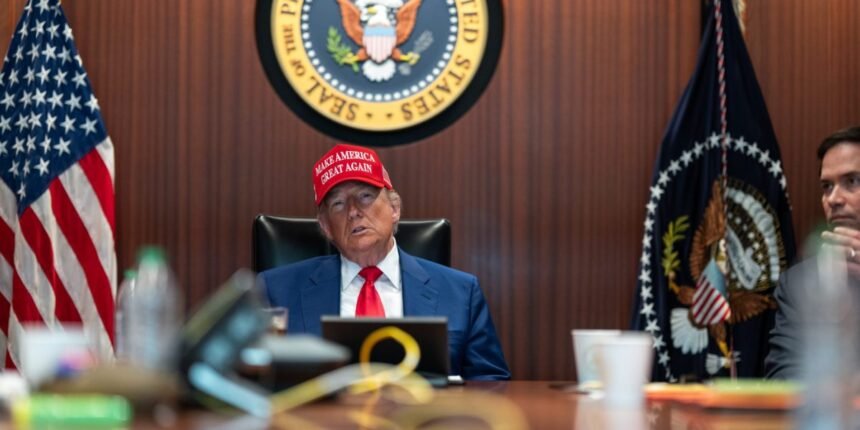
The president had been publicly ambiguous on whether he would take military action, but in a now-familiar pattern from the Oval Office, he surprised global media by confirming that warplanes had struck three separate targets.
In response Iran warned of “everlasting” consequences.
And while Trump previously said he would not harm Iran’s supreme leader, Ayatollah Ali Khamenei, despite knowing where he is, the president has now suggested the Iranian regime should be overthrown.
He wrote on his site, Truth Social: “It’s not politically correct to use the term, “Regime Change,” but if the current Iranian Regime is unable to MAKE IRAN GREAT AGAIN, why wouldn’t there be a Regime change??? MIGA!!!”
Almost as soon as Trump made the suggestion members of his own cabinet began briefing to the contrary. Defense Secretary Pete Hesgeth told reporters that the mission “was not, and has not, been about regime change” while Vice president JD Vance denied the U.S. was at war with Iran. “We’re at war with Iran’s nuclear program,” he clarified.
The questions for voters and analysts have inevitably turned to what Iran’s “everlasting” response could be.
As Western nations weighed the possibility of Tehran acting to disrupt their economies, Iran’s Foreign Minister Abbas Araghchi also announced after the strikes that he would travel to Moscow to meet with Russian President Vladimir Putin.
Speaking in Istanbul, Araghchi told reporters Iran had a “strategic partnership” with Russia, adding: “We always consult with each other and coordinate our positions.”
Closer to home, Iran’s parliament also approved plans to shut the Strait of Hormuz which transports about one-fifth of the world’s daily global oil production.
This is the most immediate concern for analysts, who watched as oil prices jumped to a five-month high when markets opened in Asia on Monday morning, before falling back down with Brent crude sitting at approximately $79 per barrel.
But analysts also note that the nations—and indeed the consumers—which may have drawn the short straw in the conflict could be those who were not directly involved in this weekend’s action.
As Deutsche Bank’s Jim Reid notes, the U.S. has turned into a net energy exporter over the past few years, “so any negative impact would be through deteriorating financial conditions or through higher for longer rates as the Fed have another reason to delay cuts.”
Reid continues: “For Europe though, the impact is potentially more serious. Every $10/bbl increase in oil has the potential to add a quarter of a percent to HICP [the Harmonised Index of Consumer Prices used by the EU] within a quarter and if sustained, 0.4pp within a year.
“Growth could be lowered by around 0.25pp if such an increase was sustained.”
Beware the deckchair generals
With geopoliticians charting an uncertain path in the days ahead, economists have warned investors against any knee-jerk reactions.
As UBS’s Paul Donovan put it in a note seen by Fortune this morning: “We live in a world of political polarization and soundbite economics. That encourages sensationalism. Deckchair generals will offer extreme opinions on the U.S. attacks on Iran. Both supporters and opponents the attacks are likely to dramatize events. Investors should be cautious of knee-jerk overreactions.”
He continued: “President Trump’s ruling out near-term attacks immediately before attacking might be tactical, but their suggestion of regime change in opposition to official U.S. policy causes uncertainty. That raises trust issues relevant to trade negotiations.
“Even modest oil price increases will raise U.S. gasoline prices just as trade tariffs push up other prices, and may add to profit-led inflation too.”
That being said, analysts at JPMorgan said investors should buckle up for prolonged volatility.
In a note seen by Fortune this morning, JPMorgan’s Mislav Matejka wrote Trump’s conflicting statements about whether the weekend’s strike will be the only action or the beginning of a series of attacks brought “little certainty.”
“Moreover, we do not see an obvious route to a political settlement to the military conflict, which makes us think the conflict, like the one in Gaza, could last longer than many investors think,” he added. “Moreover, Iran is both much bigger than Gaza, Syria or Lebanon and, unlike the other three areas that Israel has attacked in the past 18 months, it sits on the Straits of Hormuz.
Matejka adds: “In our view, the global economy/global investors can neither ignore the risks of conflict in Iran the way they can in Lebanon, Syria or Gaza, nor can they ignore the 10% jump in global energy prices.”


