



The $1 million mark is a significant financial milestone for many people. There’s something about seven figures that feels like you have achieved a real level of financial security.
For most people, the most realistic way to reach $1 million is through investing. That’s not groundbreaking news, but what is often underappreciated is just how simple it can be. It doesn’t take hitting big on a generational winner like Nvidia or Amazon; it can be done with exchange-traded funds (ETFs) that take a lot of the guesswork out of investing.
One ETF in particular, the Invesco QQQ ETF (QQQ -0.01%), has delivered historical returns that could carry you to the $1 million mark. And it’s worth considering for your portfolio.
Image source: Getty Images.
An ETF that leans heavily on big tech stocks
The Invesco QQQ ETF mirrors the Nasdaq-100, an index that tracks the 100 largest non-financial companies listed on the Nasdaq stock exchange. The ETF is weighted by market cap, so megacap tech stocks make up a large portion of the fund. Below are its top 10 holdings (as of June 13):
Having half of a 100-stock ETF in 10 stocks doesn’t scream diversification, but it does give you exposure to some of the stock market’s heavy hitters. Each of the 10 stocks has considerably outperformed the S&P 500 over the past decade and operates in industries with plenty of growth opportunities.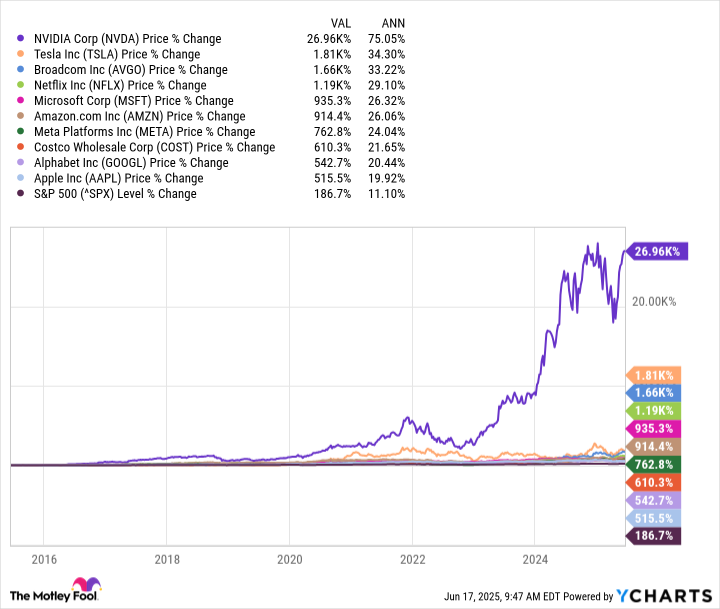
NVDA data by YCharts; ANN = compound annual growth over previous 10 years.
This ETF has a history of impressive returns
Since it hit the stock market in March 1999, this ETF has averaged around 10% total returns (close to the S&P 500 long-term average). Over the past decade, its returns have been much greater.
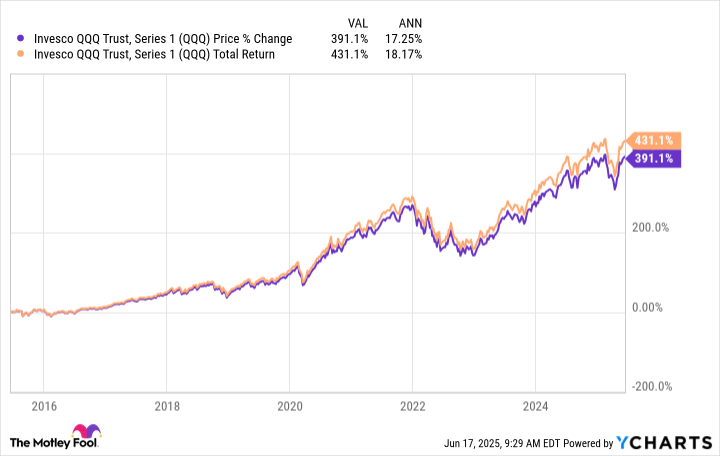
Averaging 17% to 18% annually is impressive, no doubt, but it shouldn’t be the long-term expectation. Would it be nice? Absolutely. However, it’s much better to plan for more-modest returns and be pleasantly surprised if it does work out that way.
For the sake of illustration, let’s assume the ETF’s returns are in the middle, around 14% annually. Here’s how much $500 monthly investments would grow to in different numbers of years.
| Years | Investment Value |
|---|---|
| 15 | $258,700 |
| 20 | $533,400 |
| 25 | $1.05 million |
| 30 | $2.05 million |
| 35 | $3.96 million |
Table by author. Investment values are rounded down to the nearest hundred and take into account the ETF’s 0.20% expense ratio.
The biggest factor is time because that’s what allows compound earnings to work their true magic. Even if we use the more conservative 10% annual returns, you could hit the $1 million mark a little after 30 years.
In all fairness, these are assumptions, and we should never take past performance as a guarantee of future results. However, it does show this ETF’s long-term potential with consistent investments over time.
Use this ETF as a supplemental part of your portfolio
Although this ETF is full of world-class companies and has all the tools to outperform the market, I wouldn’t make it a large portion of my portfolio because of how concentrated it is. The tech sector is over 57% of the ETF, so your returns will depend a lot on the sector’s performance, especially the “Magnificent Seven” companies.
Granted, the tech sector has been the highest-performing over the past decade or so, but there’s a risk that comes with relying heavily on one sector. It’s especially important to be aware of how concentrated your stock portfolio is if you’re investing in the S&P 500, which has become tech-heavy over the past few years with the explosion of megacap tech stocks.
Even if you can’t afford to dedicate $500 monthly solely to this ETF, a relatively small amount can go a long way over time.
John Mackey, former CEO of Whole Foods Market, an Amazon subsidiary, is a member of The Motley Fool’s board of directors. Suzanne Frey, an executive at Alphabet, is a member of The Motley Fool’s board of directors. Randi Zuckerberg, a former director of market development and spokeswoman for Facebook and sister to Meta Platforms CEO Mark Zuckerberg, is a member of The Motley Fool’s board of directors. Stefon Walters has positions in Apple and Microsoft. The Motley Fool has positions in and recommends Alphabet, Amazon, Apple, Costco Wholesale, Meta Platforms, Microsoft, Netflix, Nvidia, and Tesla. The Motley Fool recommends Broadcom and recommends the following options: long January 2026 $395 calls on Microsoft and short January 2026 $405 calls on Microsoft. The Motley Fool has a disclosure policy.


