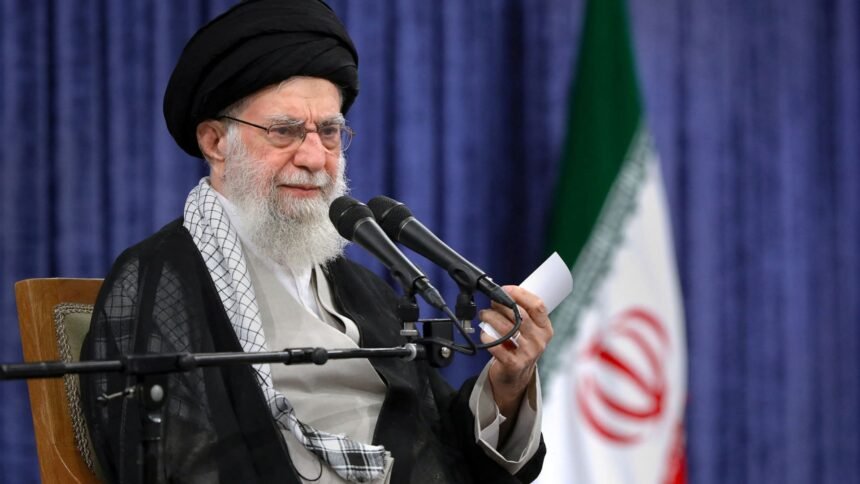
Iran’s Supreme Leader Ayatollah Ali Khamenei speaks during a meeting in Tehran, Iran, May 20, 2025. Office of the Iranian Supreme Leader.
Office Of The Iranian Supreme Le | Via Reuters
Crude futures jumped about $5 per barrel on Friday after Israel launched airstrikes against Iran without U.S. support, stoking fear among investors that the conflict could spread to disrupt oil supplies in the Middle East.
Oil traders viewed Israel’s attack as the most significant geopolitical event since Russia launched its full-scale invasion of Ukraine, with crude prices closing at their highest level since March 2022. U.S. crude oil gained $4.94, or 7.26%, to close at $72.98 per barrel on Friday. Global benchmark Brent rose $4.87, or 7.02% to settle at $74.23 per barrel.
Iran fired missiles at Israel Friday evening local time in retaliation, the Israel Defense Forces said. Crude prices were up more than 8% in extending trading after Iran’s counterattack.
Israel launched a “targeted military operation” against Iran’s nuclear and ballistic missile program early Friday local time, Israeli Prime Minister Benjamin Netanyahu said in an address. The attack does not appear to have disrupted any significant oil infrastructure.
Israel hit Iran’s main enrichment site at Natanz, its leading nuclear scientists, and struck the heart of its ballistic missile program, Netanyahu said. The airstrikes also killed senior members of Iran’s military.
“This operation will continue for as many days as it takes to remove this threat,” Netanyahu said.
U.S. Secretary of State Marco Rubio said Israel had taken “unilateral action against Iran” without U.S. support. Rubio warned Iran against targeting U.S. interests in the region.
“We are not involved in strikes against Iran and our top priority is protecting American forces in the region,” Rubio said in a statement. “Israel advised us that they believe this action was necessary for its self-defense.”
President Donald Trump said Iran paid the price for failing to make a deal over its nuclear program by his 60-day deadline.
“They should have done it!” Trump said in a post on his social media platform Truth Social. “Today is day 61. I told them what to do, but they just couldn’t get there. Now they have, perhaps, a second chance!”
Oil prices year-to-date
What next for oil prices?
At risk for oil markets is supply from both Tehran and other regional players that could be drawn into the conflict. Iranian production stood at 3.305 million barrels per day in April, according to OPEC’s Monthly Oil Market Report of May, which compiled the assessments of independent analyst sources.
The International Energy Agency, which was initially set up to respond to global oil shocks, on Friday said it had 1.2 billion barrels of emergency stocks available in its security system.
“The IEA is actively monitoring the impact on oil markets from the Israel-Iran situation. Markets are well supplied today but we’re ready to act if needed,” IEA Executive Director Fatih Birol said.
Oil investors are now concerned that Iran will retaliate by attacking either Israeli or American targets, leading to a major military escalation and a potential oil supply disruption, said Andy Lipow, president of Lipow Oil Associates.
“Iran knows full well that President Donald Trump is focused on lower energy prices,” Lipow told CNBC, adding that actions by Iran affecting Middle Eastern oil supplies and consequently raising gasoline and diesel prices for Americans are politically damaging to the U.S. president.
Iranian oil facilities not targeted
The rising Middle East tensions have raised concerns that Iran could leverage the Strait of Hormuz, a key chokepoint connecting the Persian Gulf and the Gulf of Oman, through which one-fifth of the world’s oil supply passes.
While the Israeli operation is more significant than what has been seen in a long time, there has been no direct targeting of Iranian oil production or export facilities, which means that Tehran can continue exporting oil, said Ellen Wald, co-founder of Washington Ivy Advisors.
“For Iran, there really is no net benefit to trying to impede the passage of oil through the Strait of Hormuz,” Wald said, explaining that Iran will be retaliated against if it attempted to do so.
Iran’s ability to wholly physically block the Strait of Hormuz is also debatable. While vessels do traverse through Iranian waters, they can still be diverted into United Arab Emirate and Omani waters, Wald said. “While there would be a period of disruption, it’s not likely to last all that long.”
Additionally, Wald cautioned that a spike in oil prices from closing the Strait of Hormuz may bring about economic pressure from Iran’s largest oil customer: China.
“China does not want the flow of oil out of the Persian Gulf to be disrupted in any way, and China does not want the price of oil to rise. So they’re going to bring the full weight of their economic power to bear on Iran,” she added.
“I don’t think we’re looking at anything as severe as when Russia invaded Ukraine. It’s just not that significant a threat to oil supplies,” she said.