The Sunday Magazine23:13Customs brokers are cross-border trade gurus. With tariff whiplash, they’re facing ‘toxic uncertainty’
Dan Patrick De Los Santos’s workday looks very different then it did a few months ago before the Trump administration tariffs upended trade — and his job description.
Before the levies hit, De Los Santos said about 80 per cent of the shipments he helped to clear customs were routine.
But now, “honestly, it’s just damage control,” the customs broker said.
De Los Santos works for Inland Customs Brokers Ltd., a company based in Guelph, Ont. He’s among the people who manage the details for how to get goods through customs.
They help businesses understand how much duty might apply to their imports and exports and whether they are subject to any health and safety clearances. Then, their job is to file that information with the government.
With the ever-changing tariff landscape, De Los Santos has been working overtime.
“My job used to be nine to five, Monday to Friday. Now it’s actually been like 9 a.m. to, like, 8 p.m. getting some calls [from] clients because they have a last-minute tariff change.”
Since Trump’s tariffs were enacted earlier this year, Inland Customs has been trying to help their clients reorient their business to new markets and decipher the onslaught of new tariffs. Meanwhile, they are also helping customers consider the future of their business if imports to the United States are too costly.
Customs brokers are experts when it comes to the details — their entire business is built around the idea that it’s worth hiring them to do your customs entries, because they’ll get it right. (It’s a lot like hiring an accountant to file your taxes.)
But with the constant changes, it’s very hard for them to be the authority on anything.
“We are like therapists now,” said De Los Santos. “The really hard part here is … the phone calls of people crying. That, you know, they don’t want to pay this, [they are] devastated by the fact that their product that they’re trying to sell is just being hit and … there’s no choice for them but to just absorb the cost.”
Dave Coulson can relate. He said he’s been getting calls around the clock, often from people who aren’t even their clients — and they’re all looking for help in how to navigate the nebulous world of tariffs.
“I’m picking up the phone at 11 p.m. on a Sunday night with a trucker,” the chief operations officer at Border Buddy said. “It’s somebody stuck, and they can’t get across the border and they need your help now. And we’re just all hands on deck.”
‘The initial reaction was just simply disbelief’
Industries had so little time to prepare for the tariffs, say insiders helping businesses navigate cross-border trade, which compounded the challenge.
“Those sorts of rules normally would take three-to-six months to implement,” Coulson said, noting that, in some cases, they had days to react to changes in the levies.
Coulson called an emergency company-wide meeting every morning each time new tariffs were announced to get everyone on the same page.
And it wasn’t easy. The executive orders were ambiguously worded, Coulson said, and it was hard to know how to respond.
“Even the most sophisticated licensed customs brokers were not aligned on the rules,” he said. “We were going to LinkedIn and Reddit and chatting with other brokers trying to figure out what does this mean? What do we do?”
Canada posted a $7.1 billion merchandise trade deficit in April — the largest on record — as exports fell sharply in the face of U.S. tariffs. As well, exports to the U.S. fell 15.7 per cent, and imports from the U.S. dropped 10.8 per cent.
Regular way of doing business no longer works
Part of the issue is that the tools developed to help customs brokers can’t keep up with the pace of the tariff changes.
Elvis Cavalic works for Zipments, a company that has created an online calculation tool to help brokers and importers calculate duties or levies on their goods. But it’s hard to create an equation right now because the numbers aren’t consistent, he said.
Cavalic said he started out in the business because he believed he could create a solution to simplify the sometimes elaborate hurdles needed to clear customs.

But as the tariffs continue to evolve, they can’t update the calculator fast enough to reflect the constant changes, Cavalic said.
“So something that may have taken one hour in the past could take four or five hours,” he said, noting they had to enter everything manually. “You can’t necessarily pass those costs onto customers.”
Changing work
De Los Santos saw his Canadian retailers quickly look for new suppliers outside of the U.S. after the federal government imposed 25 per cent tariffs on a host of U.S. goods in response to Trump’s initial levies.
And though the tariff doesn’t apply to all U.S. products, they affect a lot of De Los Santos’s clients.
He used to source fishing rods and hunting gear for Canadian outdoor shops from just across the border — in New York State, but now he sees his clients turning to China.
“The irony is a brutal thing,” he said. “[The tariffs] were supposed to boost U.S. factories, right? Instead, all these products we’re seeing now are made in China or Vietnam … American companies can’t scale up fast enough.”

After U.S. President Donald Trump unleashed a trade war with Canada, cross-border traffic has declined by nearly 20 per cent. For The National, CBC’s Nick Purdon went to duty-free stores to see the drastic impact on their businesses — and their lives.
And other clients are in a holding pattern.
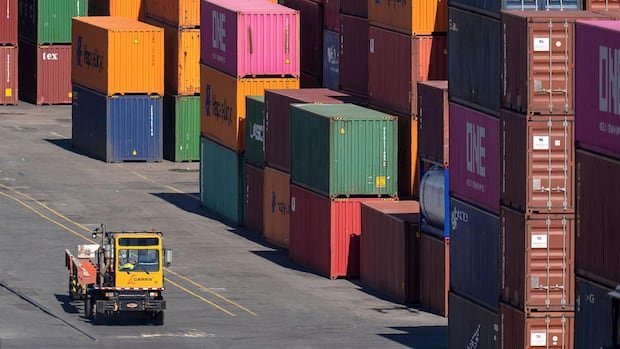
Coulson tells a story about a client who told a container ship from China not to unload dog treats and toys in California, because, at the time, on May 8, the imported goods would have been hit with levies of 145 per cent.
Instead, the container ship kept sailing.
“They’re crossing their fingers that by the time it gets to New York, the tariffs will be lifted or reduced.”
For that client, it worked out — when the ship reached New York, the tariffs had been cut to 30 per cent, and the company accepted the goods.
But other ships are still waiting, afloat on the ocean.
“They think that the tariffs could still come down,” Coulson said. “It’s a … toxic uncertainty.”